


TOS Blog: Daily Commentary from an Objectivist Perspective

Could You be Flying Cars in a Few Years?

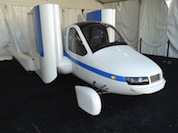
Terrafugia_Transition_Production_Prototype_AirVentureExciting things are happening in the flying car industry (yes, there is a flying car industry). CBS reports that Terrafugia, an American company, just conducted a successful test flight of its flying car. A Dutch company successfully tested its model in the same week. These amazing developments have the potential to drastically change the way we travel, making it easier, faster, and a lot more exciting.

Check out the videos. Here’s the Terrafugia Transition:

And here’s the Dutch model, the Pal-V:

If the video of the Pal-V doesn’t appear above, click here to view its test flight.

If you enjoyed this post, consider subscribing to The Objective Standard and making objective journalism a regular part of your life..

Related:

Image: Creative Commons by Ian Maddox

Posted in: Science and Technology

Comments are welcome so long as they are civil.
  • http://pulse.yahoo.com/_CRE6REGHBOCNFLN4NJIXNMIEFM Mike Kevitt

    Great, but let’s keep a few things in mind:
    1. What’s the price tag?
    2. You have to learn to fly it.  You have to learn to fly, period.
        You have to be a competent pilot, probably need a pilot
        license, or the equivalent, or better, in a free culture and
        legal environment.
    3. How ’bout flying at night, in clouds, bad weather, storms, high
        winds, snow, learning radar, navigation, etc.?
    Quite a step up from driving a car, but there’s probably a viable market for those willing and able to take the step.

  • Anonymous

    Peter Thiel in his recent debate with George Gilder, which
    you can find on YouTube, argues that most forms of engineering since 1970 have become effectively illegal. Just try to build new nuclear power plants, new supersonic passenger jets or new oil refineries, for some examples, and see how far you’ll get. The computing field has stayed relatively exempt from these prohibitions, though that may change soon as governments exert more control over the internet.  Thiel dismisses Gilder’s emphasis on the relative freedom of computing as “ghostlike
    reductionism,” and he argues that the sort of progress that matters has to come from making more and better stuff, especially in the fields of energy and medicine. The restrictions on engineering probably account for a lot of the “great stagnation” over the past 40 years, and until that changes, we’ll see relatively little technological progress for the rest of our lives, including the ability to buy and use flying cars.

  • Chris Walker

    This has to be looked at strategically. Can it really swipe aside current technologies in practice, like jets replacing prop planes?  The answer is no.

    This system is really a hybrid airplane, no matter how good the lift characteristics, which by definition is a niche invention and comments already have indicated, requires skill (and hard to earn licenses) to fly.  Unless you’re going to use jet turbines for consumer use, something that works for tanks, but might be hard imagining your children sitting next to because of safety cost, you need a different class of engine that has been conceived of, but not successfully put into production.  This class of engine needs to have the appropriate power to weight factors of at least twice its own weight and up to 10 times its weight, which would include fuel and cargo. By contract a turbine is more than sufficient for that.  Wankel actually conceived of dozens of configurations, and actually designed  the “wankel”, which after tons of money was finally built.  Sadly, it is basically the same as what we have already. (and you need two because they are unbalanced.)  He could not build the right engine that he wanted to due to technological limitations.  Now, with regulations, it is harder to do so, and given the Wankel experience, to build a truly viable vertical take-off vehicle for consumer use, investors are understandably hesitant, though frankly, the core technology is everywhere, with decades of successful practice. (hint, there are at least a billion in use.) If this problem is solved of power to weight, and the engines can be scaled to the application, ranging from micro to macro, in the appropriate format, they could also increase efficiency, power delivered, range and reliability.  If all of these factors were doubled, would it be worth the fight to get past regulations, or at least build it somewhere else more desperate to get ahead, say Myammar?

    The first vehicle to replace would be the helicopter, with much lower operating costs and dramatically improved range, including improved operating cycles before maintenance is required.  This experience could translate to long-range transports and then personal vehicles.  They could also be the basis of a new kind of society, one based on complete mobility, including flying cities, stores and factories.   It might also would reduce the need to consider putting nuclear reactors in flying vehicles used for military purposes. :)

  • Chris Walker

    There will never be a new production unless either there is a clear profit to producing it, or regulations simply do not exist to prevent its existence.

  • http://www.facebook.com/people/Keith-Sketchley/732092025 Keith Sketchley

    The Terragugia looks like a kludge, not efficient, was unstable in first version. (Most feasible dual-mode devices need to be airplanes first, just drivable to and from an airport, because the flight mode is more demanding of efficiency. Perhaps someday single device can do both well enough, if government laws don’t prevent that due their optimization of safety for each mode, but I think it will take better propulsion/lift capability.)

  • http://www.facebook.com/people/Keith-Sketchley/732092025 Keith Sketchley

    63 years ago an individual created a flying car. http://www.airventuremuseum.org/collection/aircraft/Taylor%20Aerocar.asp. IIRC he made a later one from a Ford Pinto but I don’t remember if it succeeded, a regular car is very heavy especially of that vintage.

    http://www.aerocar.com/ briefly covers that a later attempt with a different focus (clip-on wings and aero engine, thus a car first, note it is a lighweight but production car.

  • http://twitter.com/profchuck22 Charles Ivie

    There is a fundamental problem.  Aircraft and ground vehicles  operate in entirely different environments and the design must accommodate the parameters imposed by these regimes.  I think it will require a completely new concept in vehicle design if the two kinds of vehicles are ever to be integrated into a single machine.  Tacking wings on a car or putting four wheels on an airplane and folding up its wings will result in a compromise that results in a aircraft with poor performance and a car that is dangerous.  All this being said I am glad that someone is trying this again and new ideas can come from some pretty strange sources.  I am just glad that it is being done with private funding.