TOS Blog: Daily Commentary from an Objectivist Perspective

Political “Left” and “Right” Properly Defined

I’m often asked versions of the following: Given that the political right is so corrupted by conservatives who seek to limit liberty in countless ways, wouldn’t it be better to abandon the language of “left” vs. “right” and adopt new terminology?

My answer is that, because the terms “left” and “right” are already widely used to denote the basic political alternative, and because that alternative is in fact binary, the best approach for advocates of freedom is not to reject the prevalent terminology but to clarify it—by defining the relevant terms.

The problem with conventional approaches to the left-right political spectrum is that they either fail to define the alternatives in question, or proceed to define them in terms of non-essentials.

One common approach, for instance, fails to specify the precise nature of either side, yet proceeds to place communism, socialism, and modern “liberalism” on (or toward) the left—and fascism, conservatism, and capitalism on (or toward) the right.

This makes no sense, at least in terms of the right. Capitalism—the social system of individual rights, property rights, and personal liberty—has nothing in common with conservatism or fascism. Take them in turn.

Conservatism is not for individual rights or personal liberty; rather, it is for religious values (euphemistically called “traditional values” or “family values”) and a government that enforces them. Although conservatism calls for some economic liberties, it simultaneously demands various violations of individual rights in order to support certain aspects of the welfare state (e.g., Social Security and government-run schools), in order to shackle or control “greedy” businessmen (e.g., Sarbanes-Oxley and anti-immigration laws), and in order to forbid certain “immoral” acts or relationships (e.g., drug use and gay marriage). Thus, conservatism is utterly at odds with capitalism.

And fascism, far from having anything in common with capitalism, is essentially the same atrocity as communism and socialism—the only difference being that whereas communism and socialism openly call for state ownership of all property, fascism holds that some property may be “private”—so long as government can dictate how such property may be used. Sure, you own the factory, but here’s what you may and may not produce in it; here’s the minimum wage you must pay employees; here’s the kind of accounting system you must use; here are the specifications your machinery must meet; and so on. (Thomas Sowell makes some good observations about the nature of fascism.)

Another ill-conceived approach to the left-right political spectrum is the attempt by some to define the political alternatives by reference to the size or percentage of government. In this view, the far left consists of full-sized or 100 percent government; the far right consists of zero government or anarchy; and the middle area subsumes the various other possible sizes of government, from “big” to “medium” to “small” to “minimal.” But this too is hopeless.

The size of government is not the essential issue in politics. A large military may be necessary to defend citizens from foreign aggressors, especially if there are many potential aggressors—say, multiple communist or Islamist regimes—who might combine forces against a free country. Likewise, a large court system might be necessary to deal with the countless contracts involved in a large free market and with the various disputes that can arise therein.

A small government, by contrast, can violate rights in myriad ways—if its proper purpose is not established and maintained. Observe that governments in the antebellum South were relatively small, yet their laws permitted and enforced the enslavement of men, women, and children. Likewise, the U.S. government was quite small during the 1890s—even though the Sherman Antitrust Act had passed and was violating businessmen’s rights to liberty, property, and the pursuit of happiness.

The essential issue in politics is not the size but the function of government; it’s not whether government is big or small but whether it protects or violates rights. (Ari Armstrong addresses this issue with excerpts from Ludwig von Mises.)

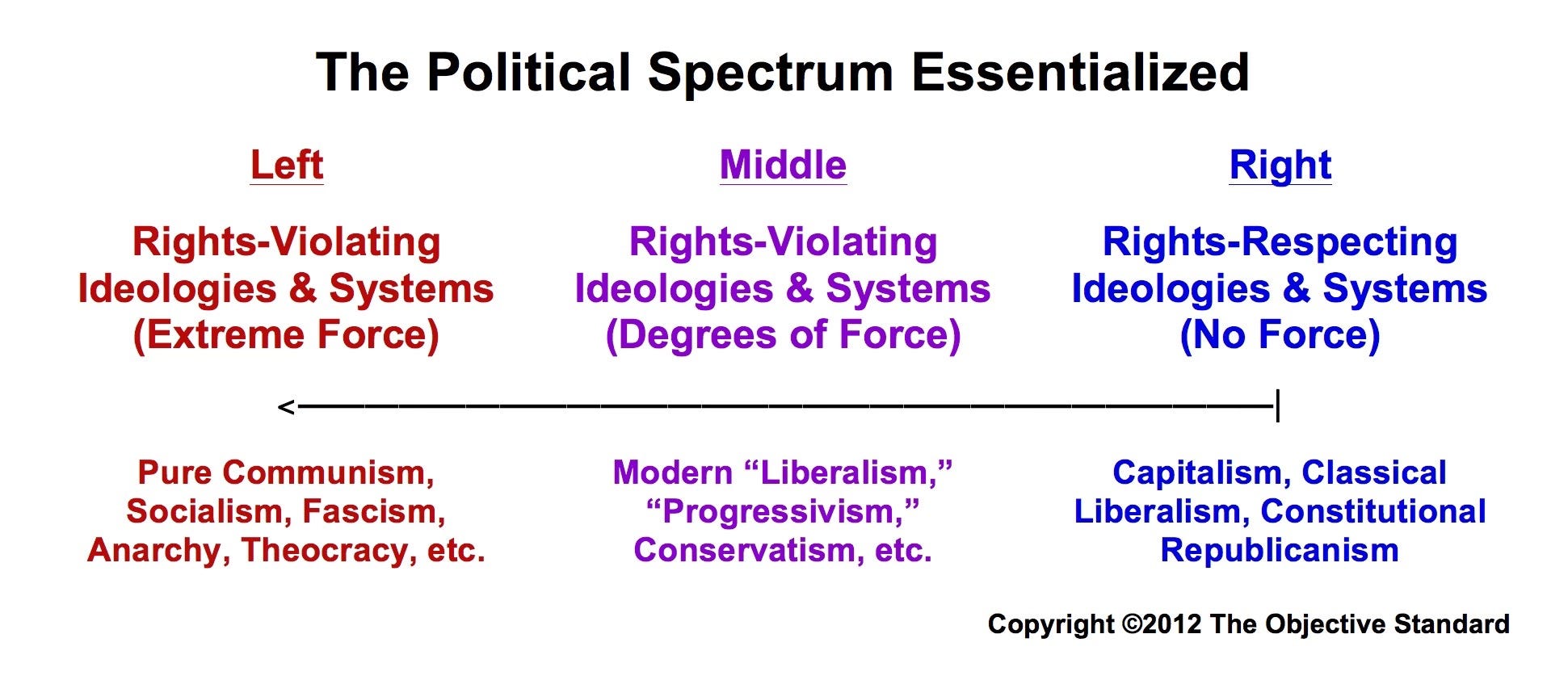
The proper purpose of government is to protect individual rights by banning the use of physical force from social relationships and by using force only in retaliation and only against those who initiate its use. A properly conceived political spectrum must reflect this fact. Whatever terms are used to identify the positions of political ideologies or systems must be defined with regard to the fundamental political alternative: force vs. freedom—or, more specifically, rights-protecting vs. rights-violating institutions.

Because the term “left” is already widely used to denote social systems and ideologies of force (e.g., socialism, communism, “progressivism”), and the term “right” is substantially used to denote social systems and ideologies of freedom (e.g., capitalism, classical liberalism, constitutional republicanism), the best approach for advocates of freedom is not to develop new terminology for the political spectrum, but to define the existing terminology with respect to political essentials—and to claim the extreme right end of the spectrum as rightfully and exclusively ours.

A notable advantage of embracing the political right as our own is that the term “right” happens to integrate seamlessly with the philosophical and conceptual hierarchy that supports freedom. This is a historic accident, but a welcome one. Although “left” and “right” originally referred to seating arrangements of 18th-century legislators in France—arrangements unrelated to anything in contemporary American politics—the term “right” conceptually relates to fundamental moral truths on which freedom depends.

Capitalism—the social system of the political right—is the system of individual rights. It is the system that respects and protects individual rights—by banning physical force from social relationships—and thus enables people to live their lives, to act on their judgment, to keep and use their property, and to pursue personal happiness. This observation grounds the political right in the proper goal of politics: the protection of rights.

Related, and still more fundamental, capitalism is morally right. By protecting individual rights, capitalism legalizes rational egoism: It enables people to act on the truth that each individual is morally an end in himself, not a means to the ends of others, and that each individual should act to sustain and further his own life and happiness by means of his own rational judgment. This observation deepens the significance of the term “right” and anchors it in the only code of morality that is demonstrably true.

In short, seen in this light, the right morality gives rise to the principle of individual rights, which gives rise to the need of a political system that protects rights, which system is properly placed on the political right—in opposition to all systems that in any way violate rights.

Observe the clarity gained by this conception of the political spectrum. The far left comprises the pure forms of all the rights-violating social systems: communism, socialism, fascism, Islamism, theocracy, democracy (i.e., rule by the majority), and anarchism (i.e., rule by gangs). The far right comprises the pure forms of rights-respecting social systems: laissez-faire capitalism, classical liberalism, constitutional republicanism—all of which require essentially the same thing: a government that protects and does not violate rights. The middle area consists of all the compromised, mixed, mongrel systems advocated by modern “liberals,” conservatives, unprincipled Tea Partiers (as opposed to the good ones), and all those who want government to protect some rights while violating other rights—whether by forcing people to fund other people’s health care, education, retirement, or the like—or by forcing people to comply with religious or traditional mores regarding sex, marriage, drugs, or what have you.

Importantly, on this essentialized conception of the political spectrum, the “right” does not entail degrees; only the left does. This is because degrees of force are degrees of force; violations of rights are violations of rights. Freedom and rights are absolutes: Either people are free to act on their judgment, to keep and use their property, to pursue their happiness—or they are not free; they are to some extent coerced. Either government protects and does not violate rights—or it violates rights to some extent.

If people are not fully free to run their businesses and voluntarily contract with others as they see fit, to engage in voluntary adult romantic relationships, to engage in their own preferred recreational activities, to purchase or forgo health insurance as they deem best, and so forth, then they are not free; they are victims of coercion.

We who advocate freedom—whether we call ourselves Objectivists or laissez-faire capitalists or classical liberals or Tea Partiers or whatever—should claim the political right as our own. And we should let conservatives who advocate any kind or degree of rights violations know that their proper place on the political spectrum is somewhere in the mushy, unprincipled middle with their modern “liberal” brethren. Perhaps such notice and company will cause them to think about what’s right.

The political right properly belongs to those who uphold the principle of rights—not merely in theory, but also in practice.

Like this post? Join our mailing list to receive our weekly digest. And for in-depth commentary from an Objectivist perspective, subscribe to our quarterly journal, The Objective Standard.

Related:

Posted in: Ayn Rand and Objectivism, Individual Rights and Law

Comments are welcome so long as they are civil.
  • http://www.facebook.com/profile.php?id=1301258613 Peter Namtvedt

    Part of the problem with arguing about this topic or any related topic involving the root “right” is that it far too often equivocates. While this is sometimes cute, it will not help our position on individual rights to allow it so often to be linked to meanings that smack of “the right end of the political spectrum”, i.e., the conservative, or even fascist side.

  • http://www.facebook.com/people/Ashley-King/1845863629 Ashley King

    When I teach US history students this idea, I do it virtually the same way: classical liberalism on the right as the true “American system” of limited government, with the protectionist, more activist 19th century types like Henry Clay in the middle, and then the Socialists, and Communists and later National Socialists on the left, who want to overthrow the old liberal system.

  • http://www.facebook.com/people/Ashley-King/1845863629 Ashley King

     I think there is the problem you mention when you put that spectrum in Europe, where the right was not the classical liberals who founded the US.

  • http://www.facebook.com/betsy.speicher Betsy Speicher

    “Political tags – such as royalist, communist, democrat, populist, fascist, liberal, conservative, and so forth – are never basic criteria. The human race divides politically into those who want people to be controlled and those who have no such desire.” — Robert A. Heinlein

  • Fabian Bollinger

    You made your case well, but I still can’t concieve of conservatism as a left-wing ideology, as it would have to be on your axis… Nor could I concieve of placing conservatism and Objectivism on the same end of the spectrum (qua ideologies; qua politicians, one can certainly make common cause with them sometimes).

  • http://profile.yahoo.com/TDBIHY24BC7CVDRQ7DF5QF2JFA ScottW

    In this article, anarchism is wrongly defined as “rule by gangs.” Any dictionary can tell you that it is rule by “no one,” a position completely compatible with laissez faire capitalism, yet you lump it in with socialism and communism, which are it’s polar opposites. Therefore I find your analysis wanting, although the article as a whole is mainly accurate.

  • http://www.facebook.com/people/David-Okner/11312290 David Okner

    I’d prefer to to not claim the term “right” by putting tyranny on the left and freedom on the right. I’d suggest using the left and right to mean what it does today, with conservatives on the right. Check out ObjectiveFreedom.com

  • http://twitter.com/michaelcaution Michael Caution

     The rule of no govt leads to gangs and gang warfare. Anarchy does not support individual rights and is a form of tyranny because taken to its logical conclusion it leads to the tyranny of the mob and then ultimately devolves into dictatorship.

  • Anonymous

    Left means:

    1.  left in regard to the chairman of the French parliament.
    There the secular political parties were seated,

    2
     clumsey, akward’

    3.  unfitted for work and making money on a free
    market,

    4   anti-social,

    5   lack of education,

    6   poor,

    7   weak,

    8   dirt; in India the left hand is the hand of
    dirt,

    9   sexual depraved as in left-tantrism (yab yum)

    10
    collectivistic,

    11
    dependent,

    12
    unfree.


    That is what left seems to be,
    universally, maybe even cosmically. Only in Attic (Classic Hellas) I found the leftwing
    of the army was the preferred one.


    Needles now to write what Right
    stands for.

    HPax, Nederland

  • http://www.allthatgamingstuff.com/ JasonGW

    I think, unfortunately, that this axis is completely silly. The Left/Right axis is the continuum of Altruist ideologies, and the entirety of that spectrum is simply varying degrees and applications of those ideologies.

    The Classical Liberal/Capitalist/Modern Objectivist ideologies aren’t on this axis *at all*, much less on the extreme right. Sorry, Craig, but you’re mistaken.

  • http://www.facebook.com/X.we.the.people.X Rick Moncada

    Great piece. Exactly what I have been saying.

  • http://www.facebook.com/Jay.Barnett1 Jay Barnett

    Not bad, but a bit simplistic and ideologically driven when he starts explaining the function of government from libertarian/classical liberal perspective. The nature of all social compacts is that they require the members to relenquish some degree of their liberty so that the collective may better enjoy and exercise devinely imbued liberty. The tradeoff is always one of liberty versus security and stability, thus when you see the quote from Jefferson that “Those who would trade their freedom for security deserve neither” or some variation, it’s important to note that NONE of our founders said that – it’s a ridiculous fake quote.

    Government is ALWAYS coercive, and, in fact, it’s vital to recognize that fact everytime we ask the government to do something. They will, in turn, coerce us to accept their definition and interpretation of what that task is, thus supplanting our own judgments. As is the case with “Health Care.” Let them take it over, they get to define it, now Catholic institutions have to provide birth control in direct violation of their rights of conscience protected by the First Amendment – at least they were.

    Again, good article, but his treatment of government force as envisioned by the Right exposes his bias. No big deal, we all have them.

  • http://phaedoscorner.blogspot.com Wynne1

    Sorry to arrive so late to the party. Just came across this post while looking for something else.
    I enjoyed your essay and the definitional approach using liberty and force as chief parameters.

    Defining political ideologies is always dicey, and with Right and Left particularly so because pre-French Revolution conceptions would seem to run directly counter to Anglo-Enlightenment ideas. Sort of muddies things up, and allows Marxists ample room to argue (as they always do) at the margins. Pairing authoritarianism with the Right. How successful they’ve been can be seen in the academic orthodoxy of right-wing fascism.

    One more comment in passing. For some while I’ve been thinking that fundamental individual and tribal (writ large) survival is strongly at play in the Right-Left spectrum. I mean to develop the idea in the near future.

    Thanks for a fine essay.

  • Paul Burns

    This is a totally subjective definition of the right-left axis which undermines itself by demonstrating incomprehension of the terminology it uses, largely due to the writer’s partisan bias. As Biddle fails to explain, the right-left distinction stems from a physical delineation of ideological groups in the French Constituent Assembly in 1789-91: the pro-Louis faction sat to the right, their opponents (pro-Commune, notably Jacobins) sat to the left. So the axis describes concentration of political power – at the extreme right, all power in the hands of one individual (the King, in the original case), at the extreme left, all power in the hands of the general population (the Commune, the mob, whatever you wish to call them).

    The extremes are in fact represented by absolute monarchy on the right and anarchy on the left. Anarchy, as another commentor has noted, is not mob rule but total absence of government – no law, no police, nothing. In its ideal form it is total individual responsibility: each person assumes responsibility for their own actions and their own survival, and makes no attempt to coerce others in word or deed. Each person has absolute political authority over themself. In reality, this is an utterly abstract concept; humans being humans, a true state of anarchy has a half-life of a few hours; people soon become confused and resort to other forms of political organisation, such as fascist dictatorship, which is the ideology of gang rule, and can be found quite close to the right-hand end of the spectrum.

    It’s fair to lump Nazism and Stalinism together at the extreme right-wing, for all their National-Socialist or Communist rhetoric, as both regimes concentrated power in the hands of an elite party led by a megalomaniac. But socialism and Communism, in conception, are left-wing ideologies because they devolve political power from the centre to the localities, from individuals to committees. Capitalism is a right-wing concept because it aims for concentration of power (economic power) in the hands of a few individuals, who will then dictate to the majority.

    The irony is that Craig Biddle, in his focus on personal freedom and rights, has the axis exactly back to front. The greatest extent of personal freedom comes in a state of anarchy, where no rules are imposed at all – on the extreme left. The closest circumscription of personal freedom comes in an absolute dictatorship, where the commoner’s life and property are at the disposal of the autocrat – on the extreme right. I hope this helps clarify the issue for some readers.

  • http://www.facebook.com/people/Buddy-Shipley/100000379525074 Buddy Shipley

    An excellent tutorial on Forms of Government:

    http://www.youtube.com/watch?v=DioQooFIcgE

  • http://www.facebook.com/people/Buddy-Shipley/100000379525074 Buddy Shipley

    Love Heinlein!
    “There is no worse tyranny than to force a man to pay for what he does not want merely because you think it would be good for him.”

    “Be wary of strong drink. It can make you shoot at tax collectors… and miss.”

    “Anyone who clings to the historically untrue — and — thoroughly immoral doctrine that violence never solves anything I would advise to conjure up the ghosts of Napoleon Bonaparte and the Duke of Wellington and let them debate it. The ghost of Hitler would referee. Violence, naked force, has settled more issues in history than has any other factor; and the contrary opinion is wishful thinking at its worst. Breeds that forget this basic truth have always paid for it with their lives and their freedoms.”
    (– Sure, it’s from a novel, but Heinlein spoke in his writings many truths in many ways.)

  • http://www.facebook.com/IdeasMatter Mark A. Peters

    I agree with JasonGW. Rights are the fundamental, so pro-rights views (of which there is only one) go in one category and the rest go in another. It’s either laissez faire or statism, and only the latter contains a spectrum of views (and then varying only on non-essentials).

    In terms of fundamentals, that spectrum is really only a single point.

  • http://mortalisk.myopenid.com/ Morten

    Capitalism does not aim for concentration of power, economic or physical, in the hands of a few individuals. The aim is for each individual to take total control and responsibility of it’s own economic decicions and to limit physical power to defence purposes. Property rights are a way to define what is the proper area of control for an individual, usually this is what he has created. If one person is the only one in the world who creates stuff, then all economic power will be in his hands under capitalism. If everyone creates exacly the same amount of value, then everyone will have the same amount of economic power. There is no particular goal of the concentration of economic power.

  • http://mortalisk.myopenid.com/ Morten

    Shouldn’t the intent of the ideology be the standard. Otherwise there will be endless discussions and undecideable problems in deciding what each ideology leads to, which is impossible, because in many instances that also depends on other factors than the ideology itself.

  • http://www.facebook.com/Populuxe Andrew Paul Wood

    Then you would have to explain why big multinationals like Apple and Monsanto strive for monopoly

  • http://bendwavy.org/ Anton Sherwood

    So far as any consistency exists over the centuries, it seems to me that the Right is for social stability and the Left is for (some kind of) equality. These are not opposites! I might argue that to defend individual autonomy is to defend procedural equality; but why bother? It’s well established that a good taxonomy of political philosophies requires at least two dimensions, and I see no point in trying to rehabilitate the tired old Left-Right “axis”.

  • http://www.facebook.com/people/John-Longhurst/100000225665984 John Longhurst

    This author is a complete moron. His “figure” of the left-right spectrum is absurd, particularly when classifying anarchy, socialism, and communism with theocracy and fascism. Fascism and theocracy are forms of extreme right government, as any political science professor will tell you. So another moron who reached a few thousand people and sent many in the wrong direction. Putz.

  • http://www.facebook.com/people/John-Longhurst/100000225665984 John Longhurst

    And obviously, he has no idea what capitalism truly is nor the effects that it truly has. Bias and warped, even this guy.

  • Malik Faisal Moonzajer

    There had been always a misunderstanding in define left, right and center terms. Never these terms have been defined with respect to their nature. I have a very quite different opinion about left and right compare to a post structuralist. The root goes to French Revolution but it has changed a lot while referring it to schools of thoughts such as interdependency or new classical

  • http://derpanese.myopenid.com/ Derpanede

    Wow… you’re such a good teacher, what you teach is totally unbiased and completely allows your students to make their own mind about political systems….. NOT.

    If that’s what you teach, then you fucking suck.

  • http://derpanese.myopenid.com/ Derpanede

    1) “Anarchy does not support individual rights” : You have no damn clue about anarchy. Shut up?

    2) Go read the definition of ideology.

    tl;dr : Stop talking about shit you have no clue about

  • http://www.facebook.com/Lauren.D.Clifford Lauren Clifford

    Fascism is on the incorrect side. Fascism is an extreme right-wing political philosophy.

  • http://twitter.com/JohnSydenham John Sydenham

    Left and Right referred to where you sat relative to the Speaker in the French Assembly.

    There is a pretty political spectrum at: political spectrum which puts fascism near to communism.

  • http://twitter.com/michaelcaution Michael Caution

    The standard for right or wrong is always reality. Someone’s intentions can never be a standard. That’s pure whim worship. “The path to hell is paved with good intentions.” If people disagree about the consequences of their ideas then either one or both of their starting premises are wrong. Check the premises by the standard of reality.

  • http://www.facebook.com/lb.bergman Lb Bergman

    Monopolies are not inherently evil…they only way, they become coercive is through and by government intervention (regulations buy favors/ favors buy regulations). That’s not capitalism or free-enterprise…that’s government run business. Monopolies are not coercive without government…They can’t be. The very institution, many believe to control such monopolies, is the source of just such monopolies. Money is not force…and to block competition doesn’t promote the best for anyone…not in the long-range, and is powerless in the short-range without the sanction of government.

  • http://www.facebook.com/lb.bergman Lb Bergman

    Monopolies are not inherently evil…they only way, they become coercive is through and by government intervention (regulations buy favors/ favors buy regulations). That’s not capitalism or free-enterprise…that’s government run business. Monopolies are not coercive without government…They can’t be. The very institution, many believe to control such monopolies, is the source of just such monopolies. Money is not force…and to block competition doesn’t promote the best for anyone…not in the long-range, and is powerless in the short-range without the sanction of government.

  • Starr Jonez

    For anyone looking for an accurate spectrum, here it is: http://www.learnalberta.ca/content/sspes/

    I majored in political science, and that looks way familar than what this blogger is masquerading as fact.

  • Starr Jonez

    For anyone looking for an accurate spectrum, here it is: http://www.learnalberta.ca/content/sspes/

    I majored in political science, and that looks way familar than what this blogger is masquerading as fact.

  • Starr Jonez

    It’s particularily stupid to classify things as “rights respecting” and “rights violating”. This is not fair or neutral, or how the concepts are supposed to be understood to begin with. Rights are complicated concepts to begin with and can include anything from the right to land ownership to right to clean water. Capitalism is rights respecting? The right to an education? Equality? I’m saddened also about the amount of people who will read this article–people who know nothing about political theory, have never read political philisophy–and will take this as a legit explanation of the spectrum.

  • Starr Jonez

    It’s particularily stupid to classify things as “rights respecting” and “rights violating”. This is not fair or neutral, or how the concepts are supposed to be understood to begin with. Rights are complicated concepts to begin with and can include anything from the right to land ownership to right to clean water. Capitalism is rights respecting? The right to an education? Equality? I’m saddened also about the amount of people who will read this article–people who know nothing about political theory, have never read political philisophy–and will take this as a legit explanation of the spectrum.