A Self-Authored Victory: How Stepping Away Made Alysa Liu an Olympic Champion
by Daria Topchii
She had everything she needed to become an Olympic champion. But first, she needed to quit.
In 2026, Alysa Liu became the first American woman to earn an individual figure skating gold medal at the Olympics in twenty-four years. Though her performance alone communicates a lot about her beautiful attitude toward this professional pursuit, the life-serving principles behind it reveal the important moral point embedded in that victory.
To grasp the attitude Alysa embodied at the 2026 Milan Winter Olympics, one must understand where she had been before. She was sixteen years old when she placed sixth at the 2022 Beijing Winter Olympics and had already won three consecutive U.S. national championships. She had the technical arsenal to compete at the highest level for another decade—yet she walked away. “I was done a year before I quit. I knew I wanted to be done way before I actually announced my retirement,” she admitted later.1
She enrolled at the University of California, Los Angeles, as a psychology student. She spent time with friends. She traveled a lot. She did all the things that normal teenagers do but that competitive figure skaters are routinely denied because of their tight schedules. Looking back, she described her pre-retirement rhythm: “Going to the rink, going home, competing. There were many, many times when I didn’t enjoy it.”2 Figure skating had become a set of blind obligations that she had never consciously chosen. “I was lacking experience in other things in the world. All I knew was skating, and I just wanted to live my life, I guess,” Alysa said.3 She was craving experiences beyond the borders of the ice rink.
However, by the end of her freshman year, her attitude toward figure skating had shifted. “Taking a step away from the sport allowed me to understand myself, because I’d never had the time before, the space to figure out who I was,” she said. “Taking a step away allowed me to see the full picture.”4 That full picture included the realization that skating could be different—that she could be different—if she returned on her own terms. “There was a time where I wasn’t confident in myself or I didn’t know I could step out of the lane,” she reflected. “That was up until I was sixteen years old when I stepped away from the sport. That was my first out-of-the-lane decision and my authenticity just domino [effected].”5 So, she decided to return—not because she felt pressure to be back on ice, had unfinished business, or something to prove to someone, and not as an obligation or an identity she had been assigned at age five. She returned because having lived without figure skating, she discovered that she wanted it. This time it was a choice of a mature, self-directed soul.
Massimo Scali, one of her two coaches, saw profound changes in her return. “I saw freedom and control,” he said. “I saw a woman who knew what she wanted and was ready to step back into the arena with even more passion and joy than before.” Alysa and her coaches started to deal with each other as independent equals, each offering something valuable—she was not sacrificing, nor were they controlling her. Scali explained: “We share a very similar way of believing in skating and in life in general. We have the same values, the same sensitivity, and a deep respect for each other.”6 The terms of her return reflected this fully. She chose the outfits and music for her performances by herself, ate what she wanted, and rested whenever she needed to. “We know her well and understand that complete freedom is essential for her to achieve results. Not a single step is taken without her consent. She is a full partner in our team; we are equals and respect each other’s opinions,” Scali elaborated.7 A coaching relationship built on those terms is rare—and it’s precisely that rarity that made the subsequent results so impressive.
An important characteristic she brought this time was what she wanted to be known for—her creativity. “I’m really big into fashion; I have my own sense of style for sure,” she said. “I have input in my figure skating dresses . . . and I wanna share that creative process, as well.”8 She integrated her sense of self with her athletic pursuit—figure skating became a pathway for her creative expression. The program packaging, the costumes, the choreography—all of it became a part of a unified creative vision that she authored. “There needs to be more individuality,” she said. “People deserve the space to express themselves and I’m glad that people are looking to me as inspiration to do that.”9
After winning gold, she spoke about the Olympics with genuine excitement. She compared her two Olympic experiences as follows: “I am grateful for both Olympic experiences, but I feel like I am more gracious now because I have stuff that I want to share, and I want to be here. And I think that’s the difference from last time.”10 This perspective connects to a broader truth about human achievement: Productive work, at its best, is not merely a means to external reward. It is an expression of one’s identity. Alysa started to skate with creativity, with individuality, and thus with joy.
With her performance at the Olympics, Alysa demonstrated that the dichotomy between enjoying yourself and working hard is false. What she experienced in Milan was genuine joy. When asked afterward how she felt on that ice, she replied, “Calm, happy and confident.”11 This attitude comes from a mindset that sees excellence and joy as naturally belonging together. “When you enjoy doing something, you can excel at it,” her second coach DiGuglielmo said. “She can really show that you can do what you love, do it really well, and win the Olympics.”12
Her victory showcases that joy is not an obstacle to achievement. It is not something to be suppressed in the service of accomplishments. It is the foundation upon which they are properly built. The result of this attitude was an athlete who could say before the biggest competition of her life: “I don’t need a medal. I just need to be here and show people what I can do.”13 After winning gold, she elaborated: “I don’t need this,” she said of the medal. “What I needed was the stage, and I got that, so I was all good no matter what happened.”14 A person who needs a medal is pursuing achievement as validation—so if it does not arrive, that person leaves with nothing or with disappointment. A person who sees the stage as a place for self-expression—as an opportunity to do what she loves and to share it with others—is pursuing performance. The former orientation focuses solely on the outcome, whereas the latter focuses on the joy that comes from the process. “I’m OK if I do a fail program. I’m totally OK if I do a great program. No matter what the outcome is, it’s still my story,” Alysa said.15 She was there to do what she had mastered, to do it well, and to enjoy doing it. Everything else—the medals, the records, the historical significance—was secondary.
Some might mistake this approach as an argument against struggle. It is not. Struggle is an essential part of a meaningful life because every meaningful thing you build requires it. Learning a skill is a struggle. Building a relationship is a struggle. Starting something from nothing is a struggle. What makes these struggles meaningful is a direction chosen deliberately; they are in service of a specific goal. But it can become destructive when a struggle becomes a permanent state that has lost its direction; when it’s no longer in service of anything; when it’s disconnected from a person’s goals and values and has become its own destination. When one stops asking “What is this difficulty moving me toward?” and “Is this goal really what I want now?,” the struggle stops being productive and results in dissatisfaction with life rather than in a reward. Alysa articulated this herself: “I love struggling, actually,” she said. “It makes me feel alive.”16 These are not the words of someone who avoids difficulty but of an athlete who understands that struggle, when it serves a chosen purpose, is evidence that she is engaged in something important to her. She did not return to skating believing she could avoid difficulty. She returned knowing that the difficulties were worth bearing because they were in service of her chosen values. They had a purpose she had authored herself. That is the only kind of struggle that produces not merely achievement but fulfillment.
When asked directly about Olympic pressure, Alysa’s response was precise: “You would have to explain what Olympic pressure is. Who is giving—who is the pressure?”17 She understood that the Olympic pressure many athletes feel is no more than an individual interpretation—a meaning assigned to circumstances by a mind that has decided that those circumstances are threatening. The circumstances themselves are not threatening. What transforms them into pressure is the athlete’s decision to treat them that way. Alysa decided not to choose that path, grasping that although external circumstances are not under her control, the orientation of her mind toward them is. This attitude allowed her to fully enjoy what would otherwise have been such a stressful moment. “What is there to lose? Every second you’re there, you’re gaining something,” she said. There’s nothing to be lost. . . . I can’t think of anything that I would find stressful or anything that would—could bring me down.”18 She looked fearless from the outside, but that fearlessness didn’t appear from nowhere—it came from the clarity she obtained by reflecting on what she genuinely valued and what she expected to take from the Olympics.
Having this attitude, Alysa is aware of the example she sets for others—particularly younger athletes who may feel trapped by expectations or unable to assert their own needs. “It’s doing stuff that people tell you you shouldn’t do,” she said. “I’ve been doing a lot of that.”19 Her decision to step away from skating and return on her own terms exemplified how athletes can take control of their own destinies in pressure-packed environments. “I really am the one deciding for myself what to do,” Alysa said. “It’s all revolved around what I want to do, which I personally like. I get to decide what I want to wear to the rink, and which rinks I want to go to—all that. It’s liberating.”20
In competitive sport, athletes are often shaped from childhood by coaches, parents, and national federations—and gradually by the weight of expectations they have internalized as their own. She reclaimed authorship of her own life. “It feels like I’m really just doing what I want to do and I’m more confident in myself.”21
Self-confidence for Alysa wasn’t instilled by external validation or winning the medal. It emerged from the experience of making her own choices and discovering that she could trust herself. Her advice is direct and uncompromising: “Don’t compare yourself to anybody. Stay on your own path, your own journey, and focus on yourself.”22 She grasped that the proper foundation for consistent achievement is a joyful attitude toward the pursuit—and that preserving that attitude requires an independently defined purpose of it. Freedom embodied by genuine authorship of one’s life is a precondition of excellence in any serious pursuit. Alysa did not succeed by relinquishing control of her career. She succeeded because she took full control of it—and the self-made decision to leave, counterintuitively, made her return possible.
Alysa showed that when you pursue what you have chosen by your independent judgment, excellence and joy follow naturally. The day after her victory, she reflected on the experience: “I mean, it was just bliss. I was so happy to be there. I felt like I was floating, and I felt the crowd carried me. I did everything I wanted to do.”23 Not everything she had to do—everything she wanted to do. When asked about the new costume she wore for her free skate, she joked with the lightness that characterized her entire Olympic experience: “If I fell on every jump, I would still be wearing this dress.”24 The dress, the performance, the momentum—all of that had value independent of the outcome for her.
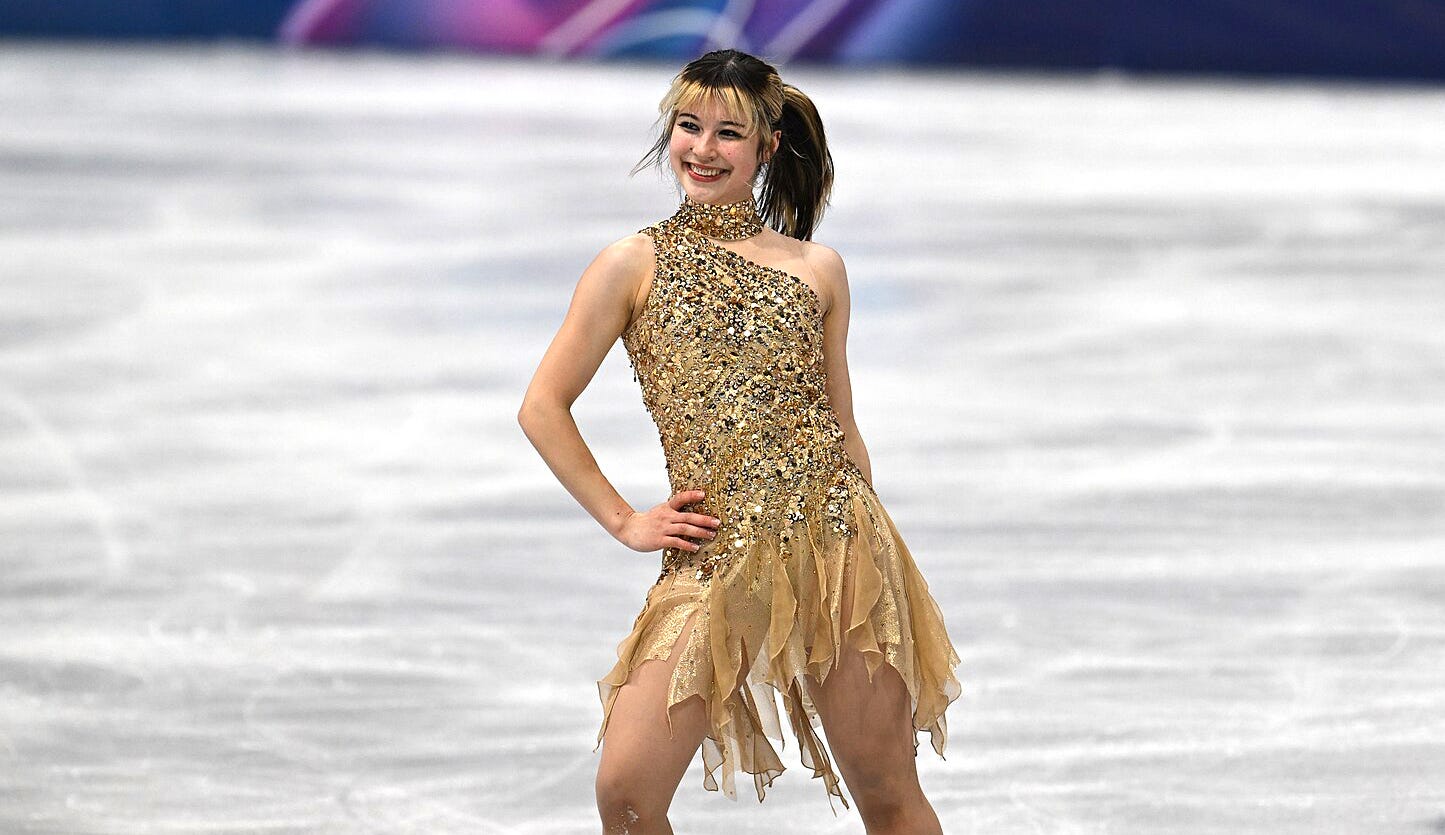
She smiled when she stepped onto the ice. She smiled through her jumps. Then she skated to the rinkside camera and let out a celebratory expletive. That was not performative joy for the cameras or the observers. That was genuine joy that she experienced because she chose her goal, achieved it, and loved it. And she would do it again, medal or no medal—because that is who she is.
KCRA 3, “Dying to Ask/Olympian Alysa Liu and Her World-Class Comeback,” YouTube video, December 11, 2025,
Philip Hersh, “How Alysa Liu Rediscovered Figure Skating and Came Out of Retirement,” NBC Sports, October 11, 2024, https://www.nbcsports.com/olympics/news/alysa-liu-figure-skating-comeback.
Darci Miller, “Older, Wiser, Alysa Liu Returns to Competition,” U.S. Figure Skating, October 7, 2024, https://usfigureskating.org/news/2024/10/7/rinkside-older-wiser-alysa-liu-returns-to-competition.aspx.
Clara Stein, “Olympic Figure Skater Goes Massively Viral—and It’s All Because of Her Body Language,” PureWow, February 23, 2026, https://www.aol.com/olympic-figure-skater-goes-massively-164727637.html.
Bentley Maddox and Charles O’Keefe, “Olympic Figure Skater Alysa Liu Reveals Future Plans after Winning Gold Medal,” E! News, February 24, 2026, https://www.eonline.com/news/1428881/olympics-2026-alysa-liu-on-future-plans-creative-projects.
Marcus Thompson II, “Alysa Liu’s Olympic Run Came with Terms. Her Choreographer Helps Her Express Them,” The Athletic, February 19, 2026, https://www.nytimes.com/athletic/7055443/2026/02/19/alysa-liu-figure-skating-winter-olympics.
“We Have an Open Dialogue. We Know Her Well and Understand That Complete Freedom Is Essential for Her to Achieve Results. Not a Single Step Is Taken without Her Consent. Massimo Scali on Working with Alysa Liu,” FS Gossips, November 12, 2025, https://fs-gossips.com/14729/.
“Alysa Liu on Her Journey and Her Art: ‘I Want to Share That Creative Process,’” Olympics.com, https://www.olympics.com/en/milano-cortina-2026/news/alysa-liu-on-her-journey-and-her-art-i-want-to-share-that-creative-process-exclusive.
Maddox and O’Keefe, “Olympic Figure Skater Alysa Liu Reveals Future Plans after Winning Gold Medal.”
Rachel Treisman, “U.S. Figure Skater Alysa Liu Said She Didn’t Care If She Medaled. She Won Gold,” NPR, February 19, 2026, https://www.wuft.org/2026-02-19/u-s-figure-skater-alysa-liu-said-she-didnt-care-if-she-medaled-she-won-gold.
Karen Rosen, “Milan Cortina 2026/Rosen Report: Liu Was ‘Calm, Happy and Confident’ on the Way to Her Women’s Figure Skating Gold,” The Sports Examiner, February 20, 2026, https://www.thesportsexaminer.com/milan-cortina-2026-rosen-report-liu-was-calm-happy-and-confident-on-the-way-to-her-womens-figure-skating-gold/.
“Alysa Liu Is Doing Things Her Way in Pursuit of a Gold Medal,” NBC Olympics, https://www.nbcolympics.com/news/alysa-liu-doing-things-her-way-pursuit-gold-medal.
“Olympic Figure Skater Goes Massively Viral—and It’s All Because of Her Body Language,” PureWow, February 23, 2026, https://www.aol.com/olympic-figure-skater-goes-massively-164727637.html.
Treisman, “U.S. Figure Skater Alysa Liu Said She Didn’t Care If She Medaled. She Won Gold.”
60 Minutes, “Alysa Liu: The 60 Minutes Interview,” Y12:59, January 5, 2026,
Treisman, “U.S. Figure Skater Alysa Liu Said She Didn’t Care If She Medaled. She Won Gold.”
Rachel Treisman and Michel Martin, “Alysa Liu Is Team USA’s Best Shot for Olympic Medal in Figure Skating Final,” NPR, February 19, 2026, https://www.npr.org/2026/02/19/nx-s1-5718411/alysa-liu-is-team-usas-best-shot-for-olympic-medal-in-figure-skating-final.
Treisman, “U.S. Figure Skater Alysa Liu Said She Didn’t Care If She Medaled. She Won Gold.”
“Older, Wiser, Alysa Liu Returns to Competition,” U.S. Figure Skating, October 7, 2024, https://usfigureskating.org/news/2024/10/7/rinkside-older-wiser-alysa-liu-returns-to-competition.aspx.
“Olympic Figure Skater Alysa Liu Reveals Future Plans after Winning Gold Medal,” E! News, February 24, 2026, https://www.eonline.com/news/1428881/olympics-2026-alysa-liu-on-future-plans-creative-projects.
A. Pawlowski and Maura Hohman, “Alysa Liu Reveals the Top 2 Habits That Keep Her Mentally Strong,” Today, March 2, 2026, https://www.today.com/health/womens-health/alysa-liu-mental-health-habits-rcna261310.
“Winter Olympics 2026: Alysa Liu Exclusive—‘I Was Peak Happiness Out There on the Ice,’” Olympics.com, February 20, 2026, https://www.olympics.com/en/milano-cortina-2026/news/winter-olympics-2026-alysa-liu-exclusive-i-was-peak-happiness-out-there-on-the-ice.
“Winter Olympics 2026: Alysa Liu Exclusive.”


