


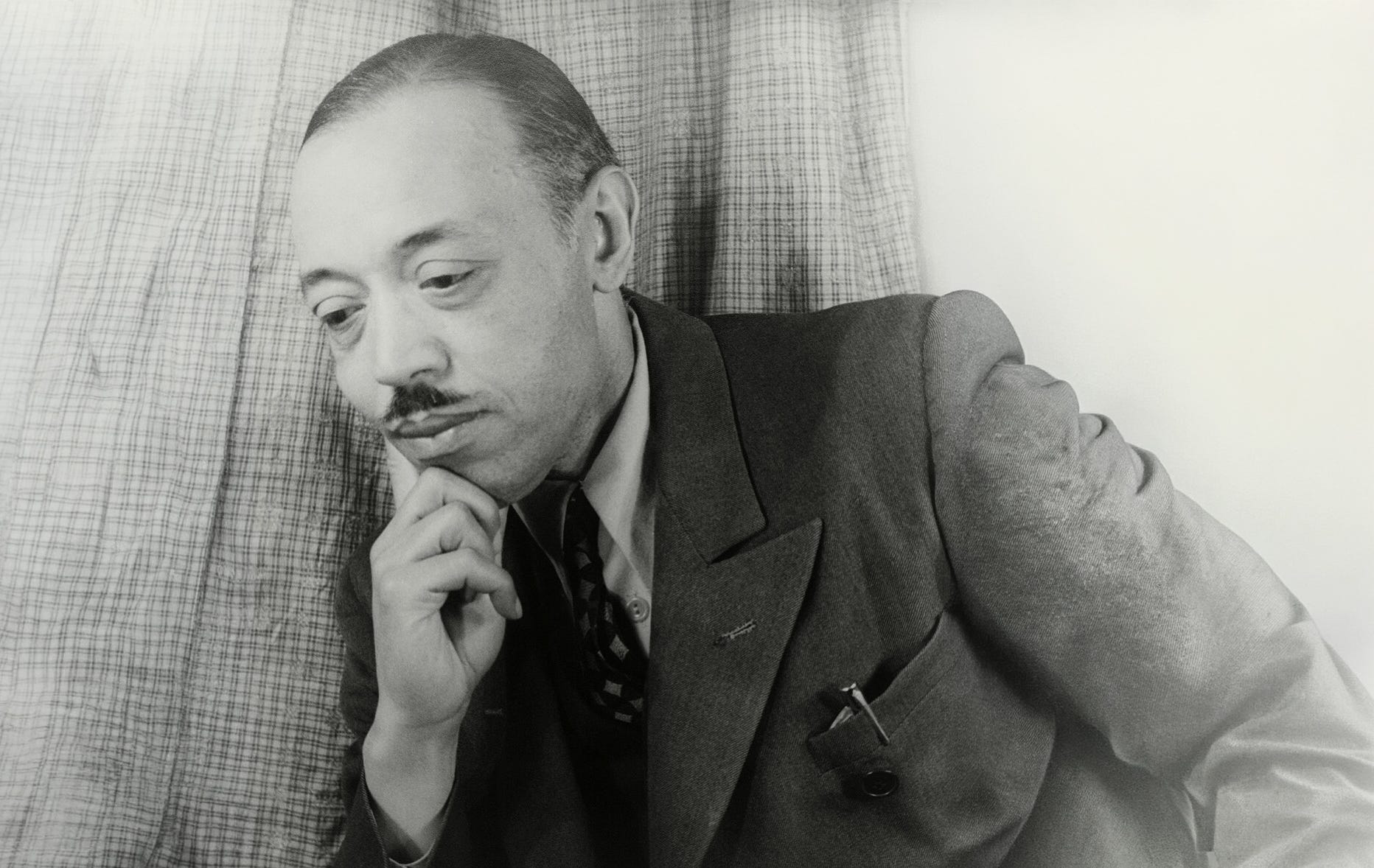
William Grant Still (1895–1978) was a pioneering composer who sought to create a distinct style of American classical music grounded in his own artistic vision. He produced nearly two hundred works during his career, spanning symphonies, suites, operas, and ballets. As he grew more prolific, his artistic perspective put him at odds with prevailing attitudes of the time, creating tension between him and his contemporaries.
Still remains one of America’s underrated composers because he worked during a time when it was popular to view music through the lens of racial identity—which Still rejected. Although Still recognized the complex history of race in America and incorporated the music of various ethnic groups into his compositions, he also strived to transcend the confines of race-based thinking. He was an individualist striving for what he described as a “universal idiom” in music. An Arkansas native, he composed during the early- to mid-20th century, an era when collectivism was especially in vogue among working artists of the Harlem Renaissance, a movement centered around reshaping, through creative works, what they considered to be black identity. As a black man, Still was often expected to support the movement. But he was his own man, and he documented his individualistic artistic stances in his writings, such as this incisive entry:
I have always felt, when people have asked me to bow to their will, that I may indeed be wrong—but if I am wrong, let it be my own mistake, not one I have been led into. It may be that I am mistaken in having tried to establish my own mode of musician expression. But it more nearly expresses my true self than any mode I might have borrowed!1
Still’s writings and musical works reveal a creator with an active mind—one who once found allies within movements such as the Harlem Renaissance before becoming the opposition.
Because of a number of factors—Still’s individualist views, his political stances, his appreciation of American culture, and how others reacted to these in light of his background—his legacy is obscure. But it is also important. His symphonies—such as his tribute to America’s bountiful resources, Western Hemisphere—and his mindset toward his work—evidenced by his remark, “It is what I would like to write, not what others have insisted that I write”—reveal a cerebral and stubborn composer who thought about artistic principle as much as the artwork itself.2 “Still was in the wrong place at the wrong time,” wrote music director Leon Botstein.3 Still’s belief in individualism and in the merit of a unified America “made him something of a pariah,” Botstein stated.4 He also noted that Still “defied expectations and set his own path.”5 And it is one worth exploring.
Musician and writer J. Edward Britton described Still as a “famed yet underappreciated composer.”6 Still’s unique artistic repertoire and his inspiring philosophical contemplation show us that though he remains an underrated founding father of American-style classical music, his visionary compositions and thought-out ideas are worthy of appreciation and study.
A Dream Realized
When Still was a teenager, he set out on an ambitious path. He had long been inspired by the Red Seal phonograph records featuring various classical composers that his stepfather brought home. One day, while listening to those records, he decided to become a professional musician. “I knew then that I would be happy only if someday I could compose operatic music,” he wrote while also sharing that the symphony orchestra was something that “deeply interested me from the very start of my musical life.”7 His mother, a teacher, was another key influence: “She constantly urged me to make something of myself, and not to follow the path of least resistance.”8
Still realized his childhood dream in 1931, when he was thirty-six years old, with the premiere of his breakthrough work, Afro-American Symphony. The work was not only a nod to his teenage classical roots, but also to his early work with W. C. Handy, known as “The Father of the Blues,” during the 1920s. Within the symphony he sought to integrate uniquely American and historically African American genres, such as the blues, with European classical music. The symphony features four movements—“Longing,” “Sorrow,” “Humor,” and “Aspiration”—that elevate the blues to a new standard within the classical framework. And the orchestra plays an uplifting story; each movement is set to a selection by Revolutionary-era poet Paul Laurence Dunbar. The accompaniment for the final section, “Aspiration,” reads,
Be proud, my Race, in mind and soul,
Thy name is writ on Glory’s scroll
In characters of fire.
High ‘mid the clouds of Fame’s bright sky,
Thy banner’s blazoned folds now fly,
And truth shall lift them higher.
The Afro-American Symphony includes race-centric elements—its title, certain poetry excerpts, the genre selection for the work—but Still’s overall goal was to position genres such as the blues as key players among the Western musical landscape. In his words, he wanted historically black genres in the country to become “another American voice.”9 “That was the reason I decided to create a musical theme in the Blues idiom and develop it into the highest of musical forms—the Symphony,” he stated.10
Early on, Still established a leitmotif that would recur throughout his catalog—a fearless exploration and fusion of genres and styles, something he felt compelled to do as he developed “an individual form of expression.”11 Although Afro-American Symphony received positive critical praise, it also set him against prevailing winds of the decade. Many of his colleagues at the time regarded the arts as divided into black and white. But Still was interested in elevating his individual voice and connecting with audiences, regardless of skin color. Commenting on the widening racial divide of the arts at the time, he said, “For me, there is no White or Black music, there is only music by individual men that is important if it attempts to dignify all men, not just a particular race.”12
A Quest for Beauty in Music
The 1930s proved to be a productive decade for Still as he shifted from what he called the “blues idiom” to the “universal idiom,” which focused on connecting with audiences through works that unify rather than divide. He was an in-demand arranger, orchestrator, and composer, and he was commissioned for the arrangement of various compositions for organizations such as the League of Composers, Cleveland Orchestra, the New York World’s Fair, and the United States Military Academy band. He briefly worked for Columbia Pictures before conducting orchestras such as the Los Angeles Philharmonic and the Philadelphia Orchestra. He also received an honorary master’s degree from Wilberforce University in 1936 and went on to receive eight more from higher education institutions over his career.
As his accolades grew, he spread his wings artistically, covering new subjects in his repertoire. His 1936 suite, III Visions, featuring the fan-favorite middle movement, “Summerland,” chronicles his view of the journey of a soul. He wrote the piano suite for his wife and musical collaborator, Verna Arvey, who played the piece during its public debut in Los Angeles. The suite highlighted an overarching goal that would set Still apart from many of his modernist contemporaries moving forward: “Experimentation for the sake of experimentation can only produce a poor substitute for music, and we are now in need of real music, not contrived sounds. We need a new contemporary goal. I suggest that this goal be beauty, and I maintain that there is no substitute for inspiration.”13
In 1945, Still wrote his penultimate symphony, his fourth, titled Western Hemisphere. In it, the listener finds the composer expressing reverence for the beauty and resources of America’s natural landscape. The piece opens with the portrayal of “The vigorous, life-sustaining forces of the Hemisphere.”14 The listener is then taken through a series of movements chronicling “the natural beauties of the hemisphere” and its benevolent essence.15 “[It] portrays—in a sense—the spirit of the American people,” Still wrote, noting that his vision for the work celebrates “the rich human and natural resources of all of the Americas.”16
His focus on individual expression, his quest for beauty in music, and his celebration of America’s abundance put him at odds with musical circles that were embracing communist ideals more and more. “He is an independent thinker, not a musical faddist. He has always spoken for himself,” stated writer Robert Bartlett Haas.17 After a busy three decades from the 1920s through the 1940s, the 1950s would be different for the inspired composer. And this made him directly confront the pushback he had been quietly facing.
“Lean Years”
Back in 1936, Still had begun work with Langston Hughes to complete the opera Troubled Island, about the Haitian Revolution of 1791. But creative differences and Hughes’s lack of availability put a strain on their professional partnership. By 1939, though the opera had been completed, their relationship had been all but dissolved. On top of that, Hughes was a popular figure of the Harlem Renaissance, a movement that became increasingly sympathetic to communism as the years passed, putting Still and his anti-communist views in direct opposition.
Sometime between 1931 and 1935, modernist musicians had formed a new organization in New York: the Composers’ Collective. It was an affiliation of the Workers’ Music League, which was part of the American Communist Party, and these affiliations held influence within the American musical landscape. Author Catherine Parsons Smith noted that through 1936, despite some negative press, Still “regularly attracted critical admiration.”18 But subsequent years were a different story. In a 1946 review of Still’s work, New York Times music critic Olin Downes, who aligned himself with leftist “progressive” causes, referred to the composer’s style and the push for universal qualities within his works as “diluted” and deprived of its “racial essence.” He described Still as a “smoothed out” composer, which, he concluded, “is unfortunate.”19
Still began speaking out about the ostracization he faced as a composer with anti-communist views. In 1949, he prepared a speech with Arvey’s help for Mount St. Mary’s College in Los Angeles, wherein he addressed the issue:
I turn now to one tremendous problem that confronts only those composers in our country who are loyal Americans. It is a problem created by the opposition of communists to all who do not subscribe to their beliefs. . . . Through underhanded maneuvering they have placed their emissaries in . . . important positions where they very effectively . . . prevent loyal American composers from being heard whenever and wherever possible.20
He then used a personal example to highlight the suppression he believed he was facing: “From a person [employed in the Victor Record Co.,] . . . a person in a position to know what goes on, I learned that a small group of communists dictate what music shall and shall not be recorded by that company.”21 His daughter, Judith Anne, later recalled a privately arranged meeting, allegedly by Hughes, in which Still was asked to become a member of the Communist Party in America. “The result seemed to create suspicion rather than interest on Still’s part,” wrote musicologist Catherine Parsons Smith.22 (Hughes would go on to publicly deny being an official member of the party.)
Still struggled to find commissions and consistent work in the 1950s. “His devotion to an individualistic musical voice led to some lean years,” wrote Paul J. Horsley for the Philadelphia Orchestra.23 Judith Anne, who began stewarding Still’s musical legacy in the early 1980s, once remarked that her father made an important decision early in his career as he faced financial difficulties while caring for his family and trying to make music that paid the bills. One evening, while lying in bed in his family home in Harlem, he made a vow. “He determined that he would write the kind of music that he wanted to write, regardless of hardship,” she recalled.24
During the later years of his professional career, that vow was tested—but never broken.
Choosing Between Principles and Peers
The 1960s and 1970s brought increasingly avant-garde and abstract compositions to the mainstream fold, and Still’s Romantic style of composing fell largely by the wayside. He continued to compose privately, but his public output significantly decreased before his passing in 1978. Despite his lackluster final years, his professional longevity through the early- and mid-20th century and his unparalleled catalog set him apart as one of America’s few distinguished composers. Music writers and historians often point out Still’s “firsts” in an effort to show his influence: the first African American to have a symphony performed by a major US orchestra, the first African American to conduct a major US symphony orchestra, the first African American to have an opera produced by a major US company—among others. But through each recognition, Still stuck to his individualist principles. The story goes, when referred to by the nickname given to him by others, “The Dean of Afro-American Composers,” he shot back, “Why wasn’t Copland the dean of white composers?”25
During a time of encouraged separatism in the arts, Still integrated; during a time of abstract musical works, he strove to create works filled with beauty and meaning. Whatever Still was expected to be, whether from the perspective of a narrow-minded white critic or narrow-minded black activist, he wasn’t, which often caused him to have to choose between his principles and his peers. “Still did not behave in a way that those who discriminated against him wished him to act; neither did he conform to the wishes of those who looked to him to join in a common cause,” wrote Botstein.26 He was too modern for traditionalists and too traditional for modernists. His music and his writing show that he chose his principles, during prolific years and lean ones.
Still risked his reputation and career for his integrity and his belief in the right to individual expression and paid for it. But today, his legacy as a skilled, visionary composer stands strong. “In the same way a sociology student must study Tocqueville to understand American society, or a philosophy student must study Edmund Burke to discover the theoretical underpinnings of American politics, there is no greater composer for the study of American music than William Grant Still,” Britton wrote.27
In a 1994 essay, author and writer Gayle Murchison shared how she hoped Still would be represented in years to come. “Perhaps the years following the 1995 centennial of Still’s birth will bring about a renaissance of Still studies and result in a deeper understanding of Still as a man of letters and a man of music,” she wrote, adding, “Perhaps he will be seen, more properly, as ‘Still, American Composer of American Music.’”28
Judith Anne Still, William Grant Still and the Fusion of Cultures in American Music (Flagstaff, AZ: The Master-Player Library, 1995), 62.
Still, William Grant Still and the Fusion of Cultures in American Music, 55.
Leon Botstein, “Revisiting William Grant Still,” American Symphony Orchestra, https://americansymphony.org/concert-notes/revisiting-william-grant-still, 2.
Botstein, “Revisiting William Grant Still.”
Botstein, “Revisiting William Grant Still.”
J. Edward Britton, “William Grant Still: The Founder of American Music,” Imaginative Conservative, December 26, 2020, https://theimaginativeconservative.org/2020/12/william-grant-still-founder-american-music-j-edward-britton.html.
Still, William Grant Still and the Fusion of Cultures in American Music, 55.
Still, William Grant Still and the Fusion of Cultures in American Music, 65.
Catherine Parsons Smith, William Grant Still: A Study in Contradictions, UC Press E-Books Collection Archive, 1982–2004 (accessed September 9, 2026), https://publishing.cdlib.org/ucpressebooks/public/book/william-grant-still-a-study-in-contradictions.html#d0e1777.
Smith, William Grant Still: A Study in Contradictions.
Still, William Grant Still and the Fusion of Cultures in American Music, 73.
Britton, “William Grant Still: The Founder of American Music.”
Still, William Grant Still and the Fusion of Cultures in American Music, 74.
“William Grant Still: Symphony No. 5, ‘Western Hemisphere,’” Pacific Symphony, https://www.pacificsymphony.org/blog/2018/07/13/william-grant-still-symphony-no-5-western-hemisphere.
“William Grant Still: Symphony No. 5, ‘Western Hemisphere,’” Pacific Symphony.
Paul J. Horsley, “William Grant Still and the Adventure of Discovery, Orchestra Today, Philadelphia Orchestra, September 13, 2023, https://philorch.ensembleartsphilly.org/press-room/blogs-and-press/william-grant-still-and-the-adventure-of-discovery.
Still, William Grant Still and the Fusion of Cultures in American Music, iii.
Smith, William Grant Still: A Study in Contradictions.
Smith, William Grant Still: A Study in Contradictions, 187.
Smith, William Grant Still: A Study in Contradictions, 169.
Smith, William Grant Still: A Study in Contradictions, 169.
Smith, William Grant Still: A Study in Contradictions, 198.
Horsley, “William Grant Still and the Adventure of Discovery.”
Horsley, “William Grant Still and the Adventure of Discovery.”
“Musical Moments #24,” The Bach Festival Society of Winter Park, June 7, 2020, https://www.bachfestivalflorida.org/news/musical-moments-24.
Botstein, “Revisiting William Grant Still.”
Britton, “William Grant Still: The Founder of American Music.”
Smith, William Grant Still: A Study in Contradictions, 61.
