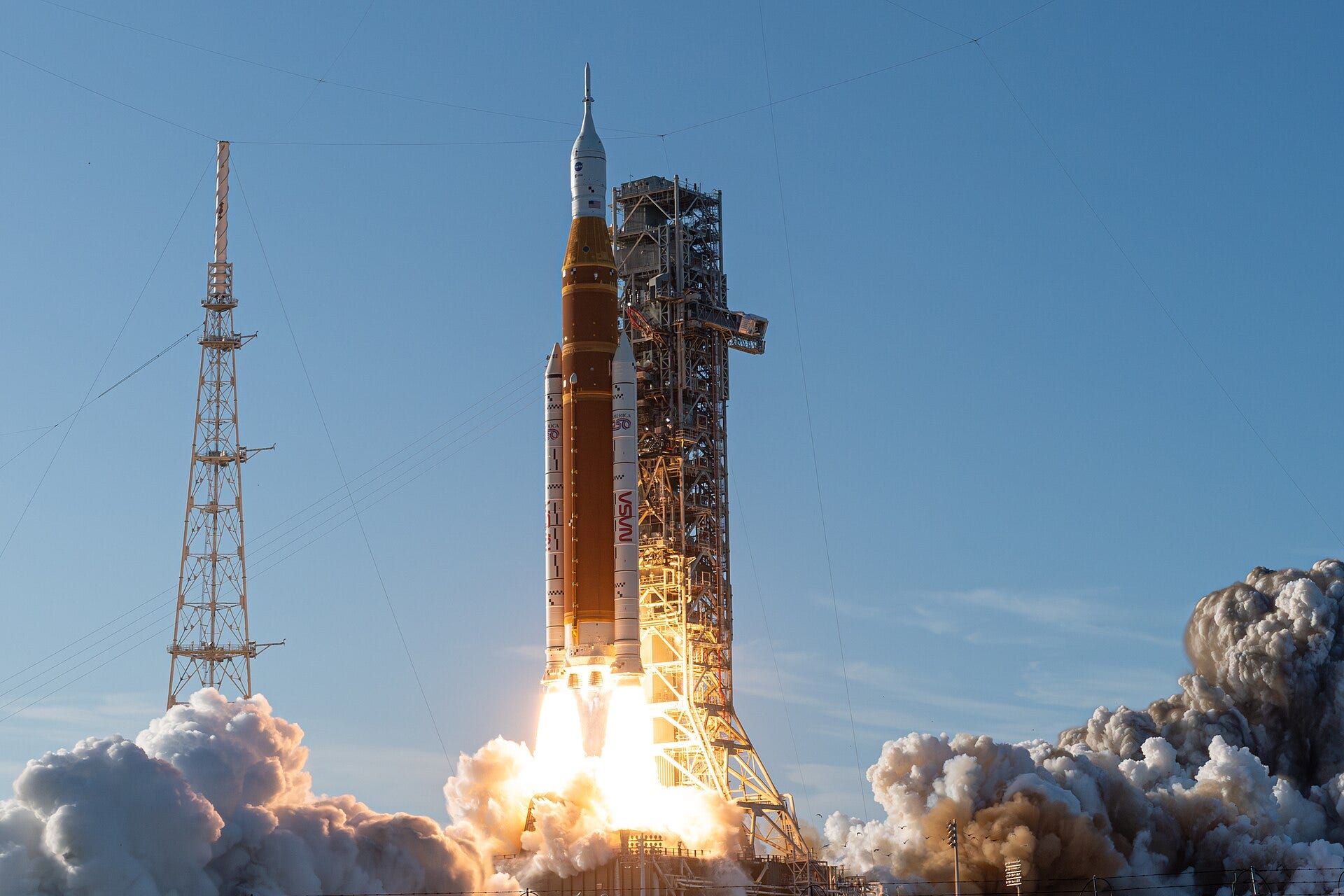
Artemis II Takes the Small Step, But Who Will Make the Giant Leap?
by Thomas F. Walker
Human beings are finally visiting the Moon for the first time since 1972, flying past the far side further than any human has gone before. NASA intends the Artemis II mission as the first step toward a permanent human lunar presence. In the fifty-four years since Apollo 17, humans have only left the relative safety of “low Earth orbit” (up to about four hundred miles) once, during SpaceX’s Polaris Dawn mission in 2024.[1] That flight reached a maximum orbital height of 870 miles—a record for humans in Earth orbit, but a tiny fraction of the 250,000 miles to the Moon that Artemis II’s Orion spacecraft has now traversed.
The fact we have returned at last to our nearest cosmic neighbor is cause for celebration. A permanent human presence on the Moon could unlock tremendous benefits. The Moon has naturally occurring Helium-3, an incredibly energy-dense isotope not found on Earth that could revolutionize power generation. It also has abundant precious metals.[2] A human settlement on the Moon could serve as a scientific outpost, a waypoint for flights to Mars and beyond, a site for prosperous mining operations, an opportunity to build innovative new societies in a demanding frontier environment, and even as a lucrative tourist destination. All of these things would also act as economic and technological turbo-chargers for innovation and industry back on Earth.
But the flight of Artemis II also shines a spotlight on a critical question: Why has this taken so long? And now that we’re going back, will we stay this time? Answering these questions reveals serious problems with the Artemis Program and how successful this attempt at lunar colonization is likely to be.
How We Got Here
In order to answer these questions, we need to understand the motivations behind the way the American space program has been managed until now, beginning with the Apollo Program. Although the Apollo Moon landings were hailed as a step forward in the human exploration of space and they did contribute valuably to many fields of science, neither scientific exploration nor the establishment of a viable colony in space was their principal purpose. Rather, the core purpose of the program was twofold:
Prevent the Soviet Union from establishing dominance in space and on the Moon, which it would likely have used for military purposes.
Demonstrate the superiority of American industry and technological capability over that of the Soviet Union (and thereby of capitalism over communism).[3]
When Apollo 11 landed on the Moon in 1969 after a decade of the Soviets leading in the Space Race, many in the West assumed America had, for now, gained the lead in a race that was far from over. They didn’t know (and wouldn’t until the 1990s) that the U.S.S.R.’s hopes for a lunar mission were literally crashing and burning. The Soviet lunar program was beset by two leading men aggressively competing for the favor of the Politburo, sometimes even sabotaging each other’s work, and a regime that threatened and silenced “disloyal” individuals who pointed out flaws in the rocket’s design and the program’s management.[4] Accordingly, it failed catastrophically. Four of the colossal rockets exploded, one of them taking much of the launch complex and ninety-one lives with it, before the Soviets gave up their ambitions of a manned lunar program.[5]
By the early 1970s, it was clear that the Soviets weren’t going to the Moon. They had refocused their space program on Earth-orbiting stations. At that point, a harsh reality set in: The Apollo Program was not designed to facilitate the development of an economically viable, long-term human presence on the Moon. It was designed to win the Space Race, and it had. So Congress cancelled the program. With the Russians focused on space stations, NASA tried to regear the hardware intended for future Apollo missions to develop an American space station with mixed success. But with relations between the United States and the U.S.S.R. becoming less tense (the two countries even staged a joint manned space mission in 1975), the military justification for manned spaceflight seemed to have largely evaporated.
So another harsh reality set in: For manned spaceflight to continue, it needed to have a sound economic justification. NASA saw the need to transform its manned space program into a commercial enterprise that could pay at least some of its own costs. But thanks to the program’s military origins, combined with the widespread belief at the time that government-planned programs were the road to prosperity, the prevailing mentality was still that manned spaceflight should be delivered by NASA. So it developed a plan for a new type of spacecraft: the Space Shuttle. Unlike the single-use Apollo capsules, the Shuttle would be partially reusable, theoretically making it cheaper to fly. It would be limited to low Earth orbit, but it would have a larger crew and cargo capacity, enabling NASA to launch large payloads and repair satellites in orbit on a commercial basis. NASA had a vision of a hundred Shuttle launches a year building a thriving orbital economy.[6]
But it was not to be. The Shuttle Program ran years behind schedule and the vehicles proved extremely complex to manufacture and maintain. In a failed attempt to cut costs, NASA and its partners made changes to the design that negated the Shuttle’s efficiency benefits, resulting in an overweight craft that was more expensive to launch than a traditional rocket.[7] Contractors, knowing they were dealing with a government-funded program in which their profits were capped at a percentage of costs, made their processes inefficient to inflate their costs and maximize their profits.[8] NASA officials attempted to bury reports that some of the Shuttle hardware was unsafe.[9] The cracks were showing in the early 1980s with several near-miss accidents, but NASA pressed on, keen to demonstrate that the Shuttle could achieve its promises. After twenty-five flights, the illusion shattered. The Space Shuttle Challenger disintegrated mid-launch live on national TV, destroyed by a fault that had been known about and covered up across countless flights. Seven astronauts died, including a schoolteacher who had been set to become the first civilian in space.
After Challenger, the Shuttle Program never recovered. Terrified of another disaster, NASA implemented safety procedures that effectively limited the Shuttle to eight flights a year and dramatically increased launch costs. Nonetheless, another fatal crash occurred in 2003.[10] On its final missions, the Shuttle had to sit rotating in space in front of the International Space Station (ISS) so that the crew could inspect its underside and confirm that it was safe to return to Earth.
After the Shuttle Program ended, NASA became reliant on Russian spacecraft to service the ISS. But the context had changed radically by this time. Legal changes during the push to commercialize spaceflight in the 1980s had opened the door for private companies to develop their own launch systems, and by the end of the 2000s, several had done so. Further, China had developed and launched its own manned spacecraft, and China and several private companies were working on missions to the Moon and beyond. Keen to remove NASA’s reliance on Russian spacecraft, Congress ordered NASA to develop a two-pronged approach:
Develop a new launch system capable of reaching the Moon, but build it using components from the Shuttle Program to preserve existing jobs associated with Shuttle hardware.[11] This became the Shuttle-derived Launch System (SLS) with the new Orion spacecraft riding atop.
Fund private companies to accelerate development of their launch systems and secure NASA use of them once they are serviceable.
Artemis II, launched fifteen years after the last Shuttle flight, is the first mission to use the SLS. That system, which relies on the same solid rocket boosters that caused the Challenger disaster, reportedly costs upwards of $2 billion per launch.[12] Meanwhile, NASA’s regular flights to the ISS are provided by SpaceX’s Falcon 9 rocket and Dragon spacecraft, a system that costs $140 million per launch and boasts a flawless safety record.[13] SpaceX is now flying test missions of Starship, a radically new type of spacecraft that will, if successful, be able to reach the Moon and Mars while being far cheaper to launch than even the Falcon/Dragon system is.
This is the context of Artemis II. NASA is racing China and its own private-sector partners back to the Moon using an inordinately expensive rocket based on a failed 1970s program and which only exists to protect special interests.
Will NASA’s Lunar Ambitions Succeed?
One significant advantage of the Artemis Program is that long-term establishment of an economically viable Moon settlement is one of its core objectives. Accordingly, early Artemis missions aim to do valuable work. Artemis II includes experiments that will study the effect of radiation on human bodies and on modern technology such as computer chips, especially during the passage through Earth’s outer magnetic field where solar radiation is concentrated. It will survey possible sites for future bases, including in the south polar region (never visited during Apollo) where water is known to exist. Following the cancellation of NASA’s planned Lunar Gateway space station, the Artemis Program now also includes the use of that station’s already-built components to construct the first permanent lunar base.
But how far any of this will get is in serious doubt. NASA’s funding has always depended on Congress; the amount and the way it must be spent swings wildly depending on Congress’s political makeup. One reason for the near-decade delay of the Artemis Program is that the funding and specifications for it and its precursor, the Constellation Program, were changed repeatedly under the Obama, Trump, and Biden administrations.[14]
Then there’s the program’s enormous cost, brought about by its reliance on Shuttle-era hardware and NASA’s approach to developing new vehicles. Whereas SpaceX adopts a “test and retest” approach, building vehicles it expects to fail and modifying them after each test flight until all the issues are ironed out, NASA, stung by its experience with the Shuttle, engages in a painstaking process of pre-flight simulations and testing with the goal of achieving a faultless first flight. This results in a long wait with many delays, during which costs spiral and there is zero return on investment. Whereas NASA took nearly twenty years to deliver one SLS launch, SpaceX’s Falcon 9 rockets began earning money from customers barely five years after the company honed its design with four test flights of the Falcon 1.
SpaceX is motivated to develop a system it can use to make money from customers as well as advance its exploratory objectives, whereas NASA is creating a bespoke system that is only intended for launching Artemis missions and will never make back its development costs. SpaceX is motivated to create a highly reliable, low-cost product as quickly as possible, whereas NASA is motivated to prove to Congress that it’s delivering jobs in particular locations (whether those jobs are efficient or not), advancing the incumbent administration’s goals, and upholding American prestige in space. If it does those things, it gets funding, regardless of whether its programs make economic sense, provide a commercial service, or advance the exploration and colonization of space.
It’s important, given China’s lunar ambitions, that the spacecraft that take American businesses—and may one day need to take American military strength—to the Moon are efficient, reliable, and sustainable, not merely signals of prestige. Sadly, Artemis is hardly a poster boy for American innovation. Alongside the SLS with its Shuttle-era components, the Orion service module is based on the European Space Agency’s Automated Transfer Vehicle because the original NASA version was cancelled to reduce costs. The main Orion command capsule takes direct inspiration from 1960s Apollo capsules and is, in many respects, less advanced than SpaceX’s Dragon.[15]
With the way NASA’s deadlines slip, its goal of landing Artemis IV on the Moon by 2028 seems questionable. Because NASA cancelled Orion’s lunar lander component, that mission depends not only on NASA’s test flights of SLS and Orion in Artemis II and III succeeding, but also on either SpaceX or Blue Origin having a lander ready in lunar orbit for Orion to dock with. Meanwhile, China plans to land its first astronauts in 2030 with an integrated system of hardware it is already building and testing.[16]
China’s lunar objectives are a legitimate reason for the U.S. government to invest in lunar transportation. A situation in which communist China dominates space doesn’t bear thinking about—the Moon’s resources would only be open to other countries through dealing with China, and China could develop the military capability to control the use of space for communications, Earth observation, and much more. But for Congress to fund the development of the SLS and the Artemis Program in parallel with Starship and other private lunar programs diverts resources into a system that’s never going to be economical for long-term colonization. NASA and the Space Force would be far better off fully piggy-backing on SpaceX and Blue Origin’s existing programs. That would rapidly open up the Moon to commercial development, save vast amounts of taxpayer money, and still provide the benefit that justifies any government involvement: the protection of commercial space activities from Chinese, Russian, and other threats by establishing the space equivalent of America’s domination—and the subsequent liberation—of the oceans.[17]
Of course, NASA and Congress have far more objectives than just that. Through Artemis, they intend to oversee the progress of lunar science, colonization, and the Moon’s use as a gateway for further solar system exploration. In so doing, they will divert investment away from private attempts to achieve these goals. It may seem that science is better served by a government mission with scientific objectives than by a SpaceX mission designed to establish a tourist outpost, but the latter will create an economic incentive to build cheaper and better infrastructure for lunar operations. Before long, that will make doing science on the Moon far cheaper and more viable than launching a dedicated scientific mission there is today.
Ultimately, the job of government is to protect rights. NASA, as a government-funded body closely tied to the U.S. military, ought to focus on doing exactly that—developing its ability to ensure that America can protect commercial spaceflight and settlements from outside threats. In so doing, it will support those businesses in creating a truly viable lunar settlement. While China is learning from both the faults of America’s government space program and the innovations of its private ones, America has the opportunity to stay in the lead by focusing wholly on the latter. China has no private space industry remotely comparable to that of the United States. It will only win the race to the Moon if America continues to stumble along trying to make a zombie version of the Space Shuttle work instead of massively better alternatives.
Artemis II is certainly cause for celebration on many levels. Like Apollo, it is inspiring a new generation of people to take an interest in outer space. It will deliver a wide range of benefits, scientifically and technologically, that will help the future colonization of space. But it is also an embarrassing example of the consequences of government mismanagement of spaceflight going back decades.
Had NASA stepped back and truly opened the door to commercial spaceflight instead of developing the Space Shuttle in the 1970s, we’d probably have lunar settlements by now. Today, the private sector has developed spacecraft unlike anything NASA has ever had. If we want to see a flourishing future in space, it’s private companies such as SpaceX and their incentives to commercialize space that we need to get behind, not lumbering government programs that waste money constantly trying to adapt to the whims of politicians.
[1] Kate Arkless-Gray, “Polaris Dawn—A New Dawn in Space,” Royal Aeronautical Society, 20 September 2024, https://www.aerosociety.com/news/polaris-dawn-a-new-dawn-in-space.
[2] “Helium-3 Mining on the Lunar Surface,” European Space Agency, https://www.esa.int/Enabling_Support/Preparing_for_the_Future/Space_for_Earth/Energy/Helium-3_mining_on_the_lunar_surface (accessed April 6, 2026);
John C.Johnson, et. al., “Understanding the Economic Worth of Precious Lunar Metals,” Universities Space Research Association, 2022, https://www.hou.usra.edu/meetings/lunarsurface18/pdf/6001.pdf.
[3] James Donovan, “Why Did the USA Have to Beat the Soviets to the Moon?,” History Hit, July 17, 2019, https://www.historyhit.com/why-did-the-usa-have-to-beat-the-soviets-to-the-moon.
[4] Sven Etienne Peterson, “The Genius Who Launched the First Space Program,” Palladium, October 25, 2024, https://www.palladiummag.com/2024/10/25/the-genius-who-launched-the-first-space-program.
[5] “Russian Space Disaster Revealed,” Flight Global, 29 March 1995, https://www.flightglobal.com/space/1995/03/russian-space-disaster-revealed.
[6] T. A. Heppenheimer, “The Space Shuttle Decision: Chapter 6: Economics and the Shuttle,” National Space Society, 1999, https://nss.org/the-space-shuttle-decision-chapter-6.
[7] Heppenheimer, “The Space Shuttle Decision.”
[8] Thomas F. Walker, “How Going to Space Can Enhance Human Flourishing, with Dr. Robert Zubrin,” The Objective Standard, Vol. 17, No. 2 (Summer 2022),
[9] Timothy Sandefur, “Challenger: A True Story of Heroism and Disaster on the Edge of Space by Adam Higginbotham (Review),” The Objective Standard, Vol. 19, No. 3 (Fall 2024).
[10] “Columbia Disaster,” Britannica, https://www.britannica.com/event/Columbia-disaster (accessed April 6, 2026).
[11] John Strickland, “The SLS: Too Expensive for Exploration?,” The Space Review, November 28, 2011, https://www.thespacereview.com/article/1979/1.
[12] Eric Berger, “NASA Does not Deny the ‘Over $2 Billion’ Cost of a Single SLS Launch,” Ars Technica, November 8, 2019, http://arstechnica.com/science/2019/11/nasa-does-not-deny-the-over-2-billion-cost-of-a-single-sls-launch.
[13] Cassidy Ward, “How Much Does It Cost to Launch a Falcon 9 (and Other Rockets)?,” SyFy, May 10, 2024, https://www.syfy.com/syfy-wire/how-much-does-it-cost-to-launch-a-falcon-9-and-other-rockets.
[14] Jonathan Amos, “Obama Cancels Moon Return Project,” BBC News, February 1, 2010, http://news.bbc.co.uk/1/hi/sci/tech/8489097.stm;
The timeline is complicated by President Obama’s 2010 cancellation of the Constellation Program, components of which then became components of Artemis. Artemis II, previously known as “Exploration Mission 2,” was originally meant to fly in the late 2010s.
[15] R. D. Boozer, “The Future and the Past: Comparing Dragon and Orion,” The Space Review, May 4, 2015, https://www.thespacereview.com/article/2743/1.
[16] Eduardo Baptista, “China’s Crewed Lunar Programme Eyes Astronaut Landing by 2030,” Reuters, April 2, 2026, https://www.reuters.com/science/chinas-crewed-lunar-programme-eyes-astronaut-landing-by-2030-2026-04-02.
[17] Robert C. Rubel, “Navies and Economic Prosperity—the New Logic of Sea Power,” King’s College London, October 2012, https://www.kcl.ac.uk/dsd/assets/corbettpaper11.pdf.


