

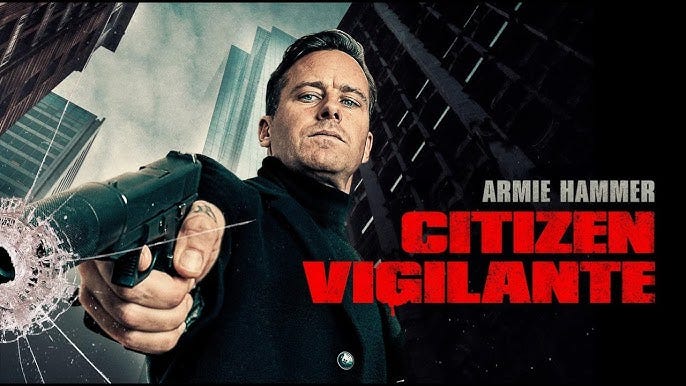
All behavior can be traced back to instincts. When justice is denied, instincts turn to vengeance. —Anonymous
This made-up, sophomoric quote is the first thing that appears on-screen in Citizen Vigilante. Like the movie itself, it might at first appear profound, but it foreshadows one of the movie’s two terminally diseased premises: the alleged moral supremacy of “instinct” (i.e., unthinking emotionalism) over reasoned thought.
We need spend only a few sentences on the movie’s almost total lack of artistic merit. Writer/director Uwe Boll intentionally makes bad movies and has openly admitted that he’s a terrible filmmaker.1 Citizen Vigilante is poorly written, poorly cast, poorly acted, poorly filmed, poorly scored, and poorly edited. None of this should be hard to believe for anyone who has seen any of Boll’s other films—but these criticisms, severe as they are, aren’t important here. Most important is what Citizen Vigilante’s generally positive reception says about the quality of thought, discourse, and art in the modern world.
Citizen Vigilante isn’t merely a bad movie. Boll has made dozens of those; a few are entertaining because of their sheer badness, and most can cause no harm beyond wasting a few hours of your time. Citizen Vigilante is a different, much worse kind of bad movie: the kind that tries and fails to take a moral stand against a severe, real-world problem—and then proceeds to dump jet fuel on the fire from a bucket labeled “water.”
The titular vigilante is Michael Sanders (Armie Hammer), whose name is never spoken aloud and only briefly seen in print once. (Boll’s intent in making the protagonist nearly anonymous seems to be to show him as someone with whom all of us should identify or sympathize; “anonymity as relatability” is a common device in vigilante stories.) Sanders takes it upon himself to fix Europe’s failing justice system—as though “Europe’s failing justice system” were a singular monolith—by torturing and murdering people who deserve it, according to his own blatantly whimsical and emotionalistic judgment. The movie doesn’t even specify the country in which it takes place; Boll only tells us that it’s set in Europe.2
In real life, some parts of Europe have been increasingly plagued by violent attacks similar to those depicted in the movie, and these attacks often are committed by migrants like those against whom Sanders retaliates.3 America has also been rocked by many high-profile cases of senseless violence committed by illegal immigrants in recent years, including those of Laken Riley, Rachel Morin, and twelve-year-old Jocelyn Nungaray.4
However, Boll’s film opens not by asking serious, carefully formulated questions about what justice requires in such cases but by reveling in the violence itself, which is almost always shown in gory, over-the-top detail. Within the first three minutes, an unnamed and presumably illegal African migrant stabs an innocent woman in front of her son for no discernible reason. Shortly after that, Muslim immigrants gang-rape a teenage girl and try to defend themselves by saying that the act was morally permissible under the teachings of Islam. Similarly graphic scenes comprise much of the rest of the film, and they clearly are intended to anger the viewer into accepting (or further entrenching) the premise that “outsiders are bad”—not to make him think.
Rational, good people are and should be enraged at the individuals who have committed such crimes in real life. Just as important, rational, good people don’t morally judge any individual on the basis of anything other than that individual’s words and actions—and they understand that morally judging others is not always necessary or appropriate. Codes of values, on the other hand, are and must be subject to moral judgment because they are volitional—people choose to create them, choose to accept them, and choose to act on them—and because the ideas and values on which people act have direct impacts on human well-being. Groups of people can be morally judged wholesale only insofar as membership in a particular group is both volitional and necessarily constitutes a moral issue; not all volitional choices are moral issues, but all moral issues are matters of volitional choice. This is why we can—and must—pass moral judgment on all Nazis, all rapists, and all murderers but cannot legitimately judge all men, all white people, or all immigrants.
Citizen Vigilante never attempts to make any of these distinctions. Within the first ten minutes, it becomes clear that the movie either cannot or will not define its terms; the phrase “illegal migrants” (and often just “migrants”) is consistently used as a synonym for “violent criminals,” and the words “rights” and “individual” are never used at all. This refusal (or, more likely, inability) to be precise about whom the film regards as enemies of human well-being not only enables but necessitates all the equivocation, conceptual unclarity, and moral whitewashing that follows.
The first dozen violent migrants we see in the film come across as glaringly exaggerated in their ethnic diversity: two African men, a generic (non-native) Western European woman, an ambiguously Eastern European man, a handful of vaguely Middle Eastern gangsters, one man who might be some kind of Asian, and two whose countries of origin are impossible to guess—Boll’s point clearly being that they’re “not from around here.” Sanders witnesses them all harass, rob, rape, and/or assault innocent locals—and the first instance we see of his “justice” is when he uses a gun to threaten a young man who gets on a bus without buying a ticket.
Some of Citizen Vigilante’s defenders are quick to claim that Sanders is not a racist or xenophobe but a staunch individualist because he punishes only violent criminals irrespective of their race, ethnicity, or migrant status.5 One of several problems with that claim is that it is not what happens in the movie. Sanders does punish some people who are shown to have seriously harmed others without cause—but he also “punishes” hundreds of presumably innocent people, most of whom are shown (or strongly implied) to be migrants.
Boll’s writing is so heavy-handed as to elicit eye rolls, as in a scene in which Sanders tells the manager of a property management company he owns, “Give me the addresses [of everyone who is late on rent], and I’ll have my people sort it out.” Worse than the clumsy dialogue is Sanders’s moral “reasoning”; it quickly becomes clear that by “sort it out” he means “use violence.” Sanders regards all his low-income tenants as criminals at worst or lazy losers at best—he says so explicitly several times throughout this scene—and he is particularly disdainful of those who are both poor and foreign. When the manager protests and points out that the police will intervene, Sanders blithely says, “Our lawyers will have something to say about that,” implying that his lawyers can somehow protect him from legitimate criminal charges of assault and conspiracy—and that the government would be morally wrong to file such charges.
As Sanders is leaving the room at the end of this scene, he stares pointedly at his employees—most of whom are of retirement age—and says, “It smells like a nursing home in here. Let’s get some fresh blood.” According to Boll, noble vigilantes don’t stop at threatening and “punishing” presumably innocent people based on race or income—old people are fair game, too.
As if mass assault and age discrimination weren’t bad enough, Sanders later kidnaps a judge who knowingly set violent criminals free—and murders several innocent people solely to demonstrate a meaningless anecdote to the captive judge, whom Sanders is about to kill anyway. While driving, with the judge in the passenger seat, Sanders says, “Human beings are such sheep. When you push them to the limit, they will obey the law, even if their own lives are in danger. Here—I’ll show you.” He then deliberately swerves into oncoming traffic, causing a random car in the opposite lane to run off the road and violently crash at high speed. He casually continues his sermon: “Did you see what happened? That car, when we went into their lane, instead of just crossing the line and breaking the law and going into our lane—they went into a ditch and most likely died.”
According to Boll, to the tens of thousands of people who have rated Citizen Vigilante four or five stars on IMDB or Amazon, and to the thousands more who are singing its praises on social media (including Elon Musk), Sanders is the sort of hero we need.6
Not once does Citizen Vigilante even accidentally imply the only premise that is morally correct with respect to immigration: People (including citizens, immigrants, travelers, and everyone else) who respect individual rights should be welcome in civilized countries, and those who do not should not.7 In fact, one of the most shocking things about the movie is the perfect consistency with which it avoids even a tangential connection to a proper moral stance (i.e., one derived from and consistent with individual rights). Instead, it frames the central conflict as, in part, “us against them,” with “us” being “those who were born in this particular geographic area” and “them” being “those who were born somewhere else.”
This is pure tribalism of the worst and most morally offensive kind. Such an attitude may not constitute racism or xenophobia in every case, but it often does, and it embodies exactly the same underlying premise: Individuals are to be judged not by their actions, character, or chosen beliefs but by some unchosen—therefore, morally irrelevant—characteristic that they happen to possess by sheer accident of birth or circumstance.
Another serious problem with this movie is its utterly unearned confidence in its dismissal of the moral validity of the rule of law. An incompetent Interpol investigator named Henry (Costas Mandylor) halfheartedly chases Sanders and serves as a one-dimensional caricature. “We have the law for a reason,” he says in one scene. “We cannot have vigilantes running around doing their own thing, you know? That’s why I’m here. We don’t want society to collapse.” This is the only reason viewers are ever given as to why Sanders’s actions might not be praiseworthy. Every other law enforcement official in the film is depicted as not merely incompetent but outright stupid to the point of comical absurdity, such as when the generic “European” equivalent of a SWAT team obligingly stand in front of the world’s most obvious trap and allow themselves to be gunned down by the vigilante—and then a second team does the same—and then a third. By the time this happens, yet another of Citizen Vigilante’s many blatant equivocations is on full display: “Some people in the justice system aren’t doing their jobs; therefore, everyone in the justice system is morally complicit and impossibly stupid; therefore, the vigilante is morally free to murder anyone who tries to stop him.”
By this point in the movie, superficially different forms of the same idea have surfaced at least a dozen times, forming a clear and sinister pattern. All immigrants are dangerous because some violent criminals are in the “immigrant” group. All late-paying tenants in the “poor” group are lazy freeloaders. All employees who are in the “old people” group must be underperforming—because they’re old. All police, judges, and politicians deserve death because they belong to the “naive idiots who still believe in the rule of law” group. Any given motorist on the road can be justly murdered on whim—because everyone except Sanders belongs to the “sheep” group.
This is pure collectivism—which has been Citizen Vigilante’s basic moral premise all along. Collectivism is not merely discussing people in terms of groups that share certain characteristics, nor is it equivalent to generalization or even stereotyping.8 Collectivism is the view—whether implicit or explicit—that the group (any group), not the individual, is the unit of moral or political concern. From any form of this view, it necessarily and immediately follows that individual rights either don’t exist or can be freely revoked so long as those individuals belong to some group that some person (or some other group) finds distasteful or inconvenient. Collectivism is the basic moral premise held in common by (to name but a few) the Nazis who murdered eleven million biologically or ethnically “inferior” individuals during World War II; the communists who executed three million individuals under Pol Pot explicitly for the crime of standing out from the group in any way (including simply by wearing glasses); the other communists who tortured, starved, and shot twenty million “dissenting” individuals under Lenin and Stalin; and the other, other communists who starved fifty million individuals to death in the name of Mao’s “Great Leap Forward.”
Sanders is no Hitler, Pol Pot, Lenin, Stalin, or Mao in terms of magnitude—but he is precisely their ideological soulmate. Just as these dictators and countless others believed that eliminating entire classes of individuals was merely the price to be paid for what they considered to be the improvement of society, Sanders believes himself justified in killing anyone who stands in the way of his vision of a better world. Sanders views himself as a wolf with unlimited license to prey on any number of sheep, but he is like a wolf in only one way: He acts on animal instinct rather than reasoned thought.
Citizen Vigilante’s basic concept of justice is that it is whatever you feel it is—so long as you are sufficiently outraged by people or things you feel are bad. In one of Sanders’s many tiresome monologues, he tells us explicitly what he (and by extension, Boll) feels justice is when he visits a rape victim in the hospital:
Sanders: The men who did this to you—what do you want to happen to them?
Victim: I want them to go to jail for the rest of their lives.
Sanders: And they might. Of course, we won’t know until the end of a trial, and that could take years. And of course, you’ll have to participate in that trial, telling the story of what those men did to you over and over in a room full of people who are going to call you a liar and try to poke holes in every detail of your story. We’ll also have to get lucky with the judgment; you never know how those things are going to turn out. And during that long, expensive trial, we have to hope and pray that the men who did this to you don’t do the same exact thing to somebody else. Is that the justice that you want?
Victim: No.
Sanders: Do you want justice?
Victim: Yes.
According to Sanders, an objective trial in which all the facts of a case are scrutinized carefully by dozens of people is not justice—nor is a public legal process intended to minimize the chances of imprisoning or executing innocent people—nor is a rigorous standard of epistemic hygiene and logical coherence. Rather, justice requires (or at least allows) the victim to sanction the murder of someone who may or may not be her attacker, at the hands of a stranger whose rationality and objectivity she can’t possibly gauge, at the risk of spending the rest of her life in prison for being a knowing accomplice or accessory to murder—all in the name of blindly emoting about what “feels” just while refusing to do any thinking about what justice requires.
Intelligent, interesting, worthwhile vigilante films point out real problems in the justice system while taking care to separate the clearly guilty, the plausibly guilty, and the presumed innocent. Such films then proceed to pose questions such as: What is justice? How do we know? How do we punish evil without becoming evil ourselves? What’s the cost of getting any of these answers wrong?
Citizen Vigilante is not intelligent, interesting, or worthwhile. Whereas other films such as The Brave One (2007) and Law Abiding Citizen (2009) take the issue of vigilantism seriously by encouraging the viewer to think carefully about it, Citizen Vigilante gestures vaguely in the direction of a real and serious problem, critically botches the diagnosis, and prescribes a catastrophically wrong treatment. This cycle of fundamental misdiagnosis followed by “solutions” that make the problem worse is increasingly common with respect to many real-world issues today; and as certain societal problems grow more severe, more and more people draw collectivistic lines in the sand, refusing to consider any view put forth by anyone not from “their side.” (I’ve provided a few examples throughout this article, but if you’re so inclined, simply search for both positive and negative reviews of the movie and assess the quality of the discourse yourself.)
Citizen Vigilante embodies exactly this kind of deeply ignorant arrogance, smugly asserting its own righteousness while refusing to consider that its basic premises may be wrong. This sort of movie is the last thing we need more of today. What we need—what we desperately need—is more reasoned, careful, good-faith discussion between people who are motivated not by a desire to destroy their ideological enemies at all costs but by a desire to discover and rationally validate objective standards of morality, of justice, and of everything else that human life requires.9 Citizen Vigilante claims to be a movie about righting wrongs, but the only reason to watch it is to look for everything it gets wrong—so that you can get those answers right. To avoid sliding irreversibly into the dystopian nightmare depicted in the film, we must start by taking the factual requirements of human life seriously, by clarifying our own thinking according to a rigorously evidence-based standard of objectivity, by dramatically raising the bars of both art and discourse, and by taking commensurate action in both politics and education—one mind at a time.
This article appears in the Fall 2026 issue of The Objective Standard.
Adam Dodd, “Uwe Boll Finally Admits He’s the Worst,” Bloody Disgusting, April 1, 2015, https://bloody-disgusting.com/news/3336090/uwe-boll-finally-admits-sucks-making-movies/.
Citizen Vigilante was filmed in Croatia, but it goes out of its way to avoid setting itself in any particular country.
“European Union Terrorism Situation and Trend Report 2026 (EU TE-SAT),” Europol, updated July 13, 2026, https://www.europol.europa.eu/publication-events/main-reports/european-union-terrorism-situation-and-trend-report-2026-eu-te-sat.
Meredith Deliso, “Timeline: Laken Riley’s Last Moments Retracted during Trial on Georgia Nursing Student’s Murder,” November 20, 2024, https://abcnews.com/US/laken-riley-case-murder-trial-texts/story?id=116009547; Jude Sheerin, “Migrant Sentenced to Life for Murdering Maryland Mum in Case Invoked by Trump,” BBC News, August 11, 2025, https://www.bbc.com/news/articles/c1dxxddqqz5o; Sarah Grunau, “Jocelyn Nungaray’s Death Sparked Outcries about Immigration. The Men Accused of Killing Her Still Await Trial,” Houston Public Media, June 16, 2025, https://www.houstonpublicmedia.org/articles/news/houston/2025/06/16/524142/jocelyn-nungarays-death-sparked-outcries-about-immigration-the-men-accused-of-killing-her-still-await-trial/.
u/CardTrickOTK, “Citizen Vigilante Is Disjointed and Messy, but Is a Good Cautionary Tale I Think,” Reddit post, r/moviereviews, June 27, 2026, https://www.reddit.com/r/moviereviews/comments/1uhi5gm/citizen_vigilante_is_disjointed_and_messy_but_is; u/DeepPlunge, “Uwe Boll’s ‘Citizen Vigilante’ Is Not a Racist Movie,” Reddit post, r/TrueUnpopularOpinion, June 29, 2026, https://www.reddit.com/r/TrueUnpopularOpinion/comments/1uiluhx/uwe_bolls_citizen_vigilante_is_not_a_racist_movie/.
Siladitya Ray, “Musk Boosts Controversial Film Which Sees Vigilante Target Immigrant Criminals,” Forbes, June 26, 2026, https://www.forbes.com/sites/siladityaray/2026/06/26/musk-boosts-controversial-film-which-sees-vigilante-target-immigrant-criminals/.
Craig Biddle, “Ayn Rand’s Theory of Rights: The Moral Foundation of a Free Society,” The Objective Standard, August 19, 2011, https://www.theobjectivestandard.com/p/ayn-rand-theory-rights.
Craig Biddle, “Individualism vs. Collectivism: Our Future, Our Choice,” The Objective Standard, February 19, 2012, https://www.theobjectivestandard.com/p/individualism-collectivism.
Craig Biddle, “How Morality Is Grounded in Reality,” The Objective Standard, August 19, 2009, https://www.theobjectivestandard.com/p/how-morality-is-grounded-in-reality.