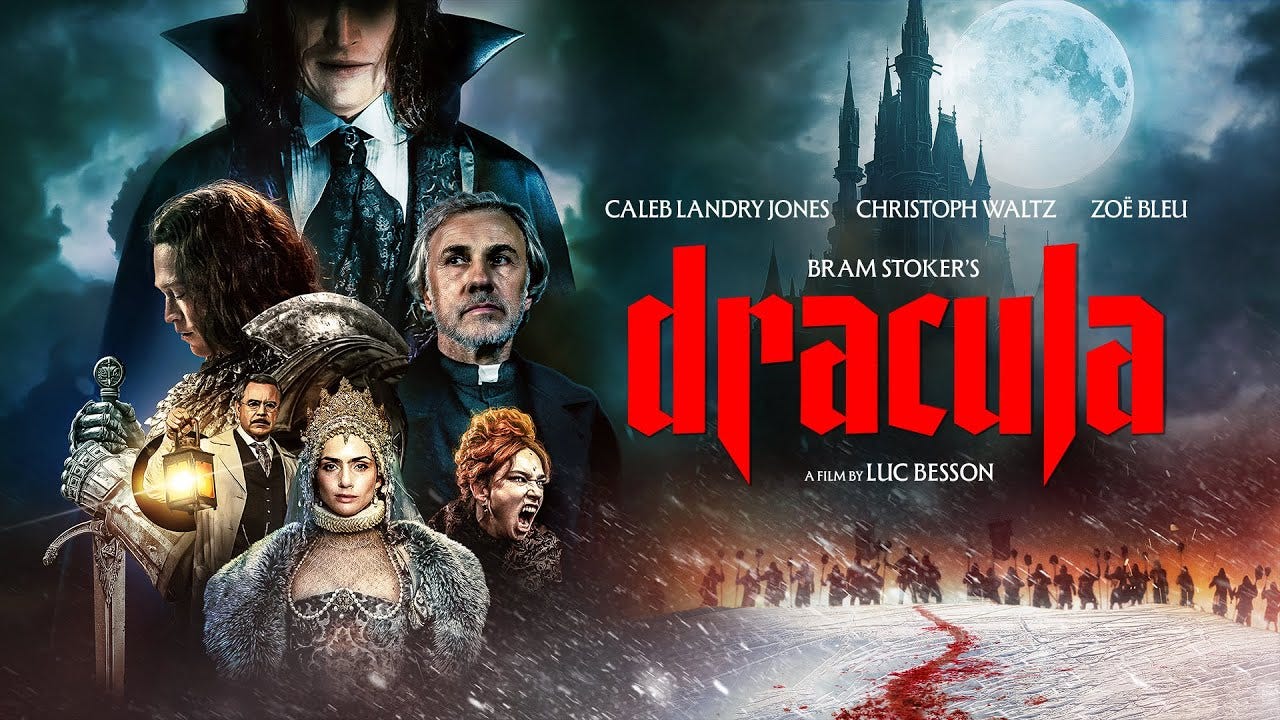
Written and directed by Luc Besson
Starring Caleb Landry Jones, Zoë Bleu, Christoph Waltz
Distributed by SND (France)
Running time: 129 minutes
Rated R for graphic violence and brief nudity
Author’s note: This review essay contains spoilers.
Dracula: A Love Tale (2025), arguably director Luc Besson’s most mature and ambitious film to date, elevates itself above most modern movies in two critically important ways: It engages deeply and sincerely with fundamental human values, and it respects its audience rather than lecturing them. It deserves meaningful praise on these grounds, but its reach ultimately exceeds its grasp because it tries to tell a love story without understanding what love is.
Sometime in the 15th century, Romanian prince Vladislav of Wallachia (a fictionalized version of Vlad the Impaler played by Caleb Landry Jones) leads a small army to victory against Ottoman invaders. He takes the field reluctantly; he would much rather be at home with his wife, Elisabeta (Zoë Bleu). They are in their mid-to-late thirties, but their relationship is passionate and youthful in its simplicity. They clearly adore one another, and their conversations imply that they would give up their political power in favor of a simpler life if they could.
While Vladislav is engaged in battle, a small band of Ottoman assassins hunts down Elisabeta, whom he believes has safely escaped the area. Vladislav rushes to her aid when he hears of the attack from a witness, but he is too late to save her.
Vladislav, enraged, confronts the local cardinal and accuses him of failing to “pray hard enough” for God to protect Elisabeta. When the cardinal protests that he is only God’s humble messenger and cannot force God to do anything, Vladislav responds: “Good. I have a message that I want you to deliver to him. Tell your God that, until he brings me back my wife, my life no longer belongs to him.” He then murders the cardinal and desecrates the chapel. For this transgression, God curses Vladislav with eternal unlife as the first vampire, Dracula. Over the next four centuries, Dracula scours the globe, searching tirelessly for Elisabeta, whom he is convinced will eventually be reincarnated.
Like countless stories throughout history, Dracula equates intense passion with love, but these are not the same thing. In the movie’s opening scenes, we see that Vladislav and Elisabeta have strong feelings for one another, but we never see where these feelings come from. Without knowing (or at least being able to reasonably infer) why they love one another, we cannot even say with any real confidence that the story we’re being told is a love story; we can, at best, only take the storyteller’s word for it.
Consider Bonnie and Clyde, who are almost always presented as having been deeply in love with one another. Together, they murdered at least twelve people, threatened and assaulted dozens of others, and stole around $2 million (in 2026 dollars). Both of them were evil—full stop. Does it make sense to say that evil people can experience true love? Most people can sense that there is something deeply wrong with such a claim, even if they can’t articulate why.
Now consider Aragorn and Arwen from Lord of the Rings, arguably one of the best examples of romantic love in fiction. Both are exemplars of outstanding moral character, and both fight to shield Middle-Earth from Sauron’s relentless malice. They treat one another and their friends with sincere affection, respect, and kindness. They want nothing more than to live a peaceful life together, but both are willing to die, if necessary, in defense of the good, the true, and the beautiful. Undeniably, the love shared by Aragorn and Arwen is romantic love in its purest form—its only real form, in fact. Does it make any sense to use the word “love” both in reference to them and to Bonnie and Clyde?
The essential (but not the only) element of romantic love is deep admiration of and respect for another person’s rational, life-serving values and character. Romantic love is a combination of such admiration and respect, and of physical (usually sexual) attraction.[1] Without the former, the latter is nothing but infatuation or lust.
Throughout Dracula’s two-hour runtime, we see very little of Elisabeta’s moral character. In contrast, we learn a lot about Dracula’s character—and most of what we see is not good. He is driven by obsession bordering on lunacy, utterly indifferent to the hundreds of lives he destroys in pursuit of his goal. Realizing that finding the reincarnated Elisabeta on his own is impossible, he creates dozens of vampires to aid him in a worldwide search spanning centuries, condemning each of those people to the same eternal, unbearable curse from which he himself longs to be released. Perhaps Vladislav was a good person before Elisabeta’s death; we should concede that that is possible, and her love for him may initially have grown from genuine and legitimate admiration of his character. However, even if Vladislav was deserving of love before her death, he certainly is not afterward.
After four hundred years, Dracula’s search comes to an end when he meets Mina Murray, who looks identical to Elisabeta but is engaged to Jonathan Harker (Ewens Abid). He inserts himself into Mina’s social life, carefully observing her mannerisms to ensure that she is indeed Elisabeta reincarnated. Once he is certain, he gives her a music box that he originally gifted to her before her death, and the melody reawakens her memories of her past life. When she learns what Dracula has become and of the atrocities he has committed in her name, she responds not with moral revulsion but with desperation: She begs him to turn her into a vampire so that they can be together forever.
Here, Dracula displays a glimmer of moral clarity for the first of only two times in the film. He initially refuses to turn her, saying “You have your whole life ahead of you, and I only offer death.” When she persists, he relents, condemning the woman he supposedly loves to the same endless pain he originally brought on himself and has since forced on so many others. It should go without saying that true love precludes inflicting horrendous, long-term suffering on one’s partner, no matter how great the immediate temptation or perceived short-term gain. True love requires thinking deeply and carefully about the long-term well-being of oneself and one’s partner, and about what is required to achieve and maintain the well-being of both partners in reality, in harmony with one another and without contradiction or rationalization. It requires taking all of this seriously and acting accordingly, consistently over time. True love is a profoundly emotional experience, but it is not solely an emotional experience; it depends on and requires rational thought. “Love” that defies reason—and thereby inevitably undermines or even destroys the well-being of either partner or of anyone else—is not love in any meaningful sense.
When Dracula retreats to his castle with Elisabeta, Harker and an unnamed priest heavily implied to be Van Helsing (Christoph Waltz), who has been hunting Dracula for decades, gather a small army of Romanian soldiers and assault the castle. Dracula kills dozens and vows to kill all who come after him or his wife. When only Van Helsing is left standing, he and Dracula share the best dialogue in the film:
Dracula: So you are the priest who has chased my people for so many years.
Van Helsing: Yes—but rest assured, I didn’t come to fight you.
Dracula: Nor I. I fight God; I’m not interested in his servants.
Van Helsing: No. You’re not fighting God, my son. You’re fighting yourself.
Dracula: No. No, no. I fought and I killed in his name.
Van Helsing: We live and we breathe in his name. Why would he want us to destroy his creation? Man kills in his own name—and you’re doing it again.
Dracula: That is all just very fine words. God sent you here to kill me.
Van Helsing: God sent me here to save you.
Dracula: So God wants to save me now, after he denies me the right to die for centuries?
Van Helsing: But this is not a punishment. This is an opportunity. Repent, Dracula, for your salvation.
Dracula: She is my salvation.
Van Helsing: But you are her damnation.
They are interrupted when more soldiers arrive and renew the assault on the castle. Dracula, appearing to seriously consider Van Helsing’s words, kills more soldiers but ultimately surrenders when the priest corners him once more and says simply: “Save her.” Dracula allows Van Helsing to mortally wound him, which breaks the curse of vampirism and makes Elisabeta human once again, along with the other surviving victims of Dracula’s power.
As Dracula is dying, Elisabeta, beside herself with grief, asks why he would choose to leave her behind just as they finally have been reunited. His last words to her are: “Because I love you.”
Narratively, Dracula’s sudden change of heart doesn’t work because it’s unearned; it happens too quickly and with far too little internal struggle on his part. Such an extreme one-eighty does not believably transpire in a matter of minutes after four hundred years of single-minded obsession.
Rushed ending aside, Dracula does have something important to say, although its message has little to do with love. Dracula’s final act, morally speaking, is not nearly enough to redeem his past sins—but it’s not nothing, either. The film makes important points about free will, partial atonement, and imperfect justice, but it ultimately fails as a work of art because its actual theme diverges sharply from its intended theme. Its actual theme—the central idea that integrates and follows logically from the events of the plot when all the characters’ actions are considered in full context—is something along the lines of “Not all evil men are completely beyond redemption.”
The movie’s intended theme—something like “the power of love as a force for good”—could not have followed from the events of the plot nor been earned artistically, even under the best of circumstances, because Besson (who also wrote the screenplay) does not understand what love is and what it is not.[2] Love—real love—is one of the highest and most precious values possible to man, and consistent moral virtue is the only foundation on which it can be built. A single act of sincere atonement at the end of a lifetime of wanton butchery is not morally worthless, but neither is it remotely akin to an act of real love.
Despite its fatal thematic flaw, Dracula is a well-acted and beautifully filmed tale of obsession, hope, regret, and justice (mostly with respect to Harker and Van Helsing in the latter case). It’s worth watching, and it’s one of the better films of 2025—it’s just not a love story. Even though it fails to show us what love is, it shows us with inadvertent clarity what love is not, and that, too, is a valuable lesson.
[1] Romantic love can exist without mutual sexual attraction, but this is exceedingly rare.
[2] It’s possible that Besson understands what love is but nonetheless chose to fundamentally misrepresent it in his screenplay for some reason, but this seems highly unlikely.


