“Hold Back the Night”: The Protomen’s Musical Warning to Stand Up for Freedom
by Thomas F. Walker
As an avid music fan, I’m constantly searching for good music. But I only find exceptional bands—the kind that blow my mind and join my all-time favorites—once or twice a decade.
Recently, one band—The Protomen—excelled beyond anything I’ve heard in the past fifteen years or so. To try to describe this band in terms of genres is somewhat futile. Their sound fuses elements of country, hard rock, electronica, progressive rock, blues, and several other genres. They took influence from Queen—a band they started their career by covering—by focusing on expressing their own artistic ideas rather than trying to fit into a particular genre. “Queen was independent in that they didn’t care about genre, they just wrote good songs,” said a band member in one interview. “In the end, no matter what genre or how you play the song, it’s still gonna sound like you.”1
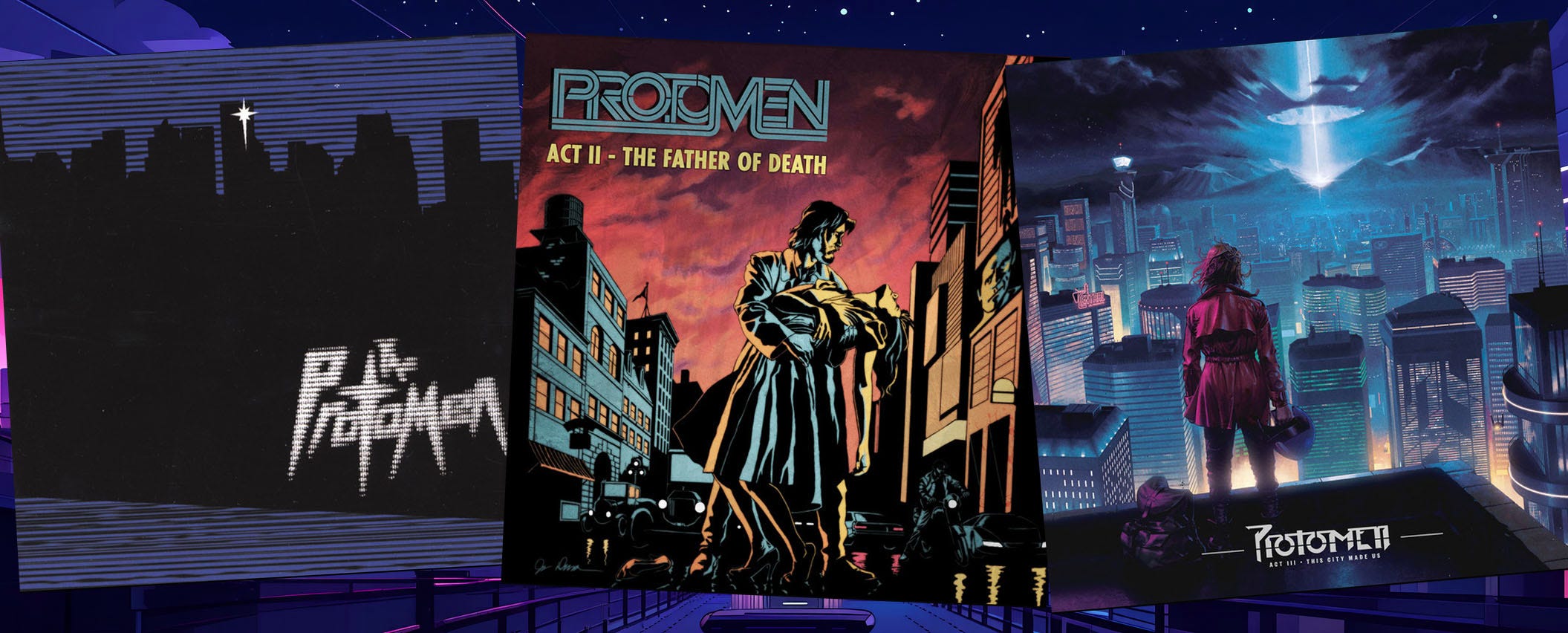
The more useful way to describe what The Protomen make would be something like “story rock” or “rock opera.” Their three main albums are as much works of fiction as works of music; The Protomen (Act I), Act II: The Father of Death, and Act III: This City Made Us together form a grand dystopian story that can only be fully appreciated on repeat listenings while reading the lyrics. The band included passages of prose among the lyrics (found in the CD liner notes or online)—these are designed to be read during the instrumental and soundscape sections of the albums, moving the story along between the lyrical sections.
Each album has a distinct style and tells a separate chapter of the overall story, so it’s worth looking at each in turn to get a sense of the richness, musically and philosophically, that The Protomen offer.
The Protomen (Act I) (2005)
The first album throws us into a dystopian world loosely based on that depicted in the Mega Man video games. But whereas the games follow the titular superhero as he battles the robot army of the evil Dr. Wily in an effort to restore peace to an embattled world, The Protomen establishes a much darker setting—a city in which the population has given up on freedom. The opening narration sets the scene over an accelerating beat:
No one was left who could remember how it had happened
How the world had fallen under darkness
At least no one who would do anything
No one who would oppose the robots
No one who would challenge their power
Or so Dr. Wily believed . . .
That sets off the opening track, “Hope Rides Alone,” in which we meet Wily’s former associate Dr. Light, “an eccentric and brilliant man . . . a loner, a thinker, a man of ideas—ideas forbidden in Wily’s society.” Light creates the part-man, part-machine Protoman, a hero “hell-bent on destroying every evil standing between man and freedom” to save the city from Wily’s robotic tyranny.
Toward the end of the song, the core theme of the album starts to come through. Light wants to save the city, but the people don’t want saving—they are too apathetic and dejected to fight for freedom. They stand by and watch Protoman get pummeled by Wily’s robots, and the song ends with a crowd chanting “We are the dead”—a direct reference to George Orwell’s 1984—as they look upon the beaten hero who could have saved them.
In the third track, “Unrest in the House of Light,” we follow a grief-stricken Light as he sings about his previous “son”—Protoman’s forerunner, Mega Man—who suffered much the same fate. Light tries to dissuade Protoman, who wants to continue the fight:
For if you leave now, you will be fighting
For a people that refuse to comprehend
They have chosen their own end
Unlike the opening two tracks, which have a lo-fi, almost industrial sound symbolizing the mechanistic inhumanity of Wily’s regime, the third track is a gently swinging country song with the sombreness befitting Light’s dismay at the people’s continued lack of appetite for freedom and his remorse at his part in creating this society (detailed in Act II). Throughout the rest of the album, the style continues to change, although generally returning to an alt-rock sound reminiscent of early Muse. Also adding to the variety are the different singing and speaking voices that the band members use to capture the characters of Wily, Light, Protoman, and Mega Man, who often exchange dialogue during the songs.
Thematically, the album continues to explore the questions of whether a hero should fight for people who don’t want saving and whether a few voices for freedom can overcome a mass who willfully live at the feet of a dictator. Those people rouse, not at the appearance of a hero, but at the regime’s broadcast chant of “We have control, We keep you safe, We are your hope.” All three albums are, in their own ways, tragedies, and the tragedy of the first album is that Light is trying to use technology—Protoman—to solve a philosophic problem: the apathy of the city’s population.
Act II: The Father of Death (2009)
With Act I depicting a society clearly unready for change, one might expect its sequel to progress the story to a later stage, but instead Act II is a prequel, showing how Wily’s society came to be in the first place. After a short instrumental, it opens with “The Good Doctor,” a far cleaner track than any on the first album that signals this album’s higher fidelity production. The song is a slow, melancholy ballad backed up by a somber string section that follows a conversation between Light and Wily, both inventors looking to change a society in which many (including Light’s father) work to their deaths in toxic mines. They design robots capable of replacing men in the mines and extracting far more of the resources the city needs, but whereas Light is content with this, Wily wants to turn the robots into tools for controlling people and achieving his vision of an orderly, centrally planned society.
The first chorus is sung by Light, but the second features Wily responding to him—an example of a technique The Protomen often use called “overlapping polyphony” in which two voices deliver the same section at the same time, offset enough that each can be understood but with some overlap as though the two voices are competing to dominate the song:
They’ve waited so long for this day
(They’ve waited so long for this day)
Someone to take the death away
(There is no price they wouldn’t pay)
No son would ever have to say
(For someone else to lead them)
My father worked into his grave
As the song concludes, the two characters get to the root of their philosophic disagreement—their differing views of human nature:
I only want to help . . .
(You are a fool!)
You underestimate the character of man
(They are weaker than you think!)
You think that they’ll surrender
If you bind their working hands
But they are strong!
(Just wait and see . . .)
We will build cities in a day
(Men would cower at the sight!)
We will build towers to the heavens
(Man was not built for such a height!)
We will be heroes!
(We will BUILD heroes!)
The two singers “playing” the two characters imbue them with different qualities, helping accentuate their differences. Raul Panther III (all Protomen members use stage names) gives Light a deep, reflective, Johnny Cash-esque voice whereas Turbo Lover gives Wily a shrill, barely controlled style in which his madness regularly breaks through. This album also introduces Gambler Kirkdouglas, who not only adds a female voice (voicing Light’s girlfriend and Wily’s heartthrob Emily) but brings a more operatic style to the mix, her vocals soaring above the male voices at times while bringing a raspy, hard-rock energy to other parts. Her character’s inclusion personalizes the human cost of Wily’s regime and of Light’s efforts to oppose it, which place her in the line of fire. Later in the album, the two men’s conflict becomes as much about her as about the city itself.
With this album, the band’s Nashville roots come through strongly. In place of the first album’s industrial sound, this one features more acoustic guitar, piano, and slide guitar, giving it a much more Southern sound that also drifts into Ennio Morricone-esque Western territory at times. As the story progresses, more styles come into play, often capturing the spirit of the character each song is focusing on. “The Hounds” (focusing on the increasingly maddened Wily) features circus-like trumpets blasting over a danceable, pulsing rhythm, after which “The State Vs. Thomas Light” returns to a thoughtful, orchestral sound. Later, as the conflict between Light and Wily intensifies, the songs get faster and adopt more of a 1980s-inspired synthwave style, exemplified best in the songs “Break Out” and “Light Up the Night.” This sound points the way to the band’s third album, for which fans—aside from a tantalizing preview in the form of the 2022 stand-alone single “The Fight”—would have to wait seventeen years.
Act III: This City Made Us (2026)
Act III is the culmination of The Protomen’s story—not just of the literal story that the three albums tell but also of the band’s musical growth. Here, they perfectly realize their fusion of upbeat hard rock and expansive, synthwave electronica. Taking place some years after the events of Act I, it introduces a new, unnamed character: a budding revolutionary (also voiced by Gambler) who, much like Light before her, is determined to bring about a change for which the passive masses aren’t prepared to fight.
The story kicks off with “Hold Back the Night,” a galloping revolutionary anthem driven as much by Gambler’s energetic, soaring vocals as by the driving guitars, synths, and percussion. After each verse describing her struggle to survive in Wily’s world, she opens each chorus by bellowing “But I know a hero will come!” This refers to the aging Light, whose distant figure she has seen observing the increasing disorder as some of the young people start to oppose Wily’s control. Eventually, after she finds Light during a slowed-down instrumental interlude, he bursts into the song with a counterpoint to her optimistic choruses, driven by his deep regret over his part in creating Wily’s world:
But all of your heroes are gone
And the blood that they spilled is on my hands
A darkness will block out the sun
Not a thing can be done with so few men
That a hero couldn’t do!
She responds to his guilt with an appeal to his sense of responsibility:
When the voice from the shadows calls you
When the wind whips past your ears
Will you stand when the weight is upon you
Or will you go to your knees in fear?There’s a chance, though I know it’s a long shot
And the city’s out of time
All for naught if your heart stops beating
’cause you’re the only one that keeps it alive
God, keep it alive!
Then, in the final chorus, the two voices debate in another instance of overlapping polyphony, driving the song to a powerful release of energy in its conclusion.
Following the example of “Hold Back the Night,” most of the album is brighter and more upbeat than its predecessors. Whereas the previous albums focused heavily on the consequences of widespread apathy about freedom, this album focuses more on the fact that hope endures as long as some are willing to fight.
With fifteen tracks, This City Made Us is a rock opera in its own right, taking us on a whole journey of a grassroots revolution and a state’s efforts to suppress it. This is The Protomen at their most Orwellian (a descriptor the band readily embraces), with the full apparatus of Wily’s regime directed at not merely suppressing the dissidents but also turning the masses against them with false-flag attacks and incessant, inescapable propaganda.
The dramatic story that The Protomen tell across their three-album series is a tale of individuals with a vision of freedom fighting against collective apathy. In a recent interview, the band members expressed their sadness that real events have paralleled the story they set out to tell in 2005, demonstrating the difficulty of motivating people to stand up for important values in a society driven by groupthink and emotionalism:
Our storyline that we’ve been writing all these years is happening all around us now. . . . As a human being in the year 2026, I didn’t know that I could get more jaded with society than in 2005.
Our first record is very much about the failure of mankind as a whole to rise to heroism or to rise to the place that they needed to be—the lowest level of making an effort. So we started out from that place and I think as we’ve gone through the acts, we try to keep hope alive. Even if it perhaps gets more and more difficult to do it, it’s still there. You have to search for the hope. That’s really what it comes down to.2
The Protomen’s rock opera series is a musical voyage exploring responsibility for one’s choices, the human cost of tyranny, and the nature of heroism. It ultimately conveys the theme that whatever physical strength a hero may possess, freedom depends on a substantial number of people understanding its importance. On the surface, it’s a riveting story told through colorful, complex, emotionally charged music. On a deeper level, it’s a warning to stand up for freedom and human life before it’s too late.
Andrew Johnson, “Third Shift Spotlight: The Protomen Interview,” No Country for New Nashville, February 28, 2013, https://nocountryfornewnashville.com/2013/02/28/third-shift-spotlight-the-protomen.
Tony Mantor, “Protomen: Music That Defines Rock Opera, Rebellion, and Rhythm,” Almost Live . . . Nashville, March 17, 2026,
.


