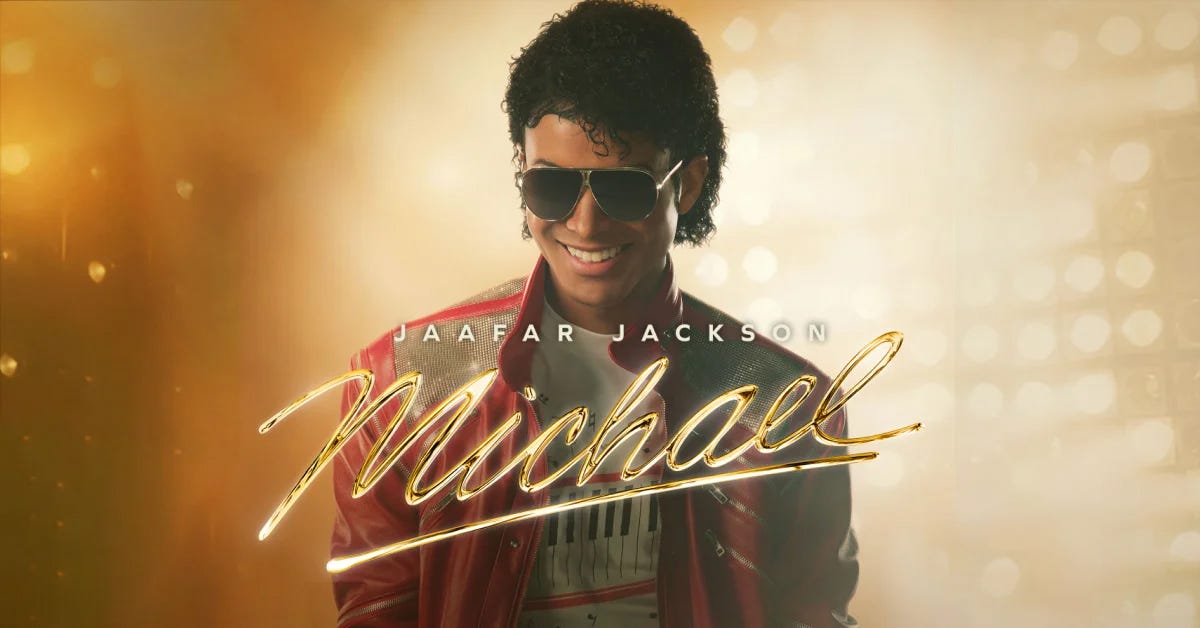
Injustice against Michael Jackson Continues in Critical Backlash to Michael (2026)
by Tim White
Written by John Logan
Directed by Antoine Fuqua
Starring Jaafar Jackson, Nia Long, Colman Domingo
Distributed by Lionsgate Films (United States)
Running time: 127 minutes
Rated PG-13 for language and brief violence
In February 2020, I published an in-depth critical analysis of the child abuse allegations against Michael Jackson that took nearly one thousand hours to research and write. I concluded decisively that Jackson was innocent and that his acquittal was entirely just; every single accusation of child abuse made against him was either proven to be impossible, completely unsubstantiated, or in a few rare cases, “supported” only by the most threadbare wisps of circumstantial evidence (and even that is debatable). When Michael, a musical biopic about the King of Pop, was announced, I was eager to gauge both its factual accuracy and its artistic merit.
The film opens in 1966, when Jackson was eight years old. By then, the Jackson 5 already had been practicing and performing small gigs for at least three years. Jackson’s abusive father Joe (Colman Domingo) drills the five boys relentlessly and beats them—Jackson in particular—for trivial mistakes. Within the first few minutes, we are treated to an unexpectedly skilled re-creation of young Jackson’s (Juliano Krue Valdi) singing voice. Valdi, who was just nine years old during filming, is an incredible singer with nearly perfect pitch, and his performance foreshadows a level of craftsmanship rarely seen today—one that the film’s musical numbers maintain throughout its duration.
For a biopic about a man who was unquestionably one of the most skilled singers and dancers of all time, singing and dancing that are merely “good” would not do. Jackson’s real-life nephew, Jaafar, portrays the adult version of his uncle with uncanny accuracy; his dance moves, his singing voice, his speaking voice, and even his subtly nervous facial expressions are so dead-on that, at times, one forgets that it’s not Jackson on screen.
Although Jackson’s unique style and flawless precision on stage can never be replicated exactly, Jaafar comes as close as anyone could. In most dancing scenes, Jaafar—not a stunt double or professional dancer—mirrors Jackson’s extremely difficult repertoire with undeniable artistry of his own. His vocal performances, though, are not entirely his. In most of the a cappella numbers, Jaafar really is singing, and his voice is not edited beyond normal audio mixing. In most of the other musical scenes, Jaafar’s vocals are digitally blended with Jackson’s for a number of reasons, one being the sheer infeasibility of asking him to do justice to his uncle’s singing while dancing at the same level, which would be vastly harder than most people realize.1 Jaafar deserves thunderous applause for achieving the nigh-impossible task of filling Jackson’s shoes, and overall, his performance is excellent, especially for a first-time actor. Domingo also deserves special praise for his chillingly faithful portrayal of Jackson’s sinister and psychologically broken father.
Clearly, one of the filmmakers’ overarching intentions is to humanize Jackson by providing context for some of his more questionable decisions. Importantly, the film does not seek to justify or rationalize any of Jackson’s choices—only to explain them. At this, it largely succeeds, if inelegantly at times. For instance, in one scene, a thirteen-year-old Jackson protests when his mother initially denies his request for a pet llama: “[These animals] aren’t my pets, mom. They’re my friends. No one else gets me, but they do.”2 Rather than trusting the audience to infer that Jackson’s proclivity for animals over people stemmed in part from the fact that nearly every person in his life wanted to ride his coattails, the writers chose to have Valdi exposit this in a somewhat ham-fisted way. In another, better scene, Jackson examines his own body without saying a word, and his subtle facial expressions reveal his growing discomfort with what he sees. We then cut to a shot of him in a medical exam room, and when the doctor enters carrying a marker, we understand without exposition: This is a plastic surgery consult.
The plastic surgery scenes are among several that show Jackson as he really was in psychological terms: a benevolent and good man whose questionable decisions were heavily influenced by severe, unresolved childhood trauma. Jackson’s obsession with plastic surgery was not motivated by vanity, as many believe; rather, it was tied to much deeper self-esteem problems that were not his fault.
In this area, as in many others, Jackson was a complex and conflicted man. In certain respects, his self-esteem was apparently healthy; in one scene in the film, he acknowledges his own musical genius in an endearingly matter-of-fact way but refuses to release an eponymous album because it would be “too egocentric.” In other respects, his self-esteem is clearly damaged in ways that are shown to be rooted in his relationship with his father. Joe demands flawless excellence of his children and flies off the handle over the most trivial mistakes or acts of disobedience, and as a result, the boys—Jackson in particular—internalize a deep-seated intolerance for imperfection. When Jackson first begins to show symptoms of vitiligo in his late teens, he sees it not as a harmless cosmetic quirk but as something wrong with him. His nose, like most people’s noses, is ever so slightly asymmetrical, and here, too, he sees not normal human variance but an inexcusable defect. In his mind, stars with perfect pitch and perfect dance moves must also look perfect—and unlike the vast majority of entertainers, Jackson actually was a grandmaster of his craft. Whereas many celebrities seek plastic surgery in an attempt to compensate for their deficiencies of skill or character, Jackson sought integration of his appearance and his earned mastery. This is a telling and extremely important aspect of his psychology that helps rational, attentive viewers properly contextualize some of his other odd choices.
Like a great many movies released in the past decade, Michael is adored by audiences and largely panned by critics. As of this writing, the movie holds a 97 percent “fresh” audience rating compared to a 37 percent “rotten” critic rating on Rotten Tomatoes, where many critics are complaining that no period of Jackson’s life is explored exhaustively and that this makes the film “shallow.” Another common related complaint is that the film is inaccurate or misleading because it changes certain minor details, such as showing the Jackson 5 performing “Never Can Say Goodbye” in 1968 (the song was written in 1970). This was most likely an intentional choice on the filmmakers’ part, not an oversight, and in the context of biopics, such choices are legitimate and well-reasoned more often than not. Perhaps a licensing issue limited the choice of songs that could be used in this way, or perhaps it was an easier song for the actors to learn and perform on a tight filming schedule. Whatever the reason, it’s simply false to say that altering minor details is misleading. (If altering a given detail would lead a reasonable person to a substantively different conclusion, then the alteration is, by definition, not minor.)
Even more critics are taking issue with what they call, in varying terms, Michael’s “overly sanitized” presentation of Jackson’s life, claiming that ending the film before the abuse allegations constitutes dishonesty. One “verified” critic (whatever that means) writes, “Michael’s disingenuously airbrushed style is directly related to the material [the Jackson estate] can’t and likely never will put on-screen; they’ve found their voice and have the resources to amplify it in Dolby Atmos.”3 Another writes, “Failing the honesty test, Michael fails the ‘portrait of the artist’ test as well.”4 Given the nature and purpose of the film, complaints about it being shallow are invalid, as are those about its supposed dishonesty; let’s take each kind of complaint in turn.
A biopic, like all forms and genres of film, is a specific thing with a specific scope and purpose. A biopic is a dramatized portrayal of the most important parts of its subject’s life—or only a portion of his life—and its purpose is to present a detailed but necessarily incomplete sketch of that person that is broadly accurate and faithful to his character. A biopic is not a perfectly accurate retelling of the real story in its entirety—and it isn’t supposed to be. An entirely factual film about a real person is a different kind of film: a documentary (and even a documentary is not obligated by its nature to exhaustively cover every major aspect of its subject’s life; in fact, most don’t).
One reason to choose to make a biopic over another kind of film is to gain a modest degree of creative liberty, which is honest and valid so long as no major and contextually relevant facts are misrepresented or omitted from the span of time that the filmmakers choose to cover.5 Another reason is to make it possible to condense decades of the subject’s life into a two-hour runtime; sometimes, filmmakers simply can’t portray the exact chronology or form of certain events as they occurred in real life because doing so would require devoting an unjustifiable amount of screen time to minor details. Those who criticize Michael for not being a documentary are simply holding it to the wrong standard; those who criticize it for not covering every major aspect of his life are holding it to an impossible standard.
The elephant in the room is, of course, the child abuse allegations, which are not mentioned in the film. Like many (if not most) of the people who believe that Jackson was guilty of child abuse, those who criticize the film on this point are dropping critical context. Michael deliberately ends in 1988 (the year in which the alleged abuse began), but the filmmakers did not make this choice as a way of avoiding controversy. In fact, their original plan was to engage the controversy directly, and they acted on that plan until external factors required them to change it. A previous version of the script opened in 1993 with Jackson being investigated by police in relation to the Jordan Chandler case, and the filmmakers shot “a tremendous amount” of footage related to that part of Jackson’s life.6 However, after principal photography was completed, a clause was discovered in Jackson’s real-life legal settlement with the Chandler family that forbids any mention or depiction of Jordan in any movie produced by the Jackson estate. The filmmakers then had to rewrite the script almost entirely and shoot hundreds of hours of new footage; all in all, the rewrites and reshoots cost $15–$20 million, according to sources who worked on the film.7
Even if the original script had not dealt with any of the abuse allegations, that still would not constitute a dishonest decision because the final film ends before any of the alleged abuse took place. Honesty doesn’t require filmmakers to deal with the abuse allegations in every film about Jackson as a blanket policy regardless of context, just as it doesn’t require any other artist or biographer to cover every controversy in every work about any other subject. Honesty is the refusal to fake reality—the refusal to pretend that facts aren’t facts or that falsehoods are facts. It also includes the refusal to pretend that contextually relevant facts are irrelevant or vice versa. “Contextual relevance” is the key criterion here; virtually all facts are relevant in certain contexts and not others.
Michael’s decision to omit the abuse allegations would be dishonest only if the filmmakers had claimed or implied that the film covers Jackson’s entire life or otherwise is meant to be a comprehensive overview of every significant event therein. They did neither; they presented the film as a biopic limited to one half of Jackson’s life and as a tribute to his legacy, and it clearly is both of those things.
Michael does, however, strongly imply a sequel: A title card before the ending credits reads, “His story continues.” Lionsgate executive Adam Fogelson told The Hollywood Reporter in 2025: “While we’re not yet ready to confirm plans for a second film, I can tell you that the creative team is hard at work making sure that we’re in a position to deliver more Michael soon after we release the first film.”8 Assuming that such a sequel biopic does come to fruition, and assuming that it covers the second half of Jackson’s life (it almost inevitably would have to), then, in that context, that film must honestly address the abuse allegations. To omit or downplay the allegations in such a context would be dishonest because they massively impacted Jackson and hundreds of other people throughout that part of his life, and it’s not possible to form an objective opinion about Jackson without an account of the allegations that is both factual and fair.
Knowing as much about Jackson as I do, I can say without reservation that Michael fulfills its goal of honoring his legacy without distortion. It would be incomplete without a sequel—but the absence of a sequel would not retroactively render it dishonest. Dramatically, it’s one of the best films of 2026 to date, and technically, it’s one of the best films of the decade, especially for those who know enough about singing and dancing to fully understand just how good Jackson was (and Jaafar is). Like Jackson himself, Michael has both adoring fans and apoplectic critics—and like Jackson, the film is something that everyone should experience at least once.
Shania Russell, “Is Michael Jackson’s Nephew Jaafar Really Singing in Michael Biopic?,” Entertainment Weekly, April 24, 2026, https://ew.com/is-michael-jackson-nephew-jaafar-really-singing-michael-biopic-11956516.
This quote is paraphrased because I don’t yet own a copy of the film for reference.
Adam Nayman, “‘Michael’ Is a Vain Account of the Man in the Mirror,” The Ringer, April 24, 2026, https://www.theringer.com/2026/04/24/movies/michael-jackson-biopic-review-reshoots-mj.
Michael Chaw, “Michael (2026),” Film Freak Central, April 27, 2026, https://filmfreakcentral.net/2026/04/michael-2026/.
Of course, there are borderline cases in which a reasonable argument can be made either way as to whether a given change is major or contextually relevant. In Michael, though, there are no such borderline cases; all factual inaccuracies are minor.
Brent Lang and Rebecca Rubin, “Inside the ‘Michael’ Overhaul: $15 Million Reshoots, Removing Child Abuse Allegations and What’s in Store for Sequels,” Variety, April 7, 2026, https://variety.com/2026/film/news/michael-movie-reshoots-removing-child-abuse-allegations-1236710221/.
Lang and Rubin, “Inside the ‘Michael’ Overhaul.”
Etan Vlessing, “Lionsgate Movie Boss Promises ‘More “Michael” Soon’ Amid Talk of Splitting Michael Jackson Biopic in Two,” The Hollywood Reporter, November 6, 2025, https://www.hollywoodreporter.com/movies/movie-news/michael-jackson-movie-split-1236420598/.


