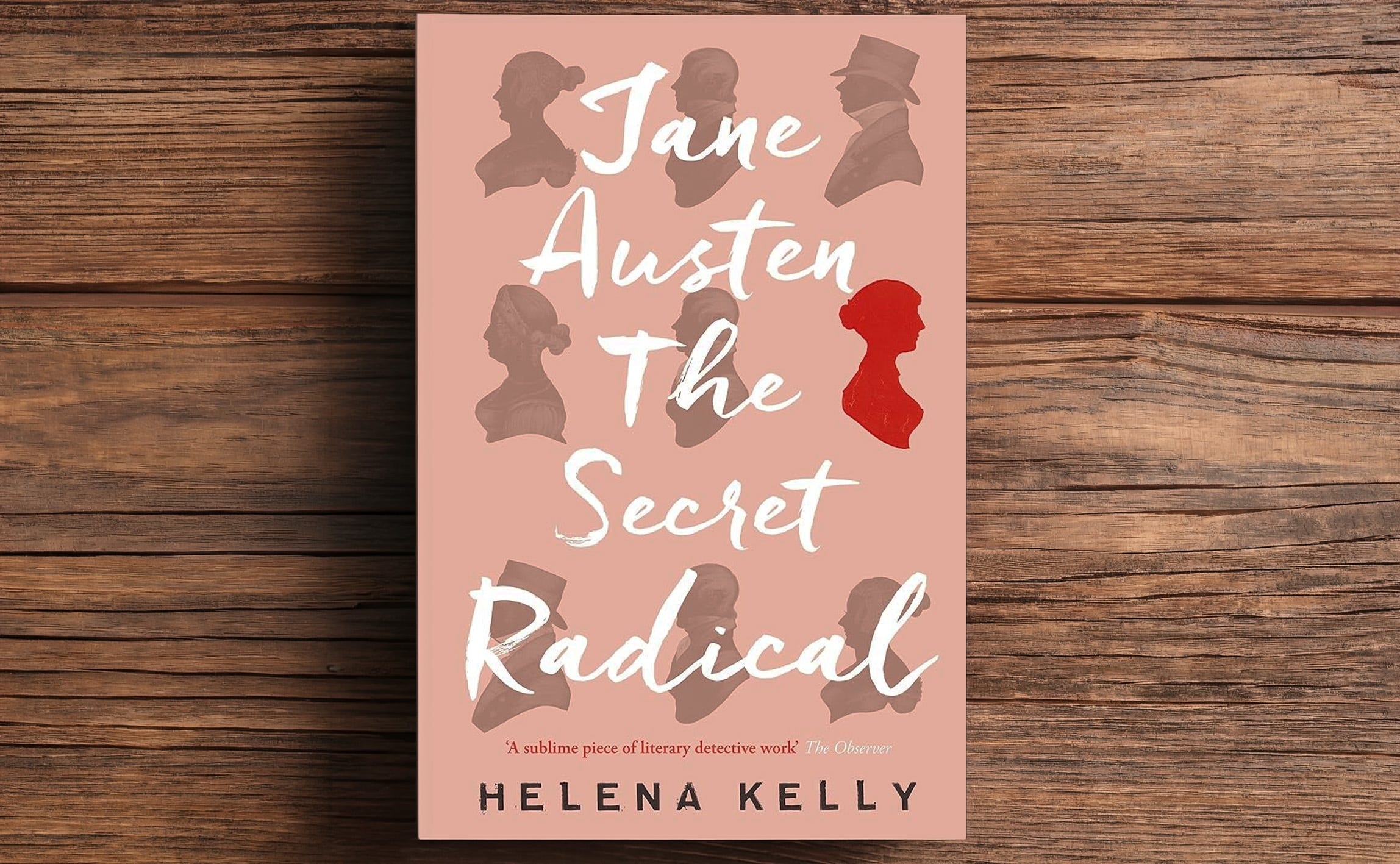
London: Icon Books, 2017
337 pp., $12.04
If you think of Jane Austen novels as light, fluffy romances—think again. Through her happy endings, she imparted essential moral themes, such as the fact that happiness requires knowing when to trust your own judgment (Persuasion) and acting on principle (Mansfield Park).
Such lessons are useful on their own, but many Janeites like to point out that Austen was also a social commentator, mocking and subtly criticizing certain norms and institutions of her day. However, few Austen fans have gone as far into understanding and explaining the substance and mechanisms of that criticism as Helena Kelly, author of Jane Austen, the Secret Radical. Kelly begins by observing two relevant facts about Austen’s life: 1) We don’t know much about it, because few letters or other documentary evidence remain, and the family reports are unreliable (the most famous was written by her nephew four decades after her death); and 2) for most of Austen’s life, Britain was at war.
Most Janeites point out these facts as a matter of mere curiosity or perhaps to highlight a few details of how soldiers and navy men play a role in certain Austen novels. But Kelly homes in on a particular effect of this context: Due to the wars, the British government increased censorship. She explains:
Treason was redefined. It was no longer limited to actively conspiring to overthrow and to kill; it included thinking, writing, printing, reading. Prosecutions were directed not just against avowedly political figures, such as Paine, the radical politician Horne Tooke, or the theologian Gilbert Wakefield, but against their publishers. . . . There can hardly have been a thinking person in Britain who didn’t understand what was intended—to terrify writers and publishers into policing themselves. (22–23)
For this reason, Kelly argues, readers ought to look very closely at the text and at the historical context it was written in, because criticism would have had to be subtle to be allowed at that time. For example, Austen doesn’t criticize the Church of England outright—but nearly all the clergymen she depicts in her works are lazy, gluttonous, pompous, or straight-up ridiculous. The self-important Mr. Collins, for instance, provides excellent comic relief in Pride and Prejudice—but no serious Christian would want him as his pastor. Kelly argues that this context alone justifies a closer look at the text and also quotes Austen’s letter to her sister in which she declared, “I do not write for such dull Elves As have not a great deal of ingenuity themselves” (124).1[1] Austen wanted her readers to be thoughtful and focused enough to take in the layers of meaning she offered, and Kelly aims to show what such focus, combined with some contextual knowledge, can yield.
The Secret Radical’s key strength is its clearly presented, well-researched analysis of the political elements of Austen’s works, based on Kelly’s thorough understanding of the debates and economic policies of the day, relevant British history, textual evidence from the novels, contemporary reviews, and the few remaining letters from Austen herself. Kelly examines each of Austen’s six full-length novels—Northanger Abbey, Sense and Sensibility, Pride and Prejudice, Mansfield Park, Emma, and Persuasion—in this way, aiming to work through them in the order Austen wrote them to provide a rough sketch of Austen’s intellectual development as well as to keep the history chronological. (Kelly acknowledges difficulty in dating with certainty when Austen wrote certain novels and explains her reasons for taking them in the order that she does.) In the best cases, the interpretation she offers enables readers to appreciate the work under discussion on a deeper level.
For example, Kelly argues that Pride and Prejudice should not be seen as only an interpersonal drama with lessons for individual behavior but also as a pattern for how people of different classes at the time should behave toward each other in order to reform society without violent revolution. “Elizabeth and Darcy,” she writes, “were written to be not just characters, but symbols as well” (167). Mr. Darcy, the wealthy nobleman, shows himself to be ready to learn, even from those of lower status than himself, and to correct his manners when necessary. He also symbolically removes the military presence and its associated potential for conflict at the end by arranging a position far away for Mr. Wickham, a militiaman.
Likewise, Elizabeth, a gentleman’s daughter, is willing to speak her mind and learns to judge people only on firm evidence of their character. Mr. Bingley is a straightforwardly sympathetic character who earned his money through trade, a point modern readers may not question or even notice. In the early nineteenth century, the nouveau riche were by no means accepted in many social circles. By showing him not only in a positive light but as being sought after by the Bennet girls and befriended by Darcy, Austen was encouraging the acceptance of such self-made men. Kelly’s interpretation not only integrates with the novel’s central theme (that one shouldn’t allow emotions to distort one’s rational, evidence-based judgment)—it adds a layer of complexity to it. One’s emotions, and especially one’s initial reaction to a situation, are often shaped by the attitudes one has been taught—one’s prejudices (according to some accounts, Austen considered naming the novel First Impressions). Austen encouraged her readers to consider carefully whether that immediate reaction is justified, taking into account not only one’s vanity but one’s social context.
Kelly deals significantly with the political context in which Austen lived and wrote. Politics necessarily affects individuals’ lives and thus often is present in fiction to some degree. But it is one thing to identify these aspects of the background, another to trace how they affect various characters’ motivations, and a much different task to interpret their degree of relevance to the theme of the work. In this last endeavor, Kelly occasionally errs by overemphasizing the relevance of politics to Austen’s themes. For example, she claims that Emma is about poverty created by a rapidly expanding population and worsened (at least in the short term) by enclosure, the controversial practice of landowners getting permission from Parliament to build fences and hedges to stop poor people from gathering firewood, roots, and so on from the land they or their families had been granted by the government. Kelly cites many lines and scenes that refer to enclosure and its effects, such as gypsies being camped in an unexpected place leading to an unsuspecting young woman being accosted by them and twisting her ankle in her attempt to get away. However, Kelly fails to establish that enclosure is anything more than a background force in the novel. Emma is primarily about a young woman learning to better weigh the evidence she has around people’s emotions and not to interfere in others’ affairs of the heart—that each person must choose what is best for herself. This is an important theme that stands alone. Knowledge of enclosure is not necessary to grasp this theme, though such knowledge helps to set up certain aspects of the plot.
Similarly, Kelly’s discussion of Sense and Sensibility focuses on the unfairness of primogeniture, the legally enshrined practice in which, in the vast majority of cases, the oldest son inherited everything when a man died, and any other children and his widow were dependent on that son. Once again, this is extremely relevant to the setup, as it explains how the Dashwood ladies find themselves in the situation they are in—once Mr. Dashwood dies, they depend on the charity of a distant relative to find a decent place to live and must learn to live frugally. They also cannot depend on large dowries to help with their marriage prospects. But the bulk of the action is about the eldest two sisters learning to harmonize their reason and their emotions, one having tended toward self-indulgent emotionalism and the other toward stoic rationalism. Primogeniture, though certainly a target of Austen’s criticism, is not the theme of the novel.
Despite this occasional overemphasis on politics, the context Kelly provides is remarkably useful in enabling readers of Austen to avoid being a “dull Elf” and thus to better enjoy her timeless works. The book is written in clear, accessible language but is scholarly in the way it synthesizes a vast quantity of information from a wide variety of sources. In addition, although it assumes familiarity with all of Austen’s novels, a thoughtful reader with that knowledge will benefit from the demonstration of how to apply historical and political context combined with careful reading to better understand the satire and social commentary in other novels. Readers can certainly enjoy Austen’s works without Kelly’s additional context that enables wider integrations, but it is very helpful.
Jane Austen, the Secret Radical opened my eyes to the interesting, often subtle ways in which this influential author challenged the premises of the world around her. For those who want to get more out of literature, it’s well worth the time.
This line is a paraphrase from near the end of Sir Walter Scott’s romantic poem Marmion.


