

Written by Bong Joon Ho
Directed by Bong Joon Ho
Starring Robert Pattinson, Seven Yeun, Mark Ruffalo
Distributed by Warner Bros Pictures (United States)
Running time: 137 minutes
Rated R for violent content, language throughout, sexual content and drug misuse
“I really hate dying. Still. Always. Every time.”
Wake up. Work. Die. Repeat. Mickey 17 is a sci-fi thought experiment: What if we stopped valuing life, and what would that do to unskilled workers? Mickey 17 addresses these questions by exploring the importance of self-interest in such a context and why one might choose to fight for a meaningful life.
Mickey 17, written and directed by Bong Joon Ho, is a comedic, dystopic techno-futurist film based on the novel Mickey7 (2022) by Edward Ashton. Set in 2054, the plot follows a down-on-his-luck young man, Mickey, who joins a private space exploration mission as an “Expendable” to escape the sadistic mafia boss to whom he owes money.
An Expendable is a disposable employee; Mickey is required to complete fatal missions, often as the sole participant in a scientific experiment, for the sake of keeping the rest of the crew safe. His role is entirely subservient, like a canary being sent into the mines. And when he dies, the scientists on the ship simply “reprint” his body, upload his memories and consciousness, and he does the whole thing again the next day.
The film shows starkly how easily people can lose respect for life. The reprinting started with a semblance of care and consideration from the scientists. In the first reprinting scene, we see a kind of conveyer belt on which Mickey can be reborn comfortably, and one of the scientists even takes care to cover his genital area to maintain his privacy. But as the reprinting continues, they begin to treat him with callous indifference, barely acknowledging his humanity through the process. In a later scene, the scientists neglect to provide the conveyor belt, so Mickey falls to the floor haphazardly. Often Mickey’s missions are preceded by torturous experiences: being injected with incredibly painful diseases, eating poisonous food, and being exposed to toxic levels of radiation. And strangely, no one seems to care.
At one point the scientists trick Mickey into going into space to check a faulty cable. But when he gets there, the lead researcher tells him on the intercom that this was a ploy to get him in contact with high levels of radiation. The lead researcher tells Mickey that he needs to explain every awful thing that he’s feeling so that they can note it and stop it from happening to other crew members, whom they deem more important. He asks Mickey to take off his glove so that they can see what’s happening to his skin, and when he tries to, his hand is sliced off by a blade from the ship’s engines. Instead of the scientists’ expected shock and horror, they all laugh in disbelief, more beguiled by seeing something so extreme than the fact Mickey is suffering.
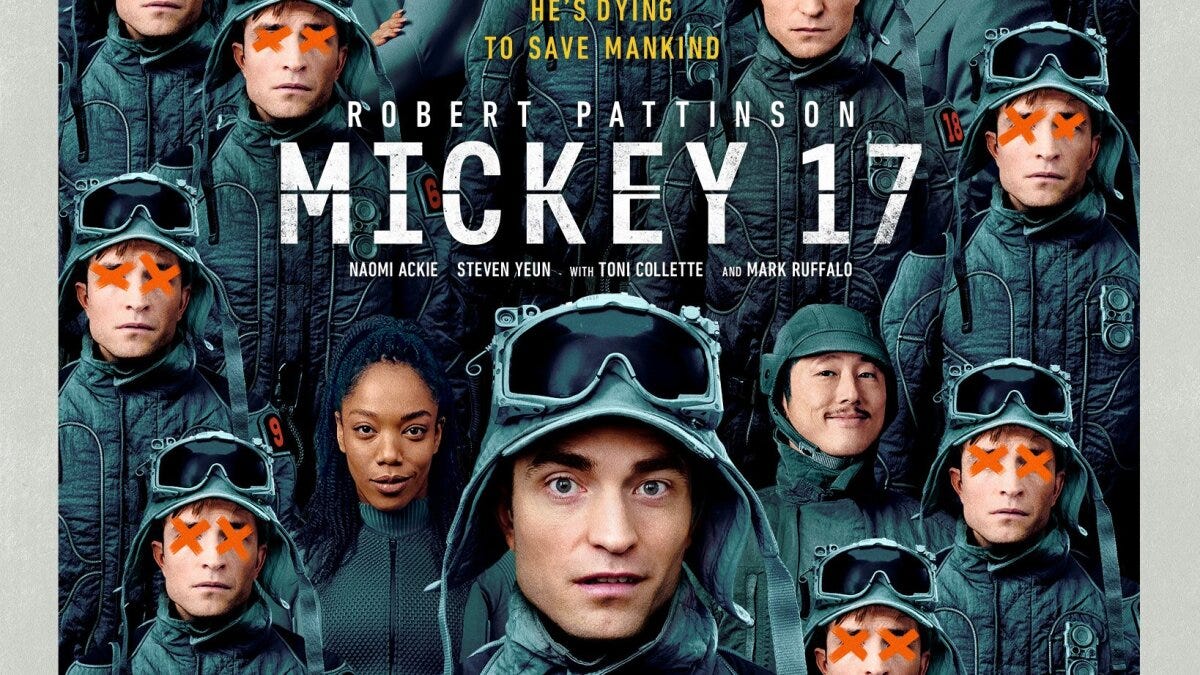
Then one day, everything changes when the scientists wrongly believe that Mickey 17 is dead and print Mickey 18 in his place, meaning that two iterations of Mickey exist at the same time—an illegal scenario and ethical dilemma.
Mickey 18 is everything that Mickey 17 is not. The contrast exposes the failures of the human printing technology. It promised to create an identical copy after death, but all the clones vary slightly in their personalities—its designers had not accounted for the depth and variety of the subconscious.
Mickey 18 is not just a cloning error; he is a significant outlier. He brings a new perspective to his role that seemingly no other Mickey has done before: He assesses his position and concludes that he deserves more. He is appalled by his crewmates’ treatment of his life and becomes angry and vicious, yet he acts decisively and defends his survival. He tries to kill a fellow crew member with whom Mickey 17 had joined the ship and had a long-standing friendship before the mission because Mickey 18 blames him for his subjugation.
The Mickeys debate, physically fighting over who should stay alive because if they are found to exist at the same time, they both will be killed and Mickey’s lives will be completely terminated—Mickey as such will no longer exist. Mickey 17, understanding this, tries to compromise, offering to halve his workload and meager rations with Mickey 18. Mickey 18 laughs in his face—why should he only get half when he is entitled to it all? And more importantly, why should he do this horrible job in which self-sacrifice is constantly required with little gratitude when he could take revenge and be free?
Mickey 18 soon becomes the hero—a person committed to rational thought and uncompromising integrity who lives for his own sake, even in the face of danger or death. Because Mickey 17 is the complete opposite, the stark differences between these two characters who should be identical reveal the film’s paramount question: Why does Mickey 17 accept his fate instead of fighting against it for his own self-interest?
The Abandonment of Personal Values: Collectivism versus Self-Interest
Mickey 17 is a victim of this society’s values as we see them on the ship. Aside from a few friends and his girlfriend, no one is appalled by Mickey’s subjugation. His value, to most others, derives solely from his self-sacrifice, and he does not benefit from any of the supposed collective goods that derive from it. He will not get to enjoy the vaccines, the painkillers, the genetically modified meat because it is not for him; his sacrifice is for the good of the rest of the ship.
Throughout the film we can see the society’s collectivist undertones—people value each crew member based only on how well he fulfills his role. This affects even the highest ranked; for example, when the head scientist realizes that he hasn’t produced edible genetically manufactured meat, he offers to kill himself as punishment, as easily as one might offer to stay later at work after a mishap. The charges thrown against collectivism by philosopher Ayn Rand apply here—it upholds the existence of a mystic and unperceivable social organism while denying the reality of actual individuals.1[1] This mystic social organism serves as a spiritual replacement for the individual’s life. That is, individuals are made to live their lives for their society instead of for themselves, much in the same way that Abrahamic theologies urge individuals to live their lives for God or in God’s image.
More specifically, Mickey’s belief in sacrifice and suffering as a constructive force for good resembles John Hick’s theory of the value of “soul-making.”2[2] Hick preached a belief that humans were created as imperfect so they could grow into the “likeness” of God through suffering. This, in turn, he argues, would allow us to develop virtues that are more meaningful than if they had simply been imparted by God.
Although Mickey 17 isn’t explicitly religious, this theology expresses itself in his baseless yet absolute belief that he is bad, and he alone cannot ensure his salvation. So, instead of thinking critically or pursuing his interests to form a better relationship with himself and his past, he uses severe punishment to become “good.”
His belief in an innate badness is irrational, an irrationality that fuels his selflessness. He has accepted without much thought that he was responsible for his mother’s death, even though he wasn’t. As a child, he begged his mom to let him sit in the front seat of her car even though he was too young, and she eventually acquiesced despite significant hesitation. While they were driving, he pressed a red button simply to see what it would do, which sent the car hurtling into a wall, killing his mother instantly but leaving him unharmed. His lack of injury is the source of his guilt, which snowballs so that every other guilty feeling he has compounded into the belief that he deserves to be punished. So, on the ship, he readily accepts his treatment. When he is poisoned by the scientists against his will, he says it’s because he didn’t tell his girlfriend straight away when he found out about Mickey 18. When he is being exposed to unthinkable levels of radiation, he says that in fourth-grade science he “messed with a frog,” so this all must be his punishment.
Mickey 18, on the other hand, doesn’t seem to be burdened by the same ideas. He wants to kill anyone who has done the Mickeys wrong. He is infallible when Mickey 17 can be weak and easy to overpower; even when the whole ship seems to be against them, Mickey 18 holds strong, which influences Mickey 17 to see his point of view.
I read once that a drama is when you watch a film and think, “What if?” What if he caught her at the airport in time, what if they managed to jump out of the flaming building, what if she could save her baby? Whereas a tragedy makes you think, “If only!” If only Romeo had known that Juliet was still alive, if only Oedipus had known who his real mother was—and if only Mickey 17 could let go of his unearned guilt, he could have avoided so much suffering.
This film is a warning about the horror of sacrificing oneself. Mickey’s suffering shows that abandoning self-interest is not life-promoting or life-fulfilling. He sacrifices himself for the good of his crewmates, hoping to cleanse his spirit of guilt, but all it does is make his situation worse.
Although this film has many layers and meanings, what stood out most to me was the value of self-love; it is not merely an advantage but a requirement to live a happy life. If you don’t value your life, no one else will.
This article appears in the Fall 2026 issue of The Objective Standard.
Ayn Rand, “Collectivized Rights,” in The Virtue of Selfishness (New York: Signet, 1964), 103.
David C. Cramer, “John Hick (1922–2012),” Internet Encyclopedia of Philosophy, https://iep.utm.edu/hick (accessed June 23, 2026).
Given the choices 18 makes, especially at the end, this seems to be a very wrong reading of the story and its intended message.