London: Bloomsbury Publishing, 2015
176 pp. $9.90 (paperback).
Mother Courage and Her Children is widely regarded as a brilliant, clinical dissection of wartime economies and as the pinnacle of epic theater.1 Yet its precise theme masks a profound dramatic failure. By taking away the titular character’s power to choose and using her merely to prove a point, playwright Bertolt Brecht denies her the moral realization that gives tragedy its meaning. What might have been a profound human drama instead becomes a political demonstration—one that replaces the struggle of a person capable of moral choices with the static passivity of an ideological illustration.
Critics praise the play’s intellectual ambition, structural innovation, and use of the “alienation effect,” a technique intended to discourage audiences from becoming emotionally absorbed in the drama and to instead encourage them to analyze the effects of the material conditions at work on stage.2
Mother Courage and Her Children takes place during the Thirty Years’ War and follows Anna Fierling (known as Mother Courage) as she travels across Europe with a wagon selling food, alcohol, and supplies to soldiers. War enables her livelihood; over the course of the play, however, the conflict that sustains her business gradually destroys her family.
At first glance, the structure of the play appears ideally suited to tragedy: A parent attempts to survive within a brutal social environment only to discover that the system she depends on exacts a terrible personal price. In classical tragedy, such suffering leads to recognition; the protagonist comes to understand the moral meaning of her own actions. Aristotle called this moment anagnorisis: a realization that transforms misfortune into insight and gives the tragedy its emotional and philosophic resolution.3 Brecht, however, deliberately denies us this moment. As he argued: “it is not the business of the playwright to arm Mother Courage with insight. . . she is a merchant, and her business is her ruin.”4
His thesis is that war is an economic system that rewards and destroys its participants simultaneously. To underscore the inescapable nature of this system, Brecht ensures that Mother Courage never learns.5 By denying her a moment of realization, he attempts to demonstrate that, once one is profit-bound to the machinery of war, there is no exit. She never confronts the lethal connection between her livelihood and her losses—she simply continues to pull the wagon and so remains a prisoner of her own choices.
This lack of development is a direct result of Brecht’s theory of epic theater. He does not want us to feel empathy for Mother Courage—he wants us to judge her. This distancing effect is established in the very first scene, when the cold logic of the wartime economy is laid bare. A recruiter challenges Mother Courage, singing “Like the war to nourish you? / Have to feed it something too” (13).
With this line, Brecht begins to reveal Mother Courage’s role not as a developing human soul but as a figure driven by the mercenary logic of the battlefield. She acts as a small entrepreneur seeking to profit from the slaughter, attempting the impossible task of remaining morally detached from the very violence that sustains her livelihood.
Nothing illustrates Brecht’s subordination of drama to ideology more chillingly than the death of her grown son Swiss Cheese in scene three.6 When Mother Courage learns that a bribe of two hundred florins can save him, her immediate reaction is not a mother’s desperation but a merchant’s calculation. She pivots quickly to haggling: “Two hundred’s too much for me . . . tell them I’ll pay hundred and twenty florins, else it’s all off” (40–42).
This moment is the structural heart of Brecht’s demonstration. Even with her son’s life on the line, Mother Courage fails to earn her nickname. She attempts to justify her hesitation by claiming that she must “keep a bit back” to ensure that she isn’t shoved into a ditch by the next “Tom, Dick and Harry.” She is so focused on her startup capital for a new life—calculating that, with eighty florins, she could “fill a pack with goods and start again”—that she explicitly allows the murder of her own son. The cost of this economic hesitation is exactly: “Eleven bullets they gave him, that’s all” (40–44).
The scene concludes with a moment that strips the protagonist of her last vestige of humanity. She denies her own son, driven by the belief that her survival and business depend on it. As a sergeant shows her the body and asks “Know him?”, she simply shakes her head. In Brecht’s view, this is the ultimate evidence that the wartime system destroys the human soul. But from a dramatic standpoint, it feels like the conclusion of a mathematical proof. Brecht ensures that the “haggling,” as an army chaplain later describes her cold negotiation, leads to death so that the audience will learn the lesson. By doing so, he succeeds in making a political point, but he fails to allow Mother Courage the moral recognition that would help the audience understand the intellectual point by making them feel the tragedy of her story—which is the entire point of fiction.
Brecht’s ideological point is clear: Mother Courage has become so corrupted that even the life of her child is subject to a financial cost-benefit analysis. But from a dramatic perspective, this scene reveals Brecht’s fundamental misunderstanding of the basic purpose of fiction. The way in which Brecht has his protagonist prioritize her wagon over her son’s life doesn’t explore the depths of human grief or the complexity of a mother’s soul—it is economic soapboxing. He denies her the visceral, desperate response we expect from a parent, ensuring instead that she remains a hollow vessel for his critique of war as the ultimate “capitalist” enterprise.
The reason lies in his theory of epic theater.7 Unlike genuine drama, which gives the audience reasons to identify emotionally with the characters, Brecht seeks in his plays to maintain distance between audience and performance. Songs interrupt scenes rather than adding to or connecting them, as they would in a musical or with a classical chorus. Additionally, narratively fragmented episodes replace continuous narrative development, and characters often function less as psychologically complex individuals than as archetypes of social roles.
These techniques are intended to provoke analysis rather than empathy and are predicated on the false dichotomy that the two are necessarily opposed. Brecht operates on the belief that, for the audience to observe the mechanisms of war and society objectively, such mechanisms must be stripped of emotional weight. However, this rigid separation ignores the possibility that empathizing with Mother Courage could actually deepen the viewer’s understanding of her context. Instead, Brecht asks his audience to judge the system, assuming that one cannot—or should not—both feel and think simultaneously.
Within this framework, Mother Courage becomes a figure illustrating a broader social dynamic: the small entrepreneur who attempts to profit from war while convincing herself that she can remain morally detached from its consequences. Brecht’s point is clear: War does not merely destroy lives directly—it also encourages individuals to participate in systems that ultimately destroy them. Yet the method Brecht employs to deliver his message comes at a cost.
As the play progresses, Mother Courage suffers a series of devastating losses. However, these are not mere accidents of war—they are tragedies in which Courage is deeply complicit. Each child’s death is a direct consequence of her prioritizing the “business of war” over the child’s safety. Her son Eilif is recruited while Mother Courage is distracted by a potential sale, a choice that exposes a moral vacuum created by his mother’s priorities. While her daughter Kattrin chooses to trade her life for the safety of a city, Courage is elsewhere, attempting to profit from the city’s impending destruction. Courage’s complicity lies not in pulling the trigger but in her absence; by prioritizing the “logic of the wagon” over her presence as a mother, she invites the tragedy she claims to be working to prevent.
These moments could provide opportunities for psychological transformation if she were to reconsider the ruthless assumptions that govern her life.8 Instead, the play systematically prevents such development.
At the conclusion of the drama, after losing all of her children, Mother Courage does not undergo a change of character. She does not abandon the behaviors that destroyed her family. She does not reach a moment of moral clarity. Instead, she straps herself to the wagon and continues following the army.
From Brecht’s perspective, this ending is essential. If Mother Courage were to learn from her experience, the audience might leave the theater with a sense of emotional resolution. Brecht wishes to deny that resolution—not as an end in itself but as a means to focus the audience’s attention on the system that traps her.9
The problem with this approach is that it transforms Mother Courage from a dramatic protagonist into a didactic device. Her suffering illustrates Brecht’s thesis, but it does not produce a fully realized human journey. Instead of witnessing a person grappling with moral consequences, the audience observes a deterministic demonstration of Brecht’s economic views. Any work that seeks to demonstrate a truth about the human experience while denying its characters humanity necessarily undermines itself.
Great drama emerges from the tension between individuals (or within the same individual) over differing ideas. Great characters embody philosophic or sociological principles, but they also challenge them through their actions and choices. When a playwright removes that tension from the story instead of letting the characters resolve it, the drama loses its human center.
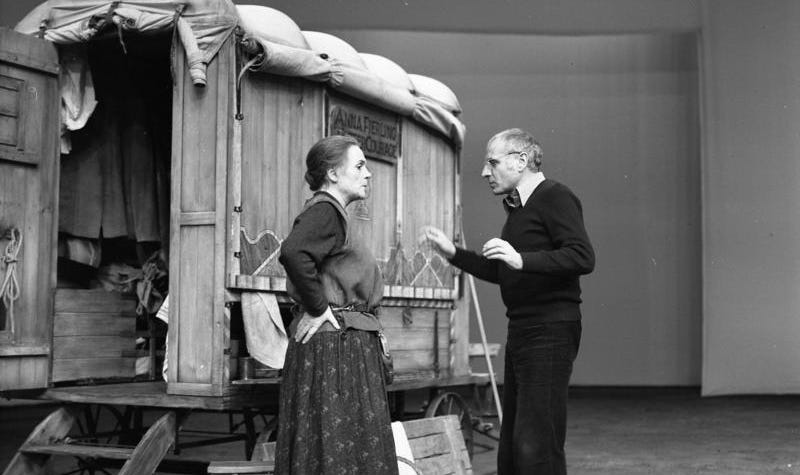
To be fair, Mother Courage contains moments of undeniable theatrical power. The recurring image of Mother Courage pulling her wagon across a devastated landscape is one of the most haunting symbols in modern theater. The wagon represents survival, commerce, stubbornness, and tragic blindness all at once. The play also captures an uncomfortable truth about human behavior in times of conflict: Individuals frequently adapt to destructive systems rather than resist them. They rationalize participation in those systems even when the consequences become increasingly catastrophic. Brecht portrays this dynamic with remarkable precision.
The true tragedy of Mother Courage and Her Children is not that the protagonist loses everything but that she learns nothing. In the final moments of scene twelve, after burying her last child, Mother Courage performs an act that is both physically and symbolically devastating: She harnesses herself to the cart (86–88). This stage direction is the culmination of Brecht’s ideological trap. Throughout the play, her children were the ones who pulled the wagon; they were the motors of her business. With them dead, she does not abandon the trade that killed them. Instead, she replaces them, declaring “Hope I can pull cart all right by meself . . . Got to get back in business again.” By the time the offstage chorus begins the final song, the play’s thesis has been fully realized. The lyrics remind us that “The war is dragging on a bit / Another hundred years or longer,” and that although “the dead remain,” life—or rather, the machine of war—simply “staggers to its feet again.” Courage’s decision to shout “Take me along!” to the passing regiment is not a sign of resilience—it is a sign of total moral capitulation (88). She has devolved from a hopeful opportunist into a perpetuator of the very wartime economy she once sought to exploit.
Nearly a century after its creation, Brecht’s critically acclaimed play continues to provoke admiration for its intellectual rigor. He succeeded brilliantly in showing us how people can hollow out their own souls. However, by removing the tension central to fiction, Brecht sacrificed the human center of his drama.
In a genuine tragedy, the protagonist’s suffering leads to a transformative insight that gives the loss meaning. In Mother Courage, there is no such insight—only the endless, circular motion of the wagon. Brecht wanted the audience to learn the lesson that his character could not. But in his attempt, he turned what could have been a profound human journey into a cold political demonstration. The audience leaves the theater with a clear thesis, but the character remains trapped in a loop of blindness. In the end, Brecht’s ideological commitment is so absolute that it denies Mother Courage the one thing she needed to become truly tragic: the agency to understand her own story.
This article appears in the Summer 2026 issue of The Objective Standard.
Peter Thomson and Glendyr Sacks, eds., The Cambridge Companion to Brecht (Cambridge: Cambridge University Press, 1994), 1–4.
This foundational technique was expounded by influential German philosopher, cultural critic, and essayist Walter Benjamin in his seminal essays on epic theater. He wrote that it enables epic theater to “treat elements of reality as though it were setting up an experiment, with the ‘conditions’ at the end of the experiment, not at the beginning. Thus they are not brought closer to the spectator, but distanced from him.”
Brett D. Johnson points out, “Although numerous theatrical artists and scholars may share artistic director Oskar Eustis’s opinion that Brecht’s masterpiece is the greatest play of the twentieth century, productions of Mother Courage remain a rarity in contemporary American theatre,” quoted in “Mother Courage and Her Children,” Wikipedia, last modified May 12, 2026, https://en.wikipedia.org/wiki/Mother_Courage_and_Her_Children#cite_note-35;
Thomson and Sacks, The Cambridge Companion to Brecht , 1–4;
The “alienation effect” (Verfremdungseffekt), a concept pioneered by Bertolt Brecht, refers to theatrical techniques designed to disrupt the audience’s emotional immersion. By making the familiar seem “strange” or unexpected, the playwright shifts the viewer’s focus from empathy to objective analysis of the social and intellectual forces at work in the drama.
Bertolt Brecht, Brecht on Theatre: The Development of an Aesthetic, edited and translated by John Willett (New York: Hill and Wang, 1964), 136–47; John Willett, introduction to Mother Courage and Her Children: A Chronicle of the Thirty Years’ War, by Bertolt Brecht, trans. John Willett (London: Bloomsbury Methuen Drama, 2015), vii–xiii.
Aristotle, Poetics, trans. S. H. Butcher (New York: Dover, 1997), chap. 11, p. 22.
Brecht on Theatre, 136–47; Mother Courage and Her Children: A Chronicle of the Thirty Years’ War, edited and translated by John Willett (London: Bloomsbury Methuen Drama, 2015), vii–xiii.
Brecht on Theatre, 136–147; Introduction to Mother Courage and Her Children, vii–xiii.
Mother Courage and Her Children, 40–42.
Brecht on Theatre, 136–47.
Mother Courage and Her Children, 1–5, 71–76.
Brecht on Theatre, 33–42.


