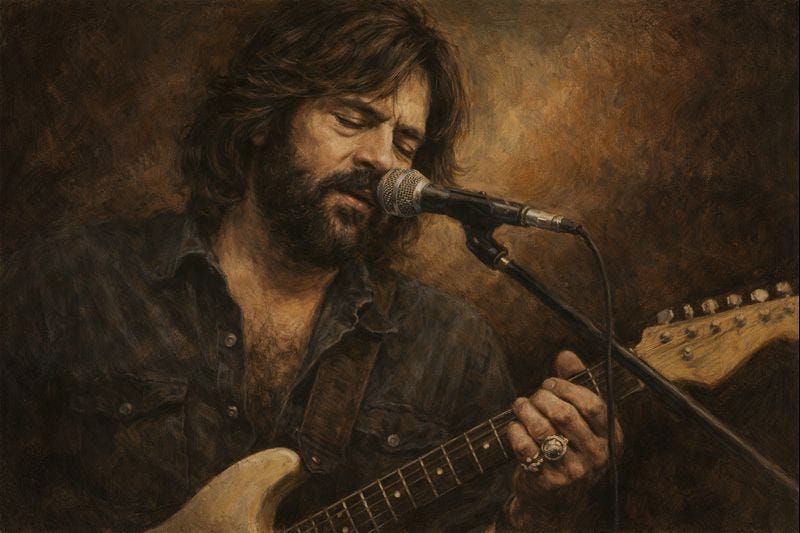
The musical landscape of the 1970s was filled with artistic rule breakers, and singer-songwriter Lowell George was certainly one of them. His dynamic approach, a sort of controlled chaos, produced melodies and musical works that are still being performed and covered today. His devotion to creative freedom shaped his entire body of work and produced one of rock ’n’ roll’s most innovative, original bands. George’s career path was harder than most because of his uncompromising mindset. His wife, Elizabeth, alluded to the fact that for him the road less traveled was inevitable. “There was nothing regular about the guy,” she said while reflecting on his lasting legacy.[1]
His group was called Little Feat, but George’s fusion of genres from folk to funk was anything but. He created momentous songs by pulling inspiration out of everyday experiences, including such classics as the band’s breakout single, “Willin.’” Trips to New Orleans were catalysts for George’s stylistic innovation, reaching a peak with the landmark album Feats Don’t Fail Me Now. Even lesser-known tracks from his repertoire show an artist determined to scale a musical summit of his own making. His enigmatic artistry spanned genres, and his label struggled to put his music in a mainstream stylistic box, making it harder to sell records. But dedicated listeners who showed up in droves to his shows with Little Feat helped him become one of rock’s unsung heroes. And his discography, showcasing melodic ingenuity, emotional depth, and artistic passion, made him one of rock’s most skilled explorers.
From Setback to Launch Point
In 1969, legend goes that George was fired by one of music’s most mysterious yet influential figures, Frank Zappa. George’s termination from Zappa’s group, The Mothers of Invention, was for good reason. Zappa thought the budding performer was too good to be in a supporting role in a band; he advised George to found one himself. And in the dawn of a 1970s Los Angeles music scene caught between the haze of the folk revival of the 1960s and the forthcoming progressive rock movement, George did exactly that. He teamed up with keyboardist Bill Payne, drummer Richie Hayward, and bassist Roy Estrada to form Little Feat.
In George’s own band, he encouraged and supported his bandmates’ creative experimentation with their instruments and musicianship as long as it stayed true to his overall genre-bending vision for soulful melodies and grooving rhythms. An excerpt from the Rock and Roll Doctor biography highlights Zappa’s influence:
George saw in Zappa’s management of the Mothers a model of how a band could be run. It was a model that worked, that was productive, and that allowed for individual creativity—but within the clear boundaries set by the bandleader. This idea of how things might be was to stay with him throughout his career.[2]
By 1971, Little Feat released its debut self-titled album. It featured “Willin,’” an acoustic-based, easy-listening ballad about the adventures of a trucker and his perseverance and personal triumphs through the twists and turns of his journey. George came up with the idea for the song before forming his band. In his college days he often drummed up inspiration outside the classroom. “Willin’” was inspired by his time spent working as a gas station attendant, and it would become one of his signature songs.[3]
George loved studying philosophy, and in interviews he sometimes quoted classical philosophers such as Socrates. For him, everything was interesting, and his insatiable curiosity made him a fount for songwriting and creative playing.
“Lowell quickly developed his own ‘sound’ which featured clean compressed notes played with precision and filled with sustain,” Gelinas writes:
Along with Lowell’s unique slide guitar, he was also developing a distinctive vocal style which employed the technique of melissima by which the singer melodically embellishes certain syllables within a [phrase]. This style of singing, much like Lowell’s slide guitar, would become a critical element of Little Feat’s musical identity.[4]
After the group’s Sailin’ Shoes album in 1972, George especially wanted to expand the band’s artistic dimensions. Bandmate Bill Payne shared in an interview the talks he and George had when they first started playing together that reflected this creative desire:
We talked about the kind of band we wanted it to be. Should we have a horn section? What should the bass player play? Are we going to relegate ourselves to one style of music? We decided there shouldn’t be any limits to what we would do. If we wanted to play a waltz, great. If we wanted to play a straight-ahead song, fine.[5]
By 1973, Little Feat’s third album, Dixie Chicken, featuring the popular title track and deep-cut-turned-cult-classic “Roll Um Easy,” marked the arrival of the sound that George had been experimenting with for years—a fresh integrated style he formed out of countless others. The album features an expanded sound (the band was now a six-piece) and boasted Cajun stylings, blues influences, and folk nuances, all with a classic rock ’n’ roll feel.
For a while, Little Feat averaged one album per year, made possible by George’s unrelenting work ethic. In a 1994 interview with Mojo, British musician Robert Palmer chatted about going on tour with Little Feat and how impressed he was with George’s commitment to his musical vision. “Lowell George was extremely bright, with a surreal sort of wit, and he was basically a workaholic. Day and night, all he did was make music.”[6]
In 1974, Little Feat reached a peak with its critically acclaimed record, Feats Don’t Fail Me Now. The band hailed from California, but their sound was unmistakably southern-inspired. George took naturally to the stylings of New Orleans musicians when he and the band visited the bustling city. Present throughout each song were a horn section, syncopated rhythms common in Louisiana, and lyrical stories with equal parts glamor and grit.
Fearless Creative Approach
“We were very eclectic. We took a lot of chances,” George explained during an interview with Little Feat about his time.[7] His penchant for creative risk-taking fostered the band’s innovative, wide-ranging sound. Journalist Elizabeth Nelson described his fearless approach to creativity: “Like a method actor, he had an eerie way of fully transforming himself into whatever a project required. Chamber music, blue-eyed soul, and avant-blues all came to him without inhibition.”[8] Gelinas noted that the American musical landscape of the 1970s often featured “musical primitives with more enthusiasm than dexterity.”[9]
But George possessed both, and for him, dexterity was more than a skill: it was a mindset, and he applied it to technology as much as his artistry. During the evolution of rock ’n’ roll in the 1970s, musicians embraced technological creativity while forging new sounds. Nowadays, digital audio interfaces make it easy to experiment with harmonies, instruments, and overdubbing—the process of recording different tracks over one another to create a layered final song. But when George was in the studio, he didn’t have any shortcuts. So, he helped pioneer a technique that became a defining recording tactic before digital recording software became available in the late 1980s—one he had begun toying around with during his days playing with Zappa. To layer tracks over one another, George physically altered the tapes he recorded onto by cutting sections with a razor blade and rearranging them with special adhesive. In a 1975 interview in zigzag magazine, George relayed his experimental approach with tape when he stated, “I use tape like someone would use manuscript paper.”[10] Although this was time-consuming and costly, it was essential to his creative process. Tape splicing helped him come up with new ideas for songs and show bandmates how he wanted specific sections to be played. The editing technique helped add to Little Feat’s genre-blending, no-holds-barred style because it gave him ultimate control over the feel of the band’s sound, rather than experimenting for its own sake.
George was a skilled musician and audio engineer, but his artistic perspective was as influential to his studio sessions as his technical prowess. Little Feat’s sound gave listeners welcome surprises. One could never quite predict when George would cue a bass solo or a drum breakdown, and his lyrics and song narratives were anything but formulaic. He understood that this liveliness needed to be contrasted with steadiness. And that steadiness could be found in the silence he left between notes.
“Space is a place” was his studio motto.[11] As rock music got busier, sometimes producing noise for noise’s sake, George’s compositions were guided by breathing room as much as the notes themselves, making for a dynamic listening experience no matter the album. Because of this motto, his slide guitar solos sang rather than screamed; they didn’t demand attention: they beckoned listeners, pulling them in.
His ingenuity didn’t stop at the studio. When performing, he often played slide guitar with a spark plug socket wrench rather than a traditional bottleneck slide, allowing him to sustain notes longer. His slide setup also gave his playing a distinct texture that evoked some of his heaviest blues influences.
The Inspiration of Howlin’ Wolf
No other musician influenced the California songwriter more than black Chicago blues vocalist Chester Burnett. Better known as Howlin’ Wolf, he remains one of America’s legendary bluesmen, releasing such enduring classics as “Smokestack Lightning.” During his heyday in the 1950s, yodeling was still popular among genres such as country, blues, and folk, but Howlin’ Wolf couldn’t yodel. Instead, when he sang in falsetto, he created a vocal slide up to a note, then held it, adding plenty of vibrato to give his vocal runs a melodic howl in place of yodeling (artists such as Adele use this technique often nowadays, but Howlin’ Wolf helped pioneer it). George followed in his footsteps in creatively overcoming musical limitations. Due to a hand injury sustained while working on model planes, it was hard for George to fully fret all six guitar strings with his left hand. So, he mastered slide guitar instead.
George was so taken with Howlin’ Wolf that he created a litmus test in his honor, which he used to decide with whom he wanted to work. If someone mentioned a player who wanted to collaborate with him, George would ask, “Is he versed in the ways of Chester Burnett?”[12] If the player didn’t know that Chester Burnett was Howlin’ Wolf’s real name, George wasn’t interested.
In the 1960s and 1970s, it was common for musicians who happened to be white to be influenced by the blues, a historically black genre. George covered Howlin’ Wolf live with such songs as “How Many More Years.” Some critics worried that these white artists were committing what some would now call “cultural appropriation,” the supposed co-opting of a “marginalized” culture by a “dominant” one. But in a 1967 interview, Howlin’ Wolf highlighted how foundational blues musicians could profit from their music becoming mainstream. When asked about the prevalence of musicians, including young, white musicians, recording blues music from the past, he responded by pointing out that music has the power to connect different musicians through the shared love of a melody. He explained, “It doesn’t matter no different who sang your song. They sang because of the way they feel.”[13] Adopting an entrepreneurial mindset, he also remarked, “Well I’ll tell you, there’s nothing wrong with that. I want all of them to make my records, because I gets money out of it, see,” he said, referencing the royalty payments he would receive when someone covered his songs.[14]
For George, Howlin’ Wolf’s catalog and the blues genre as a whole didn’t represent an opportunity for appropriation, but appreciation and innovation. In the blues he found artistic alignment and inspiration.
“What Is Success?”
Among their loyal following, the visionary rock group was known as a must-see live band for their energetic performances. While writing for Let It Rock magazine, journalist Mick Houghton highlighted the band’s tight-knit sound, a foundation that anchored performances through lengthy solos and various reimagined versions of their originals. “As musicians Little Feat are as compatible an outfit as you could hope to find,” he writes.[15] But George also felt right at home in a recording studio.
“Lowell George’s distinctive style of slide guitar and vocalizing,” writes Gelinas, “helped create a style of music that was a unique blend of second-line funk, gospel, Chicago blues, jazz and country balladry that still stands today as one of the most unique developments in American popular music during the 1970s.”[16]
For George, music was all about exploration. But for his band’s label, Warner Bros. Records, music needed to be about replication. It was hard for a label to promote a band it struggled to define stylistically. George would not renounce his artistic vision for anyone or anything. He understood the importance of being a profitable act. But for the visionary musician, profit had to be married to passion no matter the project. “What is success?” he asked during an interview. “It certainly isn’t money,” he answered. He then clarified, “Money helps. But doing something that you really like doing as a profession is really success to me.”[17] After album release days, George would visit various stores in person, only to find their new record wasn’t stocked.[18] Instead of changing his band’s sound to a more mainstream rock to boost sales and please the label, he and his bandmates toured extensively to make up the difference. The pressures of being a band manager, frontman, producer, and songwriter wore on George over the group’s ten years together from 1969 to 1979. As Little Feat disbanded due to personal differences and professional fatigue, George set out on a solo career. In March 1979, he released his debut solo album, Thanks I’ll Eat It Here. But poor health and substance abuse caught up with the dedicated musician. In June 1979, George passed away from a heart attack at the age of thirty-four. Although he battled and sometimes succumbed to vices, his artistic virtue eclipsed them.
Little Feat’s heroic legacy is not that of record label darling or radio-friendly band but of a group revered by record label darlings and radio-friendly bands. Little Feat was a band’s band, and George was a musician’s musician. Led Zeppelin founder and lead guitarist Jimmy Page once called Little Feat his “favorite American group.”[19] His bandmate, singer and frontman Robert Plant, once got a slap on the wrist for playing Little Feat records too loud in a hotel. Both modern blues icon Eric Clapton and one of rock’s most famous bands, Van Halen, covered George’s originals live and on records. Folk-rocker Jackson Browne was so taken with George’s magnetism that he called him “the Orson Welles of rock.”[20]
At Little Feat’s helm was an imperfect but ingenious captain who navigated and explored the islands of musical genres and built from his discoveries a new melodic world—a world today’s musicians continue to mine for their own artistic gold.
[1] Mark Brend, Rock and Roll Doctor, Backbeat Books, 2002, 6, https://archive.org/details/rockrolldoctorlo0000bren/mode/2up.
[2] J P Gelinas, “Lowell George, Perfect Imperfection,” Furious magazine, August 2008, https://www.furious.com/perfect/lowellgeorge.html.
[3] Gelinas, “Lowell George, Perfect Imperfection.”
[4] Gelinas, “Lowell George, Perfect Imperfection.”
[5] Gelinas, “Lowell George, Perfect Imperfection.”
[6] Paul Sexton, “Pursuing Atmosphere in Music: Robert Palmer in 20 Quotes,” udiscovermusic, 2006, https://www.udiscovermusic.com/stories/robert-palmer-in-20-quotes.
[7] Earl Guthrie, “Lowell George Interview WXRT Chicago, June 15, 1979,”
.
[8] Elizabeth Nelson, “Lowell George in Eight and a Half Songs, Oxford American, December 2021, https://oxfordamerican.org/magazine/issue-115-winter-2021/lowell-george-in-eight-and-a-half-songs.
[9] Gelinas, “Lowell George, Perfect Imperfection.”
[10] Gelinas, “Lowell George, Perfect Imperfection.”
[11] “Lowell George: Feats First,” directed by Jon Storey, 2015, https://www.amazon.com/gp/video/detail/B078TNR4J9/ref=atv_dp_share_cu_r.
[12] Albert Corey, “Lowell George—Feats First,” Life since the Baby Boom, July 2023,
.
[13] Chris Stratchwitz, “Howlin’ Wolf Interview,” The Chris Stratchwitz Collection, Arhoolie Foundation, April 1967, https://arhoolie.org/howlin-wolf-interview-2/.
[14] Stratchwitz, “Howlin’ Wolf Interview.”
[15] Michael Houghton, “Little Feat Albums,” Let It Rock, March 1975, Rock’s Backpages, https://www.rocksbackpages.com/Library/Article/little-feat-albums.
[16] Gelinas, “Lowell George, Perfect Imperfection.”
[17] Guthrie, “Lowell George Interview WXRT Chicago.”
[18] Jon Storey, “Lowell George: Feats First,” Pride Studios, 2015, Amazon.
[19] Jackson Maxwell, “Eric Clapton and Van Halen Covered His Songs, and He Led Jimmy Page’s Favorite American Band: Watch Overlooked Guitar Genius Lowell George Demonstrate His Slide Technique on German TV,” Guitar World magazine, July 2023, https://www.guitarworld.com/features/lowell-george-slide-guitar-german-tv-1977.
[20] Maxwell, “Watch Overlooked Guitar Genius Lowell George.”


