

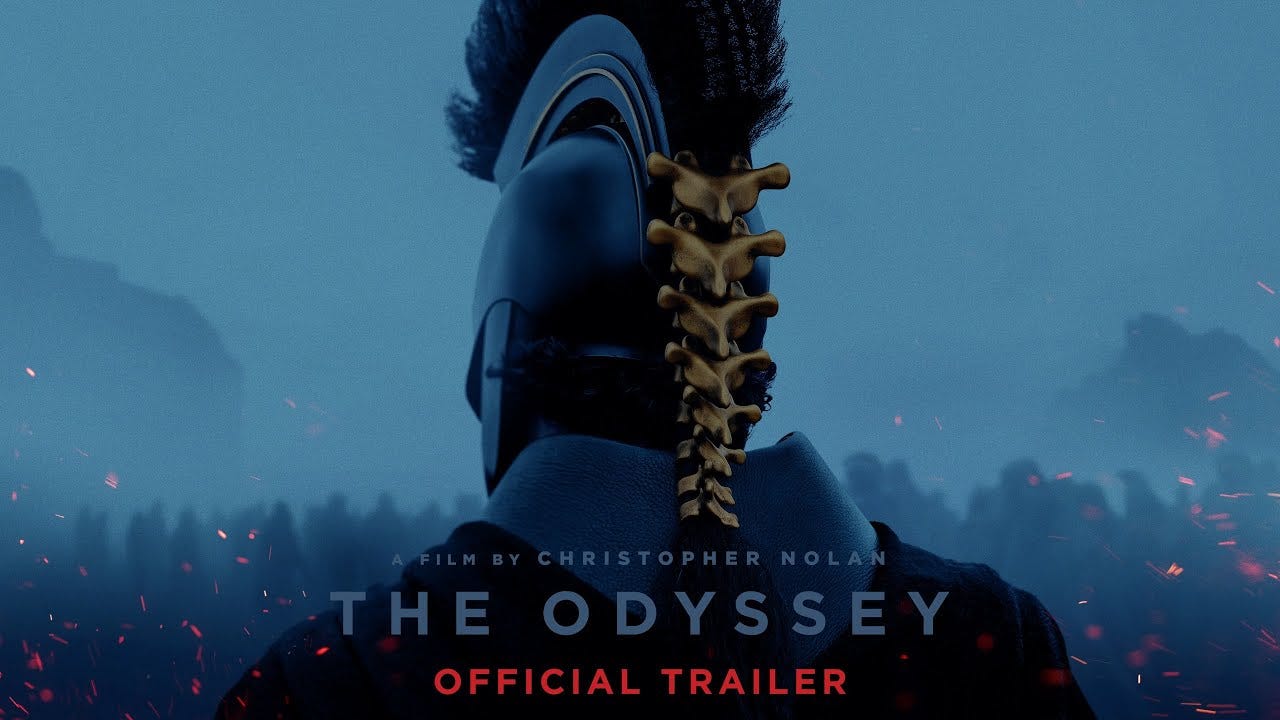
Written and directed by Christopher Nolan
Starring Matt Damon, Anne Hathaway, Tom Holland
Distributed by Universal Pictures
Running time: 173 minutes
Rated R for graphic violence, language, and brief nudity
There have been a great many translations of The Odyssey spanning hundreds of years, although the same half dozen or so tend to top the list of those most highly regarded by credible critics and literary scholars. Emily Wilson’s 2017 translation—not one of them—served as director Christopher Nolan’s primary inspiration for the film (he also wrote the screenplay).1 In a glowing review of Wilson’s translation, Annalisa Quinn of NPR wrote:
Wilson’s project is basically a progressive one: to scrape away all the centuries of verbal and ideological buildup—the Christianizing (Homer predates Christianity), the nostalgia, the added sexism (the epics are sexist enough as they are), and the Victorian euphemisms—to reveal something fresh and clean. . . . Though it’s silly to ascribe too much to her gender rather than her skill, Wilson does have a certain double sensibility that often translates male grandeur with a female half-smile.2
As if this weren’t a clear enough signal of the cancerous identity politics in Nolan’s film, the opening shot is a close-up of a black man presented—with unflinching seriousness—as a 12th-century BC Greek speaking to a room full of other 12th-century BC “Greeks” who are, in fact, primarily Asians, Indians, and other Africans.3
Here we go again.
Only Odysseus’s quest itself is grander in scope than the catastrophic failure of Nolan’s film. Its redeeming qualities are nearly nonexistent, and it fails not only as an adaptation of one of the greatest stories of all time but also as a film, and these two failure modes often overlap considerably.
The Odyssey is widely regarded as one of the greatest stories of all time, not because it’s old. It has been lauded for thousands of years because it is one of the best known examples of long-form storytelling, and storytelling has one fundamental purpose: to depict the human condition and enrich human lives. The essential task of a storyteller is to convey meaning—that is, to engage deeply with ideas and values that always have been and always will be central to human life. This is what Nolan’s film utterly fails to do and indeed does not even attempt.
This starts to become evident during an early scene depicting Odysseus’s encounter with the cyclops Polyphemus, a one-eyed giant who can speak in the original poem but does not speak in this scene. Nolan’s decision to render Polyphemus mute here is not a minor change—it entirely misses and negates the purpose of the scene. In the original text, the cyclops encounter is the first of Odysseus’s major postwar adventures that he recounts to the Phaeacians (and the reader). This was not an arbitrary choice on Homer’s part. The reason the cyclops encounter is shown first is because its purpose is to convey, in part and in fundamental terms, what sort of man Odysseus is—and he reveals his character through a verbal battle of wits with Polyphemus, who displays near-human intelligence.
In the poem, Odysseus’s men are trapped in Polyphemus’s cave when he blocks the entrance with a humongous boulder. The men move to attack the creature, but Odysseus orders them to stand down—and he reaffirms the order even after Polyphemus brutally kills and eats several of the soldiers. Odysseus’s remaining men question the order but nonetheless follow it, trusting his judgment even though they do not yet understand it. Odysseus engages Polyphemus in conversation and witty banter, amusing the cyclops until he falls asleep. Odysseus then explains to his men that, if they kill the creature, they will be trapped forever in the cave because the stone blocking the entrance is far too heavy for them to move. They cannot fight their way out of the deathtrap—they must think their way out.
Over several days, Odysseus—who cleverly has told Polyphemus that his name is “Nobody”—lulls Polyphemus into complacency with more banter and flattery until the beast drinks too much wine (at Odysseus’s encouragement) and falls into a deep sleep. This allows Odysseus and his men to carry out the preparations for their escape plan—preparations that are loud and would have woken the cyclops had he not been drunk. When they are ready, they sharpen a large wooden stake and drive it into Polyphemus’s eye, blinding and enraging him. The cyclops gropes around for the men, but they are hiding among his sheep. When the giant eventually unseals the cave entrance to let the sheep out to graze, he feels each sheep as it passes by, still searching for the treacherous men who blinded him. Odysseus, having anticipated this, has already told his men to crawl out of the cave under the sheep, maintaining their disguise. As they board their ship, Polyphemus gives chase, shouting to his brethren cyclops and to his father, Poseidon, that “‘Nobody’ has blinded me.” Once Odysseus and his men are safely away from the shore, he cannot resist revealing his true name to Polyphemus, shouting “Tell [Poseidon] Odysseus, raider of cities, took your eye: Laertes’ son, whose home’s on Ithaca!”4 Although Odysseus is remarkably smart, he nonetheless sometimes does stupid things; this is, in part, what makes him an interesting and relatable character. (Revealing one’s identity to the god of the sea after blinding his son is quite foolhardy when one needs to cross the sea to get home; Poseidon then proceeds to severely complicate the remainder of Odysseus’s journey.)
Nolan’s portrayal of this scene conveys none of this meaning. Polyphemus is mute, so there is no dialogue between him and Odysseus at all. Odysseus does point out to his men that slaying the creature will trap them in the cave, but this is framed as an almost accidental realization rather than the reasoned observation of a clever man who has been paying close attention to his surroundings all along. In the poem (and in the well-done, albeit hokey 1997 television miniseries), the tension of this scene comes from the duel of minds between hero and monster, wherein a single intellectual stumble or overstated word of praise could spell doom for the wayward sailors homesick for wives whose embraces they’ve forgotten and sons they’ve never met.
Nolan replaces this crucial dramatic tension with boilerplate slasher film tactics, substituting darkness and loud noises for the battle of wits in a clumsy horror scene that clashes tonally with the rest of the film. As in the poem, Odysseus taunts the beast by revealing his name as the men flee to safety—but because we did not first see his intelligence, his courage, and the depth of his concern for his men, he comes across more like a cocky braggart than a flawed hero. Throughout the rest of the film, Nolan continues to portray Odysseus as alternately rude and stupid while spending comparatively little time on his good qualities—and Matt Damon’s consistently phoned-in performance shows us an Odysseus whose two primary emotions are mild confusion and boredom. (I feel compelled to point out that Damon is a much better actor than this, and he deserved a vastly better script.)
The scene featuring the witch Circe is similarly butchered. Odysseus’s men, nearly mad with hunger, encounter a lone woman while foraging in the wilderness and demand food from her. Although they don’t threaten or harm her, they are unnecessarily aggressive, and she agrees to share her food with them. While they are eating, she gleefully turns them into pigs using her magic.
When Odysseus later confronts Circe, Nolan’s version of her is revealed to be another instance of modern Hollywood’s sexism:
Odysseus: You turned my men into pigs.
Circe: No—they are pigs. I only removed their disguises and showed them for what they are. They came to me with empty bellies and hot blood.5
Odysseus: Did they touch you?
Circe: They would have.
Odysseus never challenges Circe’s presumption about his men and resolves the situation by simply threatening to kill Circe’s sister if she doesn’t remove the curse.
In the original poem, there isn’t so much as a vague hint that Circe is a misandrist hellbent on punishing all men for their supposed inherent wickedness, nor is there any indication that Odysseus’s men treat her poorly; in fact, it is Circe who offers to help them, and they graciously accept her offer. She is portrayed as a mysterious and explicitly nonhuman creature, although she takes a human form and outwardly acts human in some ways. In fact, the sexual aggressor in the original text is not Odysseus nor any of his men but Circe; she uses both magic and seduction to lure unsuspecting men into her trap. Odysseus, aided by Hermes, counters Circe’s magic with mystical herbs, and although he does sleep with her, he does so not out of lust but in acquiescence to her demand and on the condition that she remove the curse she has placed on his men.6
Par for the course for Hollywood in 2026, Nolan’s version of this scene inverts Odysseus from a virtuous, clear-thinking man who is explicitly not ruled by his sexual urges into an apologist for horny thieves. One point of the original scene—which Nolan also misses or ignores—is that appearances can be dangerously deceiving, and that Odysseus is greater than most men in his ability to see the truth behind clever deceptions. Another idea central to the original version of this scene is that courage is virtuous in part because not all threats to our values can be fully understood; Circe’s nature and motives are mysterious to Odysseus, which frightens him greatly, but he nevertheless confronts her because he would rather die in the attempt to free his men than leave them to their fate.
In Nolan’s film, the cyclops scene, the Circe scene, and many others are oddly short but feel much longer because they are not enjoyable or interesting to watch. The 173-minute film feels both frantically rushed and exhaustingly slow at the same time, which also traces back to Nolan’s fundamental misunderstanding of (and disrespect for) the source material. The original poem is only slightly longer than the average novel, but it would be somewhat misleading to say “only” without qualification because the structure of an epic poem is so different from that of a novel. In general, epic poems are primarily descriptive; they summarize long, complex events in a few lines or stanzas with little exposition of motive or mechanism, leaving it to the reader to infer or imagine these elements.7 This is why an epic poem typically covers tremendously more narrative ground than a novel or short story of comparable length; the latter two, by virtue of their different structures, spend much more time on the “why” and “how” of the events shown therein.
In practice, this means that adapting an epic poem to film requires much more screen time than adapting a similar-length novel unless one is willing to massively abridge the original text—at which point the resulting film becomes not an adaptation but a different story that is, at most, loosely based on the original. Nolan’s film feels both rushed and plodding because it merely “checks off” each major scene without seeking to understand what it means or why it should be included at all. As a result, we get something that is less like a coherent, narratively driven film and more like a three-hour museum tour led by an overcaffeinated guide who started the tour an hour late. We don’t understand how Odysseus defeated the cyclops or what (if anything) he learned from the experience; we see five minutes of whispering and a brief skirmish, and then the film moves on. We don’t understand how he survives his encounter with Circe or how he changes as a result of it, if he does; we see five minutes of a bored man halfheartedly arguing with an angry woman who hates men for no clear reason, and then the film moves on. There are so many scenes in the movie, and most of them are so shallow, that the end result is an increasingly familiar one in movies today: a film that manages to say nothing despite speaking for a very long time.
I also must address Nolan’s frankly disgusting willingness to submit to the overt racism and sexism that have infiltrated so many Hollywood productions since the mid-2010s. The opening scene is far from the only one in which the actors’ sex, race, or ethnicity is wielded as a club clearly intended to “deconstruct” “white” or “male-dominated” stories. For example, there is no defensible argument to be made that Lupita Nyong’o was cast as Helen of Troy for either her acting ability or her resemblance to the character; only in the loosest sense of the word “acting” does she do any acting at all during her two or three minutes of screen time, and she couldn’t bear any less resemblance to an ancient Greek woman. The decision to cast a sub-Saharan African woman as Helen of Troy was made for one reason only, and everyone knows that reason, including those who pretend not to know: to “subvert” the “racist” assumptions of “white” audiences. Only slightly less ridiculous are the myriad scenes (at least six) in which Odysseus’s African, Indian, and Asian soldiers loudly proclaim to one another: “We are Greeks.”
Particularly offensive is the casting of Elliot Page as Sinon (a character who is not in The Odyssey at all; he is essentially a disposable extra in Virgil’s Aeneid, written centuries after Homer’s death).8 Page is five foot one and barely one hundred pounds. This alone should disqualify any male actor from playing a Greek soldier in any serious adaptation of The Odyssey—but Page is not a male, and no amount of surgery can make her look like a Greek soldier. The film pointedly ignores these facts, most glaringly when showing a shot of Page immediately after a shot of the (actual) boy who plays a pubescent version of the character in an earlier scene. Nolan extends the farce still further, rewriting Sinon from a remarkably unremarkable side character into “the greatest and bravest man I’ve ever known” (Odysseus’s words). Just as Sinon is blatantly claimed to be something he irrefutably is not, so too is Page—and the prevailing moral code of modern Hollywood dictates that no one is allowed to point out any of this.
Most of the other actors in the film deliver performances just as underwhelming as Page’s. Damon comes across as being there primarily for the paycheck, Tom Holland alternates between overacting and underacting (mostly the latter), and John Leguizamo—who is supposed to be playing a Greek servant—doesn’t even try to mask his extremely New York accent. The only notable exception is Anne Hathaway, who does what she can with the poorly written script and occasionally manages to breathe some life into otherwise yawn-inducing scenes, but she can only do so much. The film is, for the most part, similarly boring to look at; many scenes are underlit nearly to the point of complete obscurity, and most are dominated by dark blue, dark brown, or dark yellow filters. This, too, is typical of Nolan; most of his films are overwhelmingly dark in both color and lighting.
Nolan’s film is deeply flawed in many more ways, but unlike him, I will refrain from trying to cram more onto the page than the format can support. Even in my most charitable interpretation, there is almost nothing positive to say about the film, the final lines of which are possibly the least self-aware lines of dialogue ever written:
Penelope: Why will the stories [of us] always be sung?
Odysseus: Because songs will be all they have to remember those of us who could write.
Perhaps Nolan should try his hand at pop songwriting—because if this is the caliber of narrative writing that he thinks should be memorialized through the ages, then it’s time for him to put away his storytelling pen for good.
This article appears in the Fall 2026 issue of The Objective Standard.
Eliana Dockterman, “Christopher Nolan Has Been Dreaming of ‘The Odyssey’ for More Than 20 Years,” May 12, 2026, Time, https://web.archive.org/web/20260512121954/https://time.com/article/2026/05/12/christopher-nolan-odyssey-interview/.
Annalisa Quinn, “Emily Wilson’s ‘Odyssey’ Scrapes the Barnacles Off Homer’s Hull,” December 2, 2017, NPR, https://www.npr.org/2017/12/02/567773373/emily-wilsons-odyssey-scrapes-the-barnacles-off-homers-hull.
Craig Biddle, “Identity Politics vs. the Law of Identity,” The Objective Standard, August 1, 2018, https://www.theobjectivestandard.com/p/identity-politics-vs-the-law-of-identity.
Homer (tran. Robert Fagles), The Odyssey (New York: Viking, 1996), 9.502–505.
“Hot blood[ed]” is a somewhat archaic term meaning, in this context, “sexually aroused.”
Odysseus does go on to stay on Circe’s island and to have a sexual relationship with her for approximately one year, but this all happens later and under a substantially different context; it has no bearing on this particular scene.
Here, I mean descriptive in a storytelling sense, not an ethical sense—descriptive as against expository, narrative, or persuasive (the four rhetorical modes of writing).
The character of Sinon in Aeneid fulfills an important narrative function—he persuades the Trojans to bring the Trojan horse into their city—but the character himself is unimportant; the narrative function he performs could have been filled by any character.