

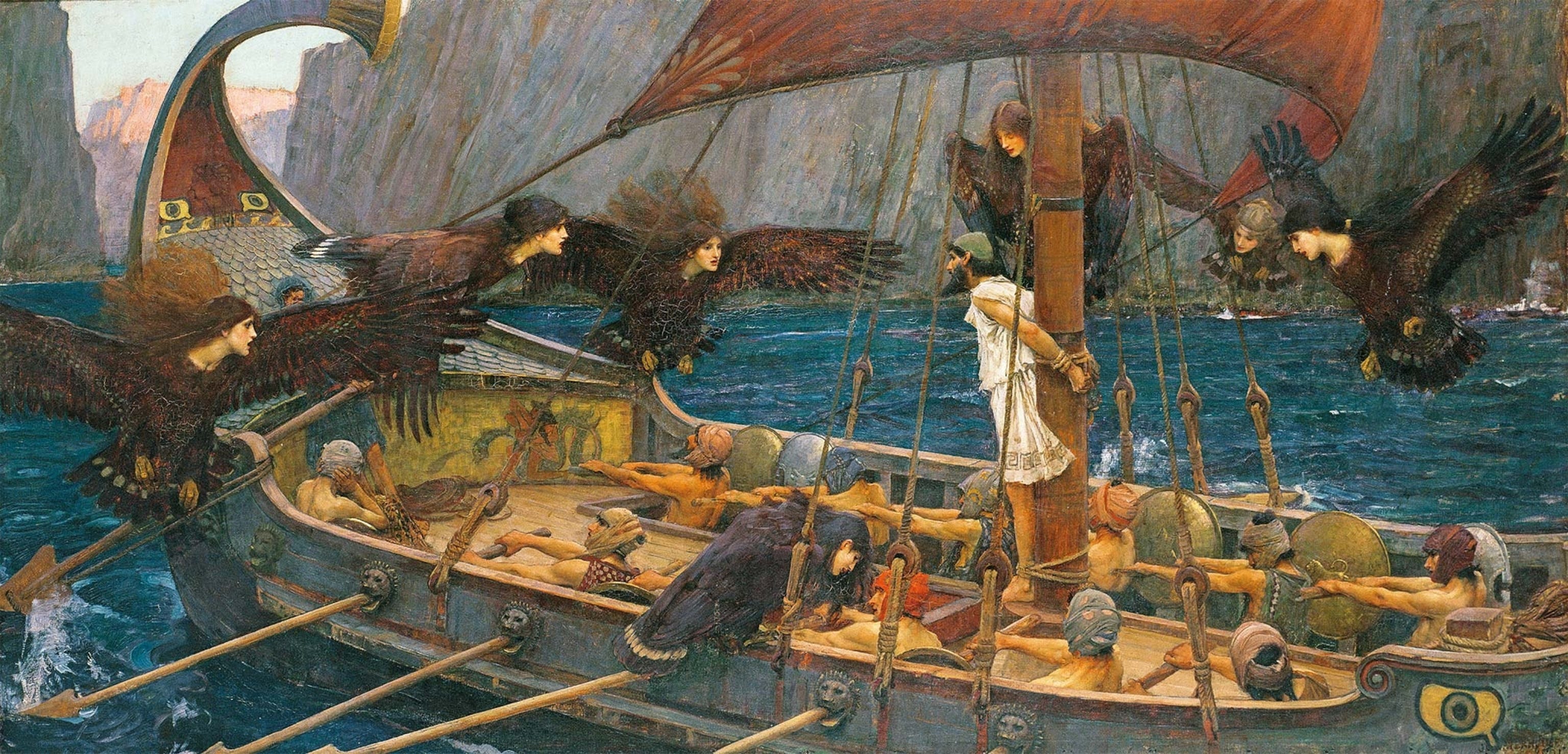
Homer’s Odyssey is an epic story with an epic protagonist—Odysseus is not simply a skilled warrior but also a thinker, a trickster, and an “obstinate, cunning and irrepressible intriguer.”1
Although this is a deeply heroic work that pioneered the idea of centering a story on a rational, proactive character, it also depends upon a premise fundamentally opposed to the conditions that make heroism possible. It is set in a universe where the attainment of goals and values doesn’t ultimately depend on one’s choices but upon the decrees and interventions of Olympian deities.
In many respects Odysseus is a prototype of a romantic hero of literature. Romantic narratives are characterized by larger-than-life characters, purposeful action, and value-driven plots, all of which are exemplified in Odysseus’s arduous striving and overcoming of monstrous obstacles to return home to his family. We see his courage, perseverance, and intelligence during his journey’s most memorable moments: when he devises the wooden horse plot that leads to the downfall of Troy; his quick-witted plan to evade the seductive snare of the sirens; and when he outwits the Cyclops Polyphemus—where, assessing that killing the giant outright would trap him and his men in the cave, Odysseus devises a plan to intoxicate their foe, blind him, and lead his men to escape beneath a herd of sheep. Each of these episodes revolves around Odysseus using reason to overcome ordeals and move closer to his main goal—to return home. But the emotional response the reader feels in these moments is somewhat dampened when we are reminded of Homer’s fundamental view of man and of existence.2
The problem with the Homeric universe is not that gods and monsters exist—good art can have fantastical, mythical elements so long as its theme is rational and thereby life-serving. The problem is that the gods limit Odysseus’s efficacy, which undermines his achievements. We repeatedly see Odysseus act to achieve his goals, but whether his actions matter is largely determined by the whims of the gods. His favor with the goddess Athena, in particular, becomes the deciding factor of his fate on multiple occasions. His escape from Calypso’s island after seven years of captivity is due solely to divine command following Athena’s petition to Zeus. His subsequent survival of Poseidon’s storm is made possible only by the interventions of Athena and her fellow goddess Leucothea. Upon finally returning to his homeland of Ithaca, his victory over the parasitic suitors is again made possible thanks to the divine intervention of Athena and Zeus. None of this detracts from Odysseus’s capacity to think, act, and strive in pursuit of his goals (in fact, these attributes somewhat influence his favor with Athena). But instead of directly earning every victory himself, his actions are constantly subsidized by the interference of divine forces. For heroic storytelling to be effective, the hero’s actions need to be the primary driver of the story. From a reader’s perspective, wouldn’t his victories be greater—and more heroic—if they depended solely on his own strength of body and mind?
Difficult obstacles reinforce this storytelling principle, and these could even take the form of intervening gods—provided they remain obstacles, such as the hostile Poseidon in The Odyssey. The problem arises when such intervening gods become the final causal explanation of unfolding events. In romantic storytelling, the hero overcomes adversity through volitional action, but in deterministic storytelling, he overcomes adversity because “destiny” dictates it. The Odyssey, which mixes both styles, is impactful to the extent that it’s romantic and undermined to the extent that it’s deterministic.
None of the above should be viewed as an attack on Homer; he wrote this in an age before formal philosophy—before explicit conceptions of volition, individual rights, and reason as man’s absolute guide. Despite the dominance of mysticism in Archaic Greece, Homer captured the dramatic cogency of human greatness at a time when nobody had formulated its philosophic explanation. One might say that he discovered the hero before the philosophy of heroism.
Despite its flaws, The Odyssey often feels like a story of human efficacy. Homer constantly dramatizes choice, particularly regarding Odysseus’s unique skill in scheming his way out of dangerous situations. It’s these moments that drive the story forward most climactically, and one of the reasons it has endured for millennia. The decisions, the disguises, the scheming, and the action—not the divine meddling—remain the most imperishable factors behind the story’s enduring emotional power.
This heroic spirit eventually would require a different philosophy—one in which the hero’s choices and actions are the primary causes of his own achievements. There would be stormy sailing ahead before mankind found that philosophy, but Homer’s Odyssey gave this heroic spirit its bearings and set the course for it to pursue its destination.
This article appears in the Fall 2026 issue of The Objective Standard.
Homer, The Odyssey, translated by E. V. Rieu (London: Penguin Classics, 2003), 176.
I refer here to the views of the person(s) who composed the poem. Doubts have long persisted over the actual identity of Homer and the historicity of his oeuvre having been composed by a single individual.
Heroes have existed for millennia. The Greeks believed in their gods; we do not, because those particular gods have long since been relegated to mythology. Yet there is something to be said for the fact that cultures across the globe, often separated by immense distances and with no contact between them, independently believed in some version of “the Force,” to borrow the term from Star Wars: an unseen power operating in human affairs, whose existence and effects Rand denied.
I believe this is what Homer represents through his gods. They are not merely storytelling devices that diminish Odysseus’s agency, but embodiments of forces the ancient Greeks believed were genuinely at work in the world. Their presence does not negate his heroism any more than the Force negates the heroism of the characters in Star Wars.
I don't share your objections to mysticism in the Odyssey as a story telling vehicle. First of all, no one who reads and enjoys the Odyssey believes in the Greek gods. They're just a mechanism, albeit a complex one, for advancing the story. To me, to object to them would be like objecting to the warp drive in Star trek or Star Wars. Yes, it does not exist and may never exist since there are rational objections to the creation of such a drive but it is effective as a story telling mechanism. An even deeper problem arises with time travel stories since to me, time travel is clearly impossible since its creation would allow severe violations of cause and effect. But I very much enjoy the first two Terminator movies because of James Cameron's/Gale Anne Hurd's carefully controlled use of time travel to advance the stories. I also enjoy the classic Universal horror films, Frankenstein, Dracula, the Wolfman, and particularly the Invisible Man with the wonderful Claude Raines, though I never have and never will encounter a single vampire. Am I worried about meeting a Frankenstein? Probably not but it is odd that I have this neighbor who during the severe thunder storms here in Texas opens his roof, invites in the lightening bolts, cackles loudly to himself as he does so, so.... :)