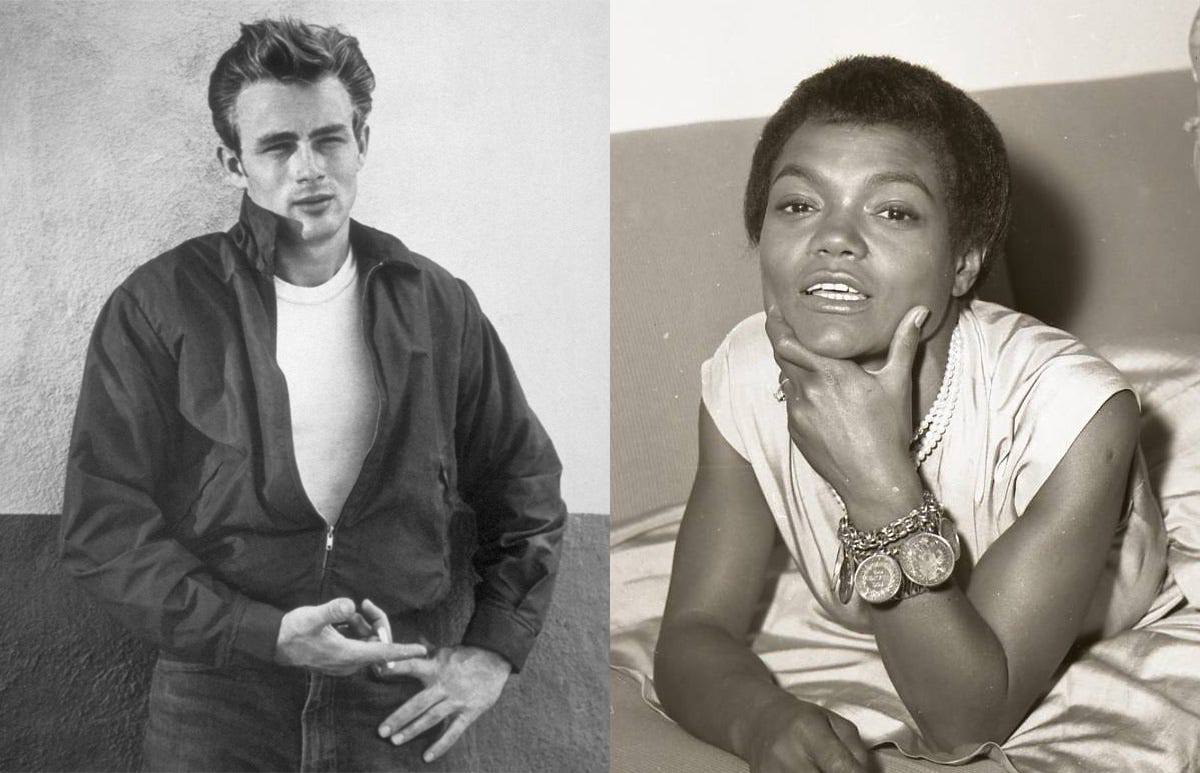
“Our Souls Were Mates”: The Inspiring Friendship of James Dean and Eartha Kitt
by Rebecca Day
During his brief but influential career, actor James Dean starred in three acclaimed films that left an indelible mark on the movie industry: East of Eden, Rebel Without a Cause, and Giant. Becoming the caliber of actor who was able to do this took a lot of work and inspiration. In the early 1950s, on the recommendation of his acting coach, he moved from Hollywood to New York City to audition for Broadway plays. The relocation was a catalyst for his acting career—but it was a person, not a place, who inspired him artistically for his defining cinematic role.
Soon after moving to the city, he met singer and performer Eartha Kitt, whose attention-grabbing role as Teddy Hicks in the 1954 play Mrs. Patterson would establish her as a Broadway star. Dean had lived in Los Angeles during his college years at UCLA, and Kitt had lived in New York for most of her life, but both were originally from small towns. Dean spent most of his childhood on a farm in Indiana, and Kitt was born in rural South Carolina. They bonded over their roots and their love of New York’s vibrant performing arts scene.
Although their friendship lasted only a few years due to Dean’s early death in 1955, they bonded deeply and quickly over their shared values. They studied movement together in dance studios for their respective crafts, getting in touch with their bodies for stage presence and character development. They also got lost in conversation, talking out problems in their personal and professional lives. They spent time people watching, viewing it as a valuable tool for character study.[1] They strengthened their connection over cups of coffee between dance sessions.
Kitt and Dean’s friendship shows us how people can grow individually from deep connections built on dedication to purpose, a passion for life, and honesty as a guiding principle.
“I Want to Move Like You”
Photographer Dennis Stock has a collection of candid photographs of Dean from 1955. He asked the budding actor if he could photograph him for Life magazine, and for almost a month, he shadowed Dean and took photos. During one of their sessions, Stock accompanied Dean and Kitt on an outing in New York City. His black-and-white photos show them huddled and talking at a small corner table in a restaurant, Kitt with cigarette in hand, looking intently at Dean, his back to the camera (he was shy offstage). The snapshots also document the dance classes they took together, with Kitt showing him ballet moves and poses to help with flexibility and confidence.
After these sessions, they’d often make the short trip to their favorite meetup spot, a little coffee shop near Times Square. The two would talk about work; Dean wanted to get more in touch with his body for physical roles, and Kitt’s lifelong experience as a dancer meant that she was well-positioned to help him. They would talk about difficulties from their childhood. Dean’s mother died in 1940 when he was only nine years old, and Kitt was born on a cotton plantation in 1927, surviving neglect and sexual abuse before moving to New York as a young girl.
Kitt appreciated Dean’s ability to understand her without explanation, but she later revealed that their regular coffee get-togethers were sparked by his seeing her perform live. He had asked her, “I want to move like you, can you teach me how to move my body like you do on stage?”[2]
According to Kitt, their coffee sessions were filled with “little tete-a-tete conversations.”[3] As she related,
He was like my brother. . . . He wanted to learn from me how to move on the stage the way I do, so I taught him how to control his body and how to let the words physically carry you from this point to that point. I was in a play and he’d just done his first film so we were both becoming known at that time. It was a good time.[4]
Kindred Spirits
Kitt’s career reached a high point in New York after the 1953 release of her timeless Christmas single “Santa Baby.” Around this time, Dean landed several guest-star roles on television, increasing his popularity. As both became prominent public figures, they continued to value artistry more than the attention that came with being stars.
For Dean, the preparation for a film role mattered more than seeing his name in lights at the film’s premiere. He wasn’t chiefly concerned with the finished product but with the work it took to get to that point—with the understanding that the quality of the work will (or at least should) influence the success of the final product more than anything. In his words, “The gratification comes in the doing, not in the results.”[5]
He found a kindred spirit in Kitt, who shared a similar philosophy and drew her own artistic fuel from a wealth of experience. She viewed living itself as a learning opportunity, saying, “I’m in school every day. My tombstone will be my diploma.”[6]
Pressures of Fame
As Dean’s career grew due to the success of his breakout film East of Eden (an adaptation of the John Steinbeck novel), he struggled to handle the pressure. Artistry agreed with the introverted actor, but celebrity did not.
Dean was always thinking, mostly from curiosity but also from bouts of insomnia, and he had a penchant for making late-night phone calls. Kitt was his top choice to ring, and she always answered.[7] “Our souls were mates,” she would recall some thirty years later.[8] Her daughter, Kitt Shapiro, later shared that her mother’s relationship with Dean was non-romantic, but “she was very protective of him.”[9]
As Kitt began to notice Dean struggling with the demands of Hollywood, she decided to talk to him about it. For her, their friendship wasn’t one of mere convenience but radical candor.
She traveled to Las Vegas to perform while Dean prepared for a role in Hollywood. She took time away from rehearsal to visit him, and he took her for a spin in his new car, a Porsche 550 Spyder, on Mulholland Drive. She reportedly expressed concern over his purchase of the infamous, featherweight racing car and told him, “James, I don’t like this car. It’s going to kill you.”[10] Others, such as friend and fellow actor Alec Guiness, warned him as well.[11]
Not long after, on a sunny California day in September 1955, Dean took a drive with his mechanic, Rolf Wütherich, and headed to a race. On the way, a vehicle made a left turn in front of Dean, and the two cars collided. The crash resulted in Dean’s death. Wütherich and the other driver sustained injuries but recovered.
Initial reports suggested Dean’s speed could have been a factor. He had received a speeding ticket earlier the same day. But witnesses of the crash shared that they didn’t think that the actor was going too fast when they saw the driver of the other car turn in front of Dean’s.[12] Later, the driver stated in an interview with the Tulare Advance-Register newspaper that he didn’t see the actor’s vehicle before making his turn, leading some to conclude that the car’s small frame and silver color made it hard to see against the glare of the sun.[13]
The Premiere of Giant
A month after the crash, Dean’s second major film, Rebel Without a Cause, premiered, solidifying his legacy as a youthful actor who transformed the way male characters were often played, taking on roles of emotionally nuanced dreamers rather than stoic traditionalists. Then, a little more than a year after his death, Giant premiered in 1956. Following the life of Jett Rink, a ranch hand discounted by his peers who eventually strikes oil on an inherited property, the posthumous release brought the late actor’s artistic spirit back to life. Dean didn’t just play the character of Rink—he embodied him, using different postures and detailed mannerisms with his hands to give the character individuality. He delivered lines with intensity and precision still talked about today, outshining his veteran costars Elizabeth Taylor and Rock Hudson. Kitt’s direction at the dance studio was an instrumental force behind the magnetism of his role in the film. Dean received posthumous Academy Award nominations for Best Actor for both films.
Dean’s death affected Kitt for the rest of her life, and she honored his memory by speaking about her late friend whenever given the opportunity until her death from colon cancer in 2008. When reminiscing, she always used the nickname she gave him, “Jamie,” though most called him “Jimmy.” She spoke about his need for meaningful conversation and how it fostered a connection between them that eventually didn’t require words:
He wanted to communicate with you and he wanted you to communicate with him. He didn’t like to be in a conversation that didn’t make sense. That’s why a lot of times we didn’t have to talk to one another because we understood what the other one was thinking even if the words weren’t spoken.[14]
While covering her memoir, Confessions of a Sex Kitten—a nod to her sultry stage presence and role as Catwoman in the 1960s Batman TV series—Vanity Fair featured an excerpt that illuminated the essence of their relationship:
Kitt found in Dean a “giver who wanted to receive, to be stimulated, to be ignited, to spark in order to spark.” She credited Dean with helping her understand ‘that all was okay in me, that I need not be afraid of myself or my ability to think and use my thinking to challenge others.’[15]
Although they only knew each other closely for a handful of years, the impact of their friendship was not lessened by its brevity. Nor does its briefness take away the important lessons we can glean from closeness such as theirs. Their friendship helps us understand that the best relationships don’t simply entertain us or indulge us. When a friendship is formed on a foundation of shared values, the positive effects extend beyond the relationship itself. We are shaped by it and grow over time because of it. We aren’t transfixed—we are transformed.
[1] Hadley Hall Mears, “C’est Si Bon: Eartha Kitt’s Transformative Life,” Vanity Fair, January 22, 2021, https://www.vanityfair.com/hollywood/2021/01/eartha-kitt-old-hollywood-autobiography?srsltid=AfmBOoruPJyirZZqgMo7enjbbjJ7t5gSIvHYs2j6GK7I3WNiY6X4gNaq.
[2] “The Friendship of Eartha Kitt and James Dean,” Past Hollywood History, April 24, 2019, https://pasthollywoodhistory.home.blog/2019/04/24/the-friendship-of-eartha-kitt-and-james-dean.
[3] “Friendship of Eartha Kitt and James Dean.”
[4] “Friendship of Eartha Kitt and James Dean.”
[5] Sarah Berger, “James Dean Quotes: 11 Things the ‘Rebel Without A Cause’ Actor Said to Remember the Icon on 60th Anniversary of His Death,” International Business Times, September 30, 2015, https://www.ibtimes.com/james-dean-quotes-11-things-rebel-without-cause-actor-said-remember-icon-60th-2120074.
[6] History.com Editors, “Eartha Kitt Speaks Out against the Vietnam War,” History, last modified February 18, 2025, https://www.history.com/this-day-in-history/january-18/eartha-kitt-speaks-out-against-vietnam-war-lady-bird-johnson.
[7] “Eartha Kitt Recalls the Last Time She Ever Saw James Dean,” Far Out Magazine, June 15, 2020, https://faroutmagazine.co.uk/james-dean-eartha-kitt-relationship-final-moments/.
[8] Mears, “C’est Si Bon.”
[9] Stephanie Nolasco, “Eartha Kitt’s Daughter Speaks Out about Star’s Relationship with Orson Welles, James Dean,” Fox News, January 16, 2018, https://www.foxnews.com/entertainment/eartha-kitts-daughter-speaks-out-about-stars-relationship-with-orson-welles-james-dean.
[10] Rob Finkelman, “The Curse of the Little Bastard: James Dean Never Stood a Chance,” Street Muscle Magazine, October 19, 2015, https://www.streetmusclemag.com/features/the-curse-of-the-little-bastard-james-dean-never-stood-a-chance/.
[11] Ryan Parker, “Alec Guinness Warned James Dean about His Car One Week before Deadly Crash,” The Hollywood Reporter, July 11, 2017, https://www.hollywoodreporter.com/movies/movie-news/alec-guinness-warned-james-dean-his-car-one-week-before-deadly-crash-1019948/.
[12] Samantha Stutsman, “James Dean’s Death: Inside the 24-Year-Old Actor’s Tragic Car Crash, 70 Years Later,” People, September 30, 2025, https://people.com/james-dean-death-everything-to-know-11820454.
[13] Mark Gray, “Inside the Haunted Life of Donald Turnupseed, the Other Man in James Dean’s Fatal Car Crash,” People, November 8, 2025, https://people.com/donald-turnupseed-james-dean-death-11777017.
[14] In Love with James Dean, “Eartha Kitt on James Dean’s Death”; Kitt appears on Larry King Live in 2005, 4:47, posted April 29, 2015.
[15] Mears, “C’est Si Bon.”


