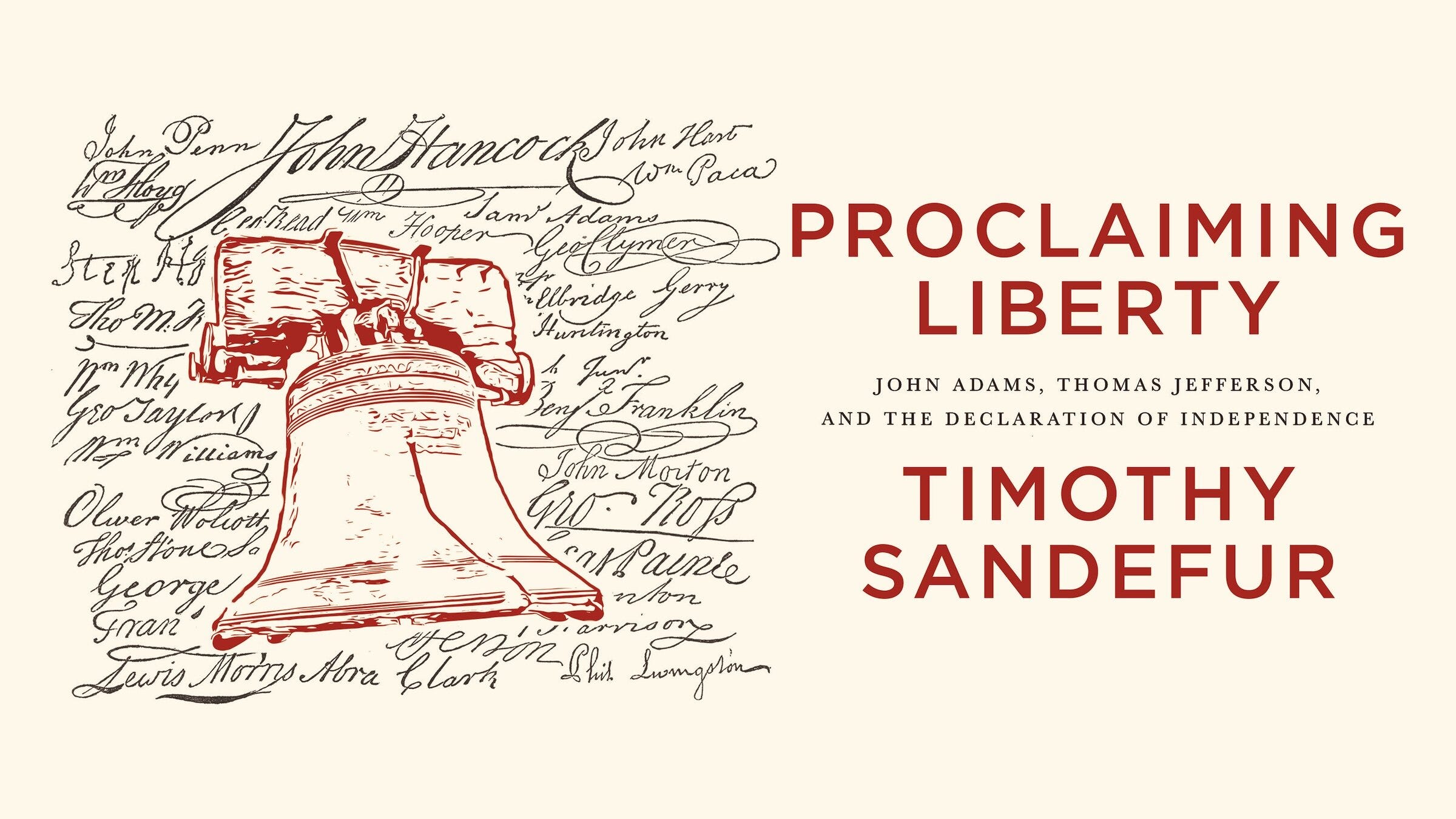
Proclaiming Liberty: John Adams, Thomas Jefferson, and the Declaration of Independence by Timothy Sandefur (Review)
Reviewed by Tom Malone
When John Adams was asked in the summer of 1826 to compose a toast for the upcoming fiftieth anniversary of the Declaration of Independence, he offered merely two words: “Independence forever.” When asked if he wanted to elaborate, the ninety-year-old ex-president replied, “Not a word” (1).
As we approach the 250th anniversary of American independence, Timothy Sandefur’s Proclaiming Liberty arrives at a moment when the Declaration is under assault from all directions. It’s dismissed by many conservatives as dangerously abstract, repudiated by “progressives” as a hypocritical cover for oppression, and treated by many legal scholars as mere rhetoric with no binding legal force. Opposing all these positions, Sandefur mounts a carefully documented, intellectually serious, and genuinely stirring defense: He argues that the Declaration meant exactly what it said, that its authors knew what they were doing, and that the principles it proclaims are as valid today as they were in 1776. “What makes the Declaration more than ‘merely revolutionary,’” writes Sandefur, “is the electric spark animating its circuits: the idea that all men are created equal, with inalienable rights, which government must respect, and which people may justly vindicate by rebelling against tyranny” (11).
Sandefur is a prolific scholar whose previous books have covered Frederick Douglass, property rights, and the history of classical liberalism. He is comfortable with legal and philosophic complexities, but he also has demonstrated an ability to write compelling narratives about history rather than dry treatises (most notably in Freedom’s Furies, the story of how Isabel Paterson, Rose Wilder Lane, and Ayn Rand pioneered the modern liberty movement). In Proclaiming Liberty, he combines both skills. The book is a dual biography of John Adams and Thomas Jefferson, a history of the American Revolution, and a legal argument all woven together with two central questions: How did these men come to believe so strongly in the principles of liberty, and why does it still matter?
The Origins of the Declaration
The first half of the book traces the intellectual growth of Adams and Jefferson from childhood through the eve of American independence. Sandefur demonstrates that the philosophic framework underlying the Declaration was not invented by its authors on the fly during a crisis; rather, it was the considered conclusion of decades of study, legal and moral argument, and direct colonial experience.
For Adams, the thread runs from Cicero and the Stoics through John Locke and Cato’s Letters to the Boston minister Jonathan Mayhew. Mayhew argued that government officials derive their authority from the people, not from divine right or mere custom, and that a ruler who governs tyrannically should be resisted. Mayhew had a profound impression on the fourteen-year-old Adams, who years later sent a copy of Mayhew’s 1749 sermon to Jefferson in retirement, remembering how it had been “a tolerable catechism for the education of a boy . . . who was destined in the future course of his life to dabble in so many revolutions” (21).
Jefferson’s intellectual formation happened largely in Virginia rather than Massachusetts. His mentors, William Small and George Wythe, introduced him to the works of Newton, Locke, and Bacon. He was also a devotee of Greek and Roman philosophers, including Epicurus, Lucretius, and the Stoics. He studied law in Wythe’s office, attended the Virginia House of Burgesses, and at twenty-one, was electrified by the spectacle of Patrick Henry denouncing the Stamp Act. Jefferson later said of Henry, “He appeared to me to speak as Homer wrote” (105). Henry’s main argument was essentially the same as Mayhew’s: The British Parliament’s claim of the right to legislate for the colonies “in all cases whatsoever” was not a legitimate extension of authority but a usurpation because it rendered the colonists entirely subservient to a legislature in which they had no voice (105).
Sandefur weaves many fascinating anecdotes about both Adams and Jefferson throughout the book, such as the first time Jefferson publicly spoke the words “all men are born free” during his legal defense of a black slave, six years before the Declaration of Independence.
Sandefur traces the decade from the Stamp Act crisis to the Declaration with particular care, and this is one of the book’s most valuable contributions. Most popular accounts of the Revolution oversimplify the situation by reducing it to a story of taxation and rebellion, as if Americans went to war over a stamp duty. Sandefur shows that much more was at stake. He explains that Parliament’s claim was not merely that it could impose taxes—it was that there were no principled limits on its authority at all. British judge William Blackstone even wrote that Parliament could do “everything that is not naturally impossible” (5). It was this doctrine of unlimited parliamentary supremacy—not the details of any single act—that led the colonists to conclude that no diplomatic solution was possible.
Throughout the book, Sandefur effectively demonstrates that this was an argument from principle, not a post-hoc rationalization for a decision already made on other grounds (11). He writes, “For a decade, lawyers like Adams and Jefferson devoted tremendous amounts of time to scholarship, debate, and sometimes delicate negotiations, searching for that solution. But none could be found” (6). The evidence the colonists accumulated to support their grievances was substantial. Sandefur documents the escalation in concrete detail: colonial assemblies shuttered, petitions refused and left unread, soldiers quartered in private homes, jury trials denied and replaced by admiralty courts, American sailors conscripted into the Royal Navy, and even a royal proclamation declaring the colonists the legal equivalents of foreign enemies (6).
By 1776, the question was not whether Americans had legitimate grievances—it was whether those grievances justified the radical step of declaring independence. The Declaration was the argument that they did. Sandefur says that in 1776 Americans “gave up legal and constitutional debates, ceased to assert the ‘traditional rights of Englishmen,’ and put forward their rights as human beings instead” (11).
What the Declaration Actually Says
The book’s second half turns from history to a careful analysis of rights, first principles, and what the Declaration actually says.
The chapter titled “The Rights of British America” covers the Continental Congress of 1774 and its effort to articulate exactly what Americans were entitled to and why. Sandefur shows that this Congress marked the moment the colonial argument shifted from complaints to principled refusals: The Congress did not merely list grievances but declared that Americans possessed rights “by the immutable laws of nature”—rights to life, liberty, and property; to trial by jury; to representative government—rights they had “never ceded to any sovereign power whatever” (251). Following that logic, Parliament’s claim of authority to legislate “in all cases whatsoever” made a diplomatic settlement impossible because accepting such a claim would mean accepting the idea that rights were not immutable “laws of nature” but privileges to be granted or withdrawn at the whim of Parliament or a king (5).
In the face of this realization, the founders responded by asserting the moral principle that precedes, necessitates, and legitimizes government: individual rights. Sandefur argues that when the king refused even to read colonial petitions and endorsed Parliament’s absolutism outright, Americans could no longer defend themselves only with law and history; more fundamental principles were needed. What remained was the deeper question of what makes any government legitimate in the first place. As Alexander Hamilton put it, the “sacred rights of mankind are not to be rummaged for among old parchments or musty records”—they are inherent within human nature itself (304). That shift from the rights of Englishmen to the rights of all people is what Sandefur identifies as the intellectual pivot that made the Declaration of Independence not merely possible but necessary.
The Continental Congress’s endorsement of the Suffolk Resolves in September 1774 was, in Sandefur’s telling, a crucial moment—and Adams called it “one of the happiest days of my life.” Drafted by Adams’s friend Joseph Warren after the Massachusetts Government Act banned town meetings, the Resolves declared that no obedience was owed to Parliament’s illegitimate legislation, called on royal officials to resign, urged colonists to arm themselves, and recommended holding any official who tried to seize colonial munitions in “safe custody.” When the Continental Congress officially endorsed this language, British Secretary of State for the Colonies Lord Dartmouth proclaimed that it amounted to a declaration of war. He was not wrong. The Congress had moved from petitioning for relief to sanctioning organized resistance, crossing a threshold that could not be uncrossed. Two years before Jefferson put pen to paper, Warren had already stated the essential point: Parliament’s authority was not recognized.
Sandefur then turns to the Declaration and walks through it clause by clause—not as a dry technical analysis but as an effort to uncover what its authors understood themselves to be saying, which turns out to be more rigorous than either its admirers or critics typically acknowledge.
“All men are created equal” is perhaps the most misread phrase in political history. Sandefur addresses both the “progressive” reading (that it promises equality of outcomes) and the conservative reading (that it was a statement about human nature in theory, not a rule for how government must treat people in practice). Sandefur explains why both are wrong:
By “created equal,” the Declaration obviously does not mean that people are equal in terms of talents, skills, or character, or that they should be made equal through the redistribution of wealth or by compelling some to labor for others. It just means that nobody is entitled to dictate how others may live. (330)
Sandefur also points out that unlike the Virginia Declaration of Rights, Jefferson made no exception when it came to slavery, saying “his wording asserts unequivocally that the equality of rights is inherent in human beings, whose rights may never be justly taken away” (331).
The substitution of “pursuit of happiness” for the third part of John Locke’s traditional triad of life, liberty, and property receives particular attention, and Sandefur’s analysis is illuminating. He explains that Jefferson was not ignoring property rights—he was making a philosophical point: The reason that people have a right to property is that they have a more fundamental right to pursue happiness—to live a flourishing life as each individual defines it and by his own effort. Property is the result of one’s effort and labor; to take it without consent is to take a portion of someone’s life. Jefferson and the founders understood economic freedom and the pursuit of happiness as inseparable. “In short,” Sandefur writes, “the phrase ‘pursuit of happiness’ refers to freedom of opportunity. It encompasses the principle that people have the right to use their liberty to obtain property and thereby enjoy happiness in peace” (333).
Equally important is Sandefur’s treatment of the Declaration’s theory of government. Jefferson wrote in the Declaration that governments derive their “just powers from the consent of the governed.”1[1] The word “just” is doing crucial work here. This means that the people cannot organize a government to do what the majority wishes; they can only organize a government that is just. A government designed to oppress any minority (or majority) by popular vote is not a legitimate government, merely a more democratically organized gang. Limiting majority rule by making individual rights foremost is one of the Declaration’s most philosophically important features; without it, the principle of consent collapses into the “tyranny of the majority.” Critics say that this ignores the “common good.” Sandefur addresses this succinctly: “the Declaration recognizes that the preservation of each individual’s freedom is the common good, at least as far as the political realm is concerned” (334–35).
Perhaps the most original section of the book is Sandefur’s argument that the Declaration is not merely a historical document but actual law. He points out that it appears on page 1 of Volume One of the United States Code, is implicitly referenced in the Constitution, and has been regularly applied by courts from the nineteenth century to the present. The claim that the Declaration is not law—advanced by scholars including Supreme Court Justices Antonin Scalia and Amy Coney Barrett—rests, Sandefur argues, on an indefensibly narrow concept of what constitutes law. Sandefur points out that laws, to be legally binding, need not command specific behavior or prescribe specific penalties; many laws, such as the Ninth and Tenth Amendments, set out principles that guide interpretation without prescribing conduct. The Declaration does the same, establishing the ethical and legal framework for the Constitution. State courts have cited it in cases involving jury rights, occupational licensing, property, and more. Sandefur offers a slew of historical and recent precedents to make his case, including the Amistad trial, writing, “John Quincy Adams cited the Declaration in his famous argument before the Supreme Court in the Amistad case to support his contention that enslaved Africans had the right to kill their enslavers in self-defense” (397).
Whatever one concludes about the specific applications, Sandefur shows that the legal argument that the Declaration is irrelevant to constitutional interpretation is untenable.
1776 Versus 1619
The book closes with an afterword originally published as an essay rebutting the New York Times’s 1619 Project, and it is a model of how to take on a biased, historically distorted argument while keeping his own response measured and fair. Sandefur does not deny America’s history of slavery and racial injustice. He argues that the 1619 Project is a metaphor that fails on its own terms; the claim that America was founded on slavery and that racism is “embedded in the DNA” of the country is historically incoherent, requiring the evasion or suppression of enormous portions of the actual record.
His most devastating point is the simplest. If the Declaration’s authors did not believe the principles they wrote—if “all men are created equal” was somehow a cover for protecting slavery—then why did slavery’s most committed defenders spend decades attacking the Declaration? John C. Calhoun was explicit, announcing that the proposition that all men are created equal contained “not a word of truth”—that people “are not born free,” and that the equality clause had been “inserted” in the Declaration “without any necessity” (380). Chief Justice Taney worked hard in the Dred Scott case to explain why he thought the principles did not apply to black Americans. These men understood exactly what the Declaration said and went to great lengths to argue against it. The 1619 Project’s claim that the founding was a pro-slavery project is refuted by the behavior of slavery’s explicit champions, who recognized that the Declaration was their mortal enemy.
Sandefur also notes what the 1619 Project tries to erase: that the world’s first antislavery society was founded in Philadelphia in 1775, that the opponents of slavery consistently appealed to the Declaration’s principles, and that the Fourteenth Amendment was understood by its framers as a refounding—a fulfillment—of the Declaration’s promise rather than a repudiation of it. Sandefur notes that Martin Luther King Jr. called the Declaration “America’s promissory note.” The standard against which American failures are measured is the Declaration’s standard. To replace it with a false narrative is not to broaden American history but to grotesquely distort it and to deprive Americans of the very principles they need to identify and correct injustice.
Why It Matters Now
When it comes to the Declaration, there is a recurring pattern among American historians, intellectuals, and politicians: It is invoked when convenient and minimized when inconvenient by people across the political spectrum. Conservatives who dislike its universalism call it dangerously abstract or insufficiently rooted in tradition. “Progressives” who dislike its individualism call it a fraud. Legal positivists of both camps call it irrelevant.2 What Sandefur demonstrates, patiently and with formidable evidence, is that all these positions require misreading the document, its authors, or both.
The Declaration is not abstract in the pejorative usage of the term. It is grounded in a specific theory of human nature and political organization that Adams and Jefferson did not conjure out of thin air but rather inherited, tested, refined, and ultimately staked their lives on. That theory—that individuals have rights preceding government, that government’s authority is conditional on its protection of those rights, and that no majority can legitimately authorize the violation of those rights—is not a sentiment or an aspiration. It is the moral foundation on which the United States was built and the argument to which Americans have historically turned when confronting injustice.
As America approaches its 250th anniversary, the arguments in this book are not academic. The foundational nature of individual rights—the fact that they exist prior to government and constrain what the government may do and are not merely grants that presidents, legislatures, and courts extend and revoke at will—is as contested today as it was in the 1760s. Sandefur’s book does not pretend the question is easy. What it does show—with considerable scholarship and genuine passion—is that the men who first faced that question thought hard about it, argued through it, and reached a firm conclusion that has yet to be improved upon.
Adams wanted nothing added to “Independence Forever.” Sandefur, to his immense credit, does add something: a rigorous and compelling account of where those words came from and why they continue to matter.
Declaration of Independence, July 4, 1776, para. 2.
The basic premise of legal positivism is that laws are written and validated not by objective reference to reality or human nature but based on social norms or majority whim.


