


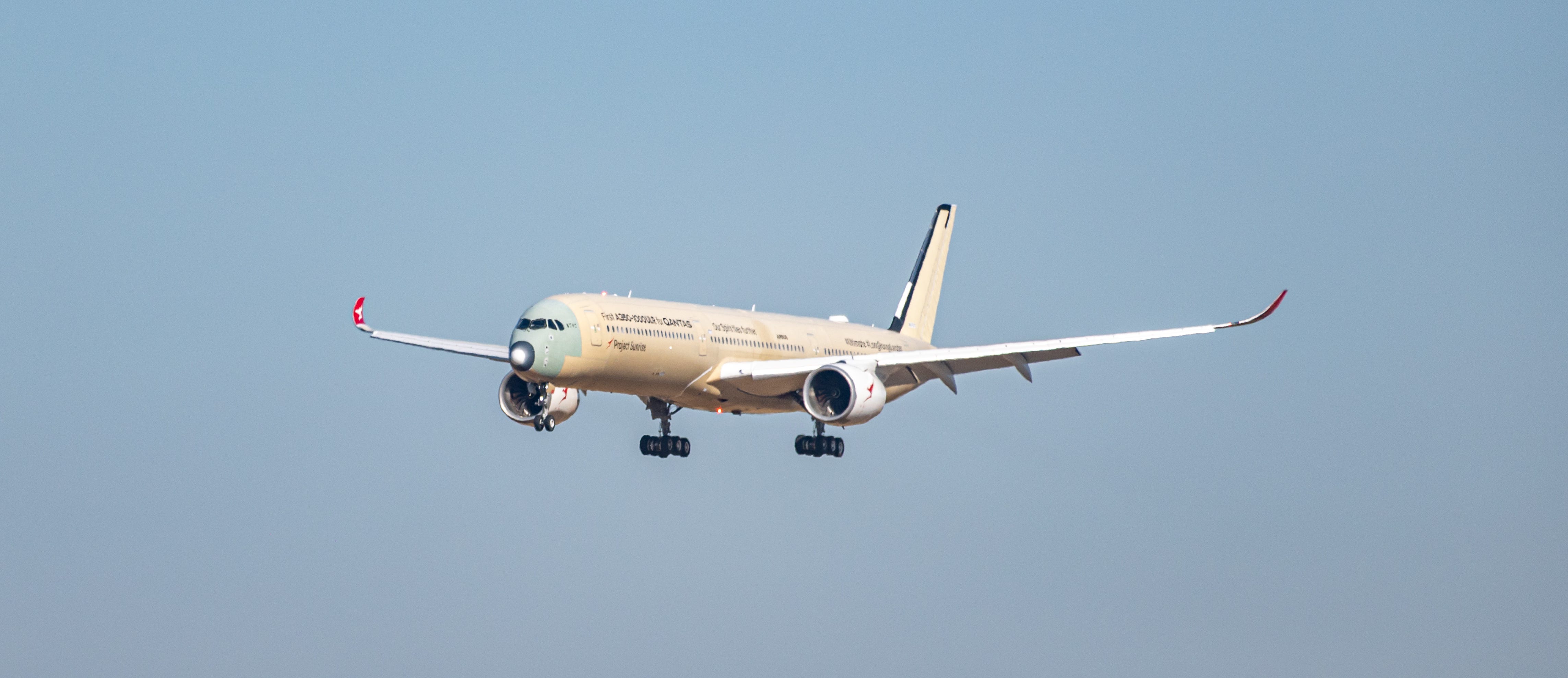
On July 28, 2026, a brand-new Airbus A350 broke the record for the longest uninterrupted flight by a commercial jet: twenty-four hours and twenty-four minutes. The 14,338-mile flight from Melbourne, Australia, to Toulouse, France, demonstrated the viability of Project Sunrise, a joint effort by Airbus and Australian airline Qantas to establish direct flights between Australian cities and destinations that were previously unreachable without a layover. The airline plans to fly in 2027 from Sydney and Melbourne to London, Paris, New York, Rio de Janeiro, and Cape Town.1
Previously, the aircraft had flown from Toulouse (Airbus’s manufacturing base) to Melbourne on July 23 on a 10,500-mile route east over central Asia, demonstrating that the aircraft can fly nonstop from Europe to Australia. The longer return flight also flew east, transiting both the Pacific and Atlantic oceans, the United States, and Canada. In two flights, the plane circumnavigated the globe and demonstrated that it can reach any American or European destination from Australia in a single flight. With a full load of passengers and cargo it can fly a little more than eleven thousand miles, enough to reach Spain or eastern Canada from Melbourne.2
Although spending more than twenty hours on a plane is arduous, it represents a saving of approximately four hours compared to an average layover journey—significant for busy business travelers. It also saves the airline (and, therefore, customers) from paying navigation, landing, handling, security, and other fees—and taxes—at the layover location. Despite these savings, the flight is still more expensive to operate than a layover flight due to the eighteen tons of fuel the plane carries at takeoff and the need to carry two shifts of flight and cabin crew on board for the whole journey. To achieve these long flights, the aircraft must also have fewer passenger seats to reduce its weight. For these reasons, Qantas is banking on passengers paying a premium for the comfort and convenience the flights will offer, charging about 30 percent more for a ticket than the layover option.
Some are dismissing Project Sunrise as a merely expensive indulgence for the wealthy, but this is untrue: Early adopters provide vital funding to drive innovation that ultimately benefits everyone (a principle that can be seen in all kinds of fields, from cars to smartphones). In the days when a jet needed four engines to cross the Atlantic, transatlantic flights cost as much as a family car—but those high-price tickets helped fund development of three- and two-engine jets that made the trip more affordable.3 That process was greatly delayed by regulations prohibiting two-engine jets from crossing the ocean for a long time, and laws that prevented competition among businesses also contributed to the high prices. For example, the Bermuda I and II regulations forbade airlines from undercutting each other’s fares and limited the number of services each airline could provide.4 Despite these artificial constraints, the market still enabled manufacturers to produce a generation of more-efficient transatlantic planes, such as the Airbus A300, the capabilities of which encouraged regulators to relax the two-engine restrictions.5
The Airbus A350 is undeniably a marvel of modern engineering. In addition to the record-breaking range of the Project Sunrise aircraft, which is Qantas’s A350-1000ULR (ultra-long range) variant, all variants of the A350 boast a number of other innovations. Their Active Load Alleviation and Fly-By-Wire systems constantly input data from the plane’s sensors into the flight computers, which make tiny adjustments to stabilize the flight and prevent adjustments that might lead to excessive stress or a loss of flight stability. This keeps the aircraft’s flight safer and more stable, even in harsh wind conditions, than human pilots can.6 Their takeoff and fault monitoring systems detect component failures and system anomalies long before they threaten aircraft functions.7 Most impressively, their pioneering carbon fiber construction increases the aircraft’s ability to endure high-stress conditions from intense crosswinds to fire—a point well demonstrated in the January 2024 accident at Tokyo Haneda Airport, during which the A350 protected its passengers from a raging inferno long enough for all 379 to safely escape following a head-on, high-speed collision with another plane.8 Had any other aircraft type been involved, the crash likely would have been a mass-casualty disaster. (Five of the six people on the other aircraft were killed in the crash.)9
The A350 is, in many respects, the pinnacle of traditional jet airliner development. Virtually no greater time saving on flights of this length is possible until supersonic flight becomes commercially viable because subsonic passenger jets cannot get closer to the speed of sound than they already do without the airflow over the wing exceeding it.10 Just as regulations slowed development of the twin-engine, long-haul jets that preceded the A350, the progress of supersonic aviation has been strangled by the recently lifted restrictions on its use over land.11 Until supersonic aircraft catch up that lost time, the A350 represents a new era in super-long-haul travel. Alongside its unique extra fuel tanks in the center rear of the aircraft, the A350 also boasts adaptations designed to improve the passenger experience in-flight, including a wellness area for exercise and relaxation and enhanced cooling systems for keeping food fresh on board. Airbus is working with Singapore Airlines on adapting its A350-900 fleet into a lighter-weight, shorter-fuselage ULR variant, and it is continuing to develop the A350-1000URL design through Project Sunrise Evolution.12
If these projects are successful and Airbus can continue making the design more efficient and affordable, the A350 could deliver the fastest, most comfortable ultra-long-haul flights for all kinds of passengers across the globe. This kind of innovation enhances people’s lives in myriad ways, making it easier for people to visit overseas family and friends, discover new places and cultures, meet new people, and build new personal and professional relationships. Moreover, it empowers businesses to more easily and efficiently move goods across borders, opening up opportunities and breaking down the barriers between nations. This is what makes the aviation industry and the people who deliver and progress it worthy of celebrating: the way their hard work and constant pursuit of knowledge and achievement enhance human life.
Project Sunrise is not merely a luxury indulgence but rather a turning point in aviation history. It represents the pinnacle of traditional jet travel, and it should spawn a global network of affordable ultra-long-distance flights in the coming years and decades. That will be a tremendous improvement for passengers in Australia and other remote countries that should make their journeys more bearable until supersonic jets finally return. Airbus and Qantas deserve praise for their remarkable achievement, which, if conditions are favorable, will be the sunrise of a new era for aviation.
This article appears in the Fall 2026 issue of The Objective Standard.
“How to Think, Not Feel about Qantas’s Project Sunrise,” Analytic Flying, December 16, 2025, https://www.analyticflying.com/p/how-to-think-not-feel-about-qantass.
“World’s Longest-Range Aircraft, the Airbus A350-1000ULR Takes to the Skies,” Airbus, June 2, 2026, https://www.airbus.com/en/newsroom/press-releases/2026-06-worlds-longest-range-aircraft-the-airbus-a350-1000ulr-takes-to-the-skies.
David Lapesa Barrera, “From 60 Minutes to 370: Key Lessons from ETOPS History,” The Lean Airline, October 21, 2025, https://www.leanairline.com/blog/etops-history.
“Airline Deregulation: When Everything Changed,” National Air and Space Museum, December 17, 2021, https://airandspace.si.edu/stories/editorial/airline-deregulation-when-everything-changed.
Dr. Omar Memon, “What Influences of the A300 Can We See in Modern Airbus Jets?,” Simple Flying, May 23, 2023, https://simpleflying.com/airbus-a300-influences-on-modern-jets.
“Takeoff Surveillance & Monitoring Functions,” Airbus Safety First, October 2019, https://safetyfirst.airbus.com/takeoff-surveillance-monitoring-functions.
“Airbus A350 Safety Features 2026-27: What Pilots Should Know,” Golden Epoulettes Aviation, May 11, 2026, https://goldenepaulettes.com/airbus-a350-safety-features.
Kelly Ng and Simon Fraser, “Japan Airlines: Hundreds Survive after Plane Bursts into Flames on Tokyo Runway,” BBC News, January 2, 2024, https://www.bbc.co.uk/news/world-67862011.
Kathleen Elkins, “Human Error Blamed for Tokyo Plane Collision That Killed Five,” Business Insider, December 25, 2024, https://www.businessinsider.com/human-error-caused-tokyo-haneda-airport-collision-official-report-2024-12.
“Why Does the Speed of Commercial Airliners Fluctuate?” Aviation Stack Exchange, https://aviation.stackexchange.com/questions/29217/why-does-the-speed-of-commercial-airliners-fluctuate-sometimes-as-high-as-1-060.
Matthew Petiti, “Trump’s FAA Moves to End the 50-Year Ban on Domestic Supersonic Flight,” Reason, July 24, 2026, https://reason.com/2026/07/24/trumps-faa-moves-to-end-the-50-year-ban-on-domestic-supersonic-flight.
David Tusing, “In It for the Ultra-Long-Haul: World’s Five Longest Non-Stop Flights and How Project Sunrise Will Top Them,” The National News, July 13, 2026, https://www.thenationalnews.com/travel/2026/07/13/longest-flights-singapore-qantas-emirates.