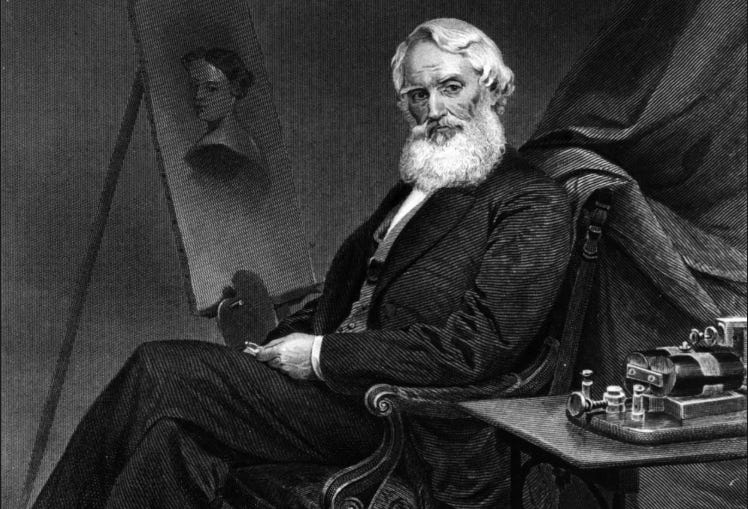
By the time Samuel Morse received the news of his wife’s illness, she was already dead and buried. For most people in 1825, it was an accepted fact of life that sending messages took days, if not weeks; but for Morse, the long delays in communication became a problem that he would devote years to solving. Morse designed and built a system that could send messages across hundreds of miles in seconds. Although he is remembered for the code that bears his name, his real achievement was the integration of the scattered discoveries that others had made about electricity into a practical machine—the telegraph.
Morse was born in 1791 in Charlestown, Massachusetts—then a center of politics and commerce—in a period of rapid scientific and technological transformation. With the Industrial Revolution underway, steam was moving goods on land and sea, industrial processes were displacing manual labor, and capital was pouring into industry and invention. Yet the transmission of messages remained largely unchanged; information still moved at the speed of the people or vehicles carrying it, as it had for thousands of years.1
Though electricity was a subject of growing scientific fascination, scientists were still struggling to understand its fundamental principles. It had been in its “parlor trick era” since the early 1700s, and people viewed it as a volatile and almost supernatural force. Elite salons and scientific exhibitions used electrostatic generators, Leyden jars, and sparks to amaze audiences.2 The public was obsessed with the idea that electricity was the “spark of life,” an idea that took hold after Luigi Galvani’s discovery that electricity could cause muscle contractions in dissected frogs.3 One thought of Dr. Frankenstein, not switches and wires, at the mention of electricity.
At the same time, scientists were making important discoveries. In 1820, Danish physicist Hans Christian Ørsted discovered that an electric current produces a magnetic field. André-Marie Ampère built on this almost immediately, establishing the mathematical relationship between electricity and magnetism. A decade later, Michael Faraday demonstrated that a changing magnetic field could produce an electric current. Across the Atlantic, American scientist Joseph Henry was making similar discoveries independently. Together, these findings established the science of electromagnetism. Yet for all this accumulated knowledge, no one had developed a practical, scalable system of communication from it.
Even the most ambitious practical thinkers remained focused on electricity as a source of physical power for lifting heavy loads and driving machinery and industry. A proliferation of projects, many undertaken without proper scientific understanding, was attempting to harness electricity to power machinery—a task to which it was fundamentally unsuited.4 But it could be used for producing a practically instantaneous, controlled effect at a distance—signaling. Morse built his electrical telegraph to do exactly that.
Morse’s achievement is all the more remarkable given that he was not a scientist by training. Rather, Morse spent much of his early life struggling to establish himself as a painter. He had studied at Yale and trained at the Royal Academy of Arts in London, but he found only limited success, and he spent years traveling and taking portrait commissions wherever he could find work. Morse sailed for Europe in 1829, visiting the museums of Paris and Rome to study European masterpieces. It was on the voyage home, in 1832, that everything changed.
Aboard the ship, Morse’s fellow passenger Dr. Charles Thomas Jackson described to a small group some of the recent experiments with electricity that he had witnessed in Paris. Jackson explained that electricity could be transmitted through a wire of any length with instantaneous speed—a spark appeared at the far end of a circuit at the exact moment that the connection was made.5 He also demonstrated the properties of the electromagnet: A core of soft iron becomes magnetic only while a current passes through its surrounding coil and loses that magnetism the instant the current is cut. This means that physical force can be triggered and released at a distance, practically instantaneously, through a simple wire.
Morse saw the implication immediately: “If the presence of electricity can be made visible in any part of the circuit, I see no reason why intelligence may not be transmitted instantaneously by electricity.”6 With that thought, the electromagnet was no longer a mere experimental curiosity.
The idea of using electricity to communicate was not new—it had been proposed in various forms since the time of Benjamin Franklin. But whereas others had used electromagnetism to produce visible, physical effects (such as deflecting needles to point at a display), Morse saw a means of carrying information directly: By controlling when the current was on and when it was off, the message could be encoded in the timing and the sequence of that single, repeatable signal. He spent the remainder of the month-long voyage filling his notebooks with designs for a recording telegraph. Morse was “most constant” in pursuing the subject throughout the voyage.7 By the time the ship docked in New York, he had already developed a nearly complete plan for his recording apparatus.
Back in New York, Morse set about building a working model of his telegraph. The device would record electric signals as marks on paper. Instead of requiring an operator to observe the signals as they occurred, it would create a permanent record that could be read afterward. His painting career had all but collapsed, and he was living in poverty, working and sleeping in his studio at New York University (NYU) where he served as a professor of painting and took on private pupils to earn his keep.
His first prototype was built from scrap materials in his studio. A clockwork mechanism pulled a strip of paper under a pencil, and electrical pulses from a battery activated an electromagnet that moved a rocker arm, which in turn moved the pencil, tracing a wavy line on the paper that could be decoded as a message. Crude as it was, the device worked. It showed that the principle of his invention was sound: Electricity could produce a precise, readable effect at a distance.
But Morse was unable to improve upon his model to overcome the problem of transmitting messages over a useful distance. His apparatus could send signals only up to about forty feet. The electrical resistance of the wire caused the current to weaken so much that it could not trigger the recording stylus over a longer distance. Previous attempts at electrical communication had failed repeatedly for the same reason, and Morse struggled with this problem for two years.
The solution already existed in the scientific literature. Henry had shown that a weak incoming signal could be used to trigger a fresh, fully powered outgoing signal through a device he called the electromagnetic relay.8 Leonard Gale, a chemistry professor at NYU familiar with Henry’s work, brought this to Morse’s attention. The relays took their name from the post stations of coach travel, where tired horses were replaced by fresh ones. In Morse’s telegraph, the weak current arriving at the end of its range simply operated a tiny electromagnet, which closed a fresh circuit powered by another battery. The incoming signal was thus repeated over another length of wire. By placing relays at intervals, a message could travel any distance.
This breakthrough did more than merely solve Morse’s problem; it established the fundamental principle of signal amplification in modern electrical engineering. The relay was the conceptual ancestor of the transistor and every electronic switching device that followed.
By 1837, Morse had been living on next to nothing for years—splitting his university salary into daily allowances, cooking his own meals in his studio, and using what little money remained to acquire parts for a working model. That year, Alfred Vail, the son of a prosperous ironworks owner in Morristown, New Jersey, proposed a partnership. He would build a working model at his own expense, using his father’s ironworks, in exchange for a share of the patents. The arrangement gave Morse the capital and precision engineering he had lacked.
Working through the winter of 1837 at the Speedwell Ironworks, Vail refined the crude prototype into a durable instrument and developed the dot-and-dash code that would carry Morse’s name. On January 6, 1838, after years of effort, Morse could finally demonstrate a fully functional version of his invention to the world. As a definitive test, Morse and Vail organized a demonstration. Two miles of wire were coiled around the room of the Speedwell factory building. Vail’s father dictated a message, and his son transmitted it. At the other end, Morse decoded the words: “A patient waiter is no loser.”9
The years following the demonstration were again a period of poverty and failure for Morse. He sought private capital to commercialize his invention, approaching financiers in New York to fund a working telegraph line. But the financial panic of 1837 had drained investment markets, and he was met with indifference and rejection. He needed to build the telegraph over a distance long enough to demonstrate its usefulness, and he lacked the capital to do so himself.
In 1837, Congress directed the Treasury Department to investigate the establishment of a national telegraph system, and proposals were requested. Morse was the only respondent to propose an electromagnetic telegraph; the rest proposed “optical telegraphs”—systems that transmitted signals visually between stations in line-of-sight using mechanical indicators such as arms and shutters.10 Morse argued that his invention could operate at any time of day or night, in any weather, and could record messages even when unattended.
Morse demonstrated the telegraph to Congress and President Van Buren, proposing that the government fund an experimental line between Washington, D.C., and Baltimore to test the practicability of transmitting messages between distant points. The line would serve as a test for an electromagnetic telegraph’s use for rapid official communication, but it failed to gain support in Congress. He sailed for Europe to secure patents but found himself shut out in London and unable to enforce the one he obtained in France. He returned to America having gained nothing and was forced to take up portrait commissions to survive.
For the next four years Morse pursued support from Congress, submitting formal petitions for the experimental line. It was a period of wasted genius—he was waiting for political approval to build a demonstration of a concept that he had already proven. In December 1842, Morse obtained permission to demonstrate the telegraph to the legislators directly, realizing that years of petitioning on paper had failed. He strung wires between two committee rooms in the Capitol and demonstrated the telegraph once more. This time, Congress listened.
The Morse bill, which had been shelved since 1838, was brought back before Congress. The bill faced considerable opposition in the House, with one representative ridiculing Morse’s proposition that if Congress was funding Morse, it ought equally to appropriate money for experiments in mesmerism—a pseudoscientific practice of hypnosis popular at that time.11 Supporters, however, argued that Congress had the authority to fund such a system under its constitutional power to establish post offices and roads.12 Seventy congressmen abstained rather than vote public money toward something they did not understand. The bill then waited behind more than 140 others in the Senate, with one day left in the session. Morse had not expected it to survive. After a dramatic midnight vote, the news reached him the next morning: The Senate had passed the bill. President Tyler signed it into law on March 3, 1843.13 Morse had $30,000.
With the funding secured, Morse set to work on the first long-distance telegraph line in the United States—thirty-eight miles of wire connecting Washington to Baltimore. On May 1, 1844, before the line was even complete, news of the Whig Party’s nomination of Henry Clay was telegraphed from Baltimore to Washington, arriving ahead of the train carrying the same information. On May 24, with the line complete, Morse sat in the Capitol and transmitted the first official message to Vail at the Baltimore railroad depot: “What hath God wrought.”14 The Baltimore Sun declared that “time and space had been completely annihilated.”15 Morse later offered to sell the telegraph to the government for $100,000. The government declined, concluding that the revenue from the line would not justify its expense.16 Morse turned to private investors, licensing the technology to commercial enterprises that expanded it rapidly. The system was a huge commercial success, and the companies that built it were later consolidated into Western Union. Within a decade, the Morse telegraph system had been adopted as the international standard, and lines were crossing continents.
Morse spent twelve years turning a sketch into a working line while battling poverty, failed patents, and a Congress that could not tell electromagnetism from mesmerism. He was not a scientist. He was an inventor who saw that electricity could carry intelligence. The telegraph was built on brilliant scientific integrations and the discipline to see a single idea through when virtually every practical circumstance was against it. Morse spent much of his later years defending his patents in court, fighting off rivals who sought to claim what he had built. By his death in 1872, his estate was valued at half a million dollars. He had lived to see telegraph lines cross continents and oceans, carrying the language of dots and dashes, all from an idea that he had devised aboard a ship forty years earlier.
Morse’s work stands as an outstanding triumph of engineering—a field whose value lies not only in uncovering nature’s laws but in bending them to human ends. His achievement shows that bringing an idea into existence demands not merely knowledge but its application and not merely ability but immense perseverance.
Though semaphore towers could relay signals across distances, they needed clear skies, a chain of operators, and could manage only a few words per minute.
Paola Bertucci, “Sparks in the Dark: The Attraction of Electricity in the Eighteenth Century,” Endeavour 31, no. 3 (September 2007), https://hshm.yale.edu/sites/default/files/files/Bertucci%20Endeavour.pdf.
“The Body Electric,” Smithsonian Institution, https://library.si.edu/exhibition/fantastic-worlds/body-electric (accessed April 17, 2026).
Joseph Henry, letter to Samuel F. B. Morse, February 24, 1842, https://commons.princeton.edu/josephhenry/telegraph/.
Although electrical signals really travel at a significant fraction of the speed of light, over the short distances available to early experimenters this created the appearance of instant transmission. Similarly, “any length” is an oversimplification—resistance increases with wire length, weakening the signal over distance.
Samuel Irenaeus Prime, The Life of Samuel F. B. Morse, LL. D., Inventor of the Electro-Magnetic Recording Telegraph (New York: D. Appleton and Company, 1875), 252.
Prime, Life of Samuel F. B. Morse.
David Hochfelder, “Joseph Henry: Inventor of the Telegraph?,” Smithsonian Institution Archives, https://siarchives.si.edu/history/jhp/joseph20.htm.
“Demonstration of Practical Telegraphy, 1838,” Engineering and Technology History Wiki, https://ethw.org/Milestones:Demonstration_of_Practical_Telegraphy,_1838 (accessed April 21, 2026).
U.S. Senate, “Morse’s Telegraph in the Capitol,” https://www.senate.gov/artandhistory/senate-stories/morses-telegraph-in-the-capitol.htm; U.S. Postal Service, “The Telegraph and the Post Office,” https://about.usps.com/who-we-are/postal-history/telegraph.pdf.
“A Congressional Made Man,””History, Art & Archives, U.S. House of Representatives, https://history.house.gov/Blog/2020/August/8_4_morse/.
U.S. House of Representatives, Electro-Magnetic Telegraph, H. Rept. 15, 27th Cong., 3d sess. (1843).
Edward L. Morse, “The District of Columbia’s Part in the Early History of the Telegraph,” read before the Columbia Historical Society, January 9, 1899, https://ipmall.law.unh.edu/content/patent-history-materials-index-district-columbias-part-early-history-telegraph-edward-l; “Invention of the Telegraph,” Library of Congress, https://www.loc.gov/collections/samuel-morse-papers/articles-and-essays/collection-highlights/invention-of-the-telegraph/.
U.S. Senate, “Morse’s Telegraph in the Capitol,” https://www.senate.gov/artandhistory/senate-stories/morses-telegraph-in-the-capitol.htm.
“Time and Space Has Been Completely Annihilated,” The Atlantic, February 14, 2012, https://www.theatlantic.com/technology/archive/2012/02/time-and-space-has-been-completely-annihilated/253103/.
“1830s–1860s: Telegraph,” Imagining the Internet, Elon University, https://www.elon.edu/u/imagining/time-capsule/150-years/back-1830-1860/.


