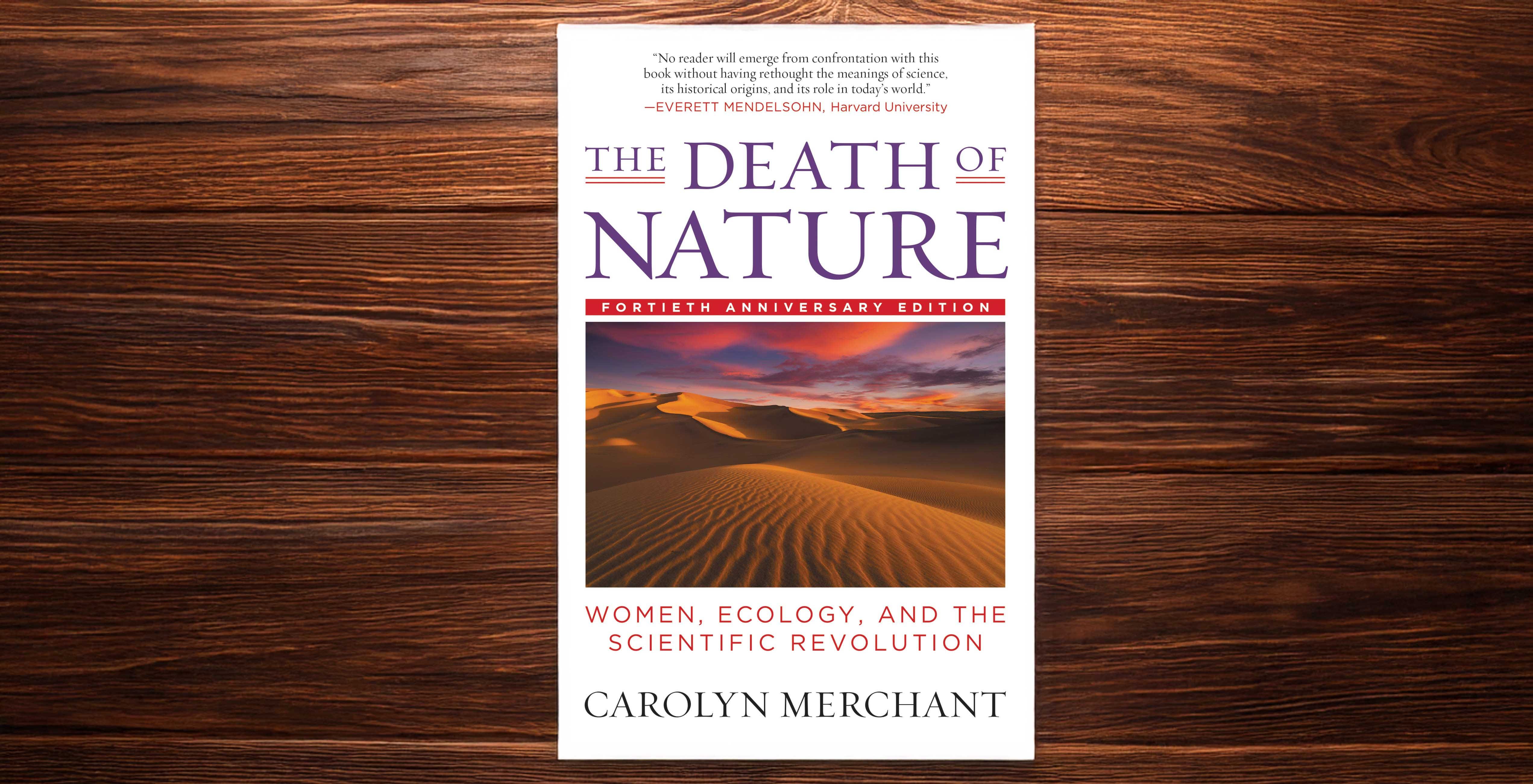
The Death of Nature: Women, Ecology, and the Scientific Revolution by Carolyn Merchant (Review)
Reviewed by Margherita Bovo
New York: Harper & Row, 1980
348 pp., $ 11.82
Carolyn Merchant’s The Death of Nature: Women, Ecology, and the Scientific Revolution (1980) was the first systematic work to develop an area of academia that became known as “ecofeminism” and is still influential among leftist feminists and environmentalists. The book argues that the Scientific Revolution replaced an organic view of the world—one that regarded the universe as a living being—with a mechanist one, in which natural phenomena can be explained as the result of the motion and interaction of matter according to the laws of physics. It focuses on the supposed social impact this change had on women and on many people’s conception of femininity: Merchant claims that the widespread rejection of “organicism” increased the marginalization and subjugation of women, whereas scientists and men in general gained much more power.
Merchant claims that the public attitude toward scientific disciplines began to change in the 1600s. She starts by looking at the philosophy of nature and literature before the 1600s, using what she deems Francis Bacon’s misogyny to claim that his influence in those fields was oppressive for women. As an example, she cites Bacon’s statement that scientists are men (meaning specifically males) who can manipulate nature (165). As Merchant explains, in the premodern world, the Earth was typically portrayed as a “feminine being.” When mechanism became popular in the 16th and 17th centuries, those who accepted it not only rejected the previous idea of nature as a living being but, she claims, imposed a male “mastery and domination” on this female entity (2). Following Bacon, they argued that nature is chaotic until men discover the laws of physics that govern it and are able in this way to predict and modify natural phenomena.
Merchant points out that women during this time were largely excluded from studying science and also argues that the disciplines that were commonly dominated by women were dismissed by many supporters of the Scientific Revolution. For example, she mentions many male philosophers throughout history who held limited or ignorant views of obstetricians (155). Merchant also claims that literature (particularly utopian literature) suffered from this change of mindset. She compares the “ideal” of equalitarian societies imagined by Tommaso Campanella in The City of the Sun (1602) and by Johann Valentin Andreä in Christianopolis (1619) with Bacon’s New Atlantis (1626). The latter is characterized by a hierarchical, patriarchal society in which scientists manipulate nature, whereas the former examples portray society as an organism in which everyone plays an equally important role for the “common good” (173; 183–84). According to Merchant, such views shaped what was once regarded as the ideal society in a more valuable way morally than did the Scientific Revolution.
Even when discussing feminist philosophers such as Anne Conway, Merchant continues to assert that the idea of man’s dominion over nature (and over women, according to her framework) was much more popular than their theories. She makes clear that Conway’s vision, according to which the universe is made up of the same substance and every part of it is self-conscious, was not as successful as the more mechanistic views of Gottfried Wilhelm von Leibniz and Isaac Newton, which Merchant claims derive from Bacon’s mindset. She even presents the new scientific method as the main cause of rising concern about “witchcraft” (140).
Industry and modern science, Merchant argues, are characterized by the nature/culture (women/men) dichotomy. She states that, because men (culture) have used natural resources to build cities and develop industries throughout history, they therefore have oppressed women (nature) since the very beginning of industrialization (236). Merchant concludes that today’s society (which she incorrectly characterizes as capitalist) derives from misogyny and mechanicist attitudes developed in the Modern Age and that it is a sign of men working on the “manipulation of the environment” (182).
The Death of Nature was a turning point in ecology and “gender studies.” The comparison between women and nature presented in the book inspired leftwing thinkers to link the two under the banner of “ecofeminism.” Since the 1980s, the study of women’s history in academia has focused largely on the history of “the environment.” In 1985, Evelyn Fox Keller further developed Merchant’s ideas in Reflections on Gender Studies; in 1989 Vandana Shiva’s Staying Alive used the term “maledevelopment” to describe what the author thinks is the main attitude men and science have toward women and nature.[1] In 1991, the magazine Hypatia focused on the “philosophy of ecofeminism,” criticizing “rational tools” and Western culture. In the 2000s, many so-called feminists were concerned about the supposed oppression that they claimed were caused by male, scientific, and capitalistic views.[2] In the 2010s, most scholars and activists kept claiming that ecology and feminism could develop only under socialism, which is opposed to the idea that individuals survive through the use of their own reason.[3] Twenty-seven years after the publication of The Death of Nature, Merchant herself declared that socialism is the best way to discover and create new paths for knowledge and gender roles.[4]
This kind of framework has rarely been challenged. Many activists and academics display great concern for the alleged problems with the environment, their attitude generally begetting a simultaneous strawman of capitalism and denial of the extent to which most Western societies today are heavily socialist already. Socialist scholars and “ecofeminists” define “capitalism” as a “male-controlled” system rather than seeing it as a system based on the recognition of individual rights.[5] These positions are not accurate, yet they are still common in universities.[6] Recent articles still focus on Merchant’s ideas and scholars still discuss them.[7]
The common thread of Merchant’s analyses is what she calls the “violent” attitude Baconian scientists and semi-capitalist societies have toward nature, an attitude that supposedly corresponds to wider misogynism in Western culture. Until the Renaissance, most people believed that every entity in nature was alive (even minerals were thought to have a “lower level” of consciousness); to Merchant, this view seemed to better respect women’s dignity because every entity has a role in the “harmonic whole” of existence and knowledge could not justify the dismissal of any living being (27–28). The Scientific Revolution rejected that vision and, for Merchant, this meant rejecting respect toward women and natural elements in general. Bacon supported inductive reasoning, and, according to his own assertion, he inaugurated a methodology that could be compared to torture, describing experiments as the tool a scientist could use to force nature to be “bound into service” and confess every secret (168). From this, Merchant concludes that women and nature are “kindred spirits” because both have been discredited and taken advantage of by Western culture since the 1600s because Bacon’s method was “so readily applicable when nature is denoted by the female gender” (169). Therefore, this nature/culture dichotomy supposedly separated women from knowledge because “Women’s reproductive function required that more energy be directed toward pregnancy and maternity, hence less was available for the higher functions associated with learning and reasoning” (163). (Merchant’s “nature/culture” framework is just as dismissive of women as those advocated by many of the men she criticizes—perhaps even more so—but this irony seems to be lost on her.)
Humans depend exclusively on our rational faculty to survive; we must use natural materials to create what we need. Merchant seems to be aware of this fact and attributes it to men (but not women) while holding that it is somehow bad. She claims that after the Scientific Revolution, Western societies began to judge science largely in terms of the extent to which it could facilitate industrial productivity (251). Merchant criticizes capitalism as the consequence of a misogynist mindset and “the effort to control and harness nature through technology,” and she condemns “capital-intensive economic methods” (295) because they allegedly are related to the “subjugation of nature and women” (294). Merchant claims that this emphasis on industrial progress had terrible consequences for the Earth, such as the 1979 Three Mile Island nuclear incident, which she claims “damaged” the surrounding environment. She bases this claim wholly on the fact that the soil nearby later contained high levels of cesium-137—but this had no consequences whatsoever for human, animal, or plant life in the area (295). That seems to be irrelevant to Merchant, or maybe she was not aware of the scientific studies that followed the incident and confirmed the absence of damage. In any case, her comment on the event is superficial and she ignores most facts related to the case.
The epilogue declares that the “death of the concept of living nature” in the 17th century is the main cause of both prejudice against women today and the current “ecological crisis” (XV). Merchant’s main conclusion is threefold: (a) that “natural resources and energy supplies” (295) are diminishing, (b) that pollution is increasing, and (c) that it is crucial to “reevaluate human priorities” and “change our attitude” with respect to these things (290). She also states erroneously that to see the “human race as a rational species” is not a complete definition, because a great part of humankind “seems to have been excluded by it” (251). As a possible solution, she recommends that we reject the oppression women have been facing “since the Scientific Revolution,” which she thinks led to today’s society and “environmental dilemma” (XXI), and “discover values associated with the premodern world that may be worthy of transformation and reintegration into today’s and tomorrow’s society” (XXIII).
The book does not mention the Enlightenment at all, negligently ignoring a time in which both the Baconian and Newtonian systems were further developed and challenged. She excludes influential thinkers of that time, such as Voltaire and Denis Diderot, to support her claim that Renaissance thinkers believed that the universe has no consciousness.[8] Voltaire was always opposed to mechanism and Diderot spent almost his whole life looking for a consistent system able to describe nature.[9] Both thinkers dealt with the issue of women’s treatment in their centuries, and their attitudes are far from misogynist. Similarly, Jean Baptiste le Rond D’Alembert never regarded progress as incompatible with women’s freedom. D’Alembert used rational tools to approach the study of the world and was convinced that the Scientific Revolution had improved living conditions, and believed this applied to everyone, including women—D’Alembert always claimed that men and women had the same value and needed to have the same legal rights.[10] The description Merchant offers is, therefore, historically inaccurate and does not convey how complex the cultural framework was at that time. Her book is deeply unfair to many thinkers who contributed to the development of reason and improvement of human life.
The comparison Merchant makes between the beginning of the Scientific Revolution and the birth of capitalism is also superficial. It is true that the two events are linked in some respects, but her claim that they both caused women to be oppressed is baseless. Regardless of Bacon’s ideas, it is undeniable that, for both men and women, life before the Scientific Revolution was much worse overall than afterward.[11] Even if women today face prejudice and violence more often than men, this does not mean that the past was better in this respect or that the Scientific Revolution was to blame.
The fundamental issue of The Death of Nature is the way it deals with human nature. Merchant tries to challenge a view of mankind that, according to her, has been dominant for centuries—the idea that humans are rational beings—but ends up explaining history by using a concept that has nothing to do with reality: her nature/culture dichotomy (which corresponds in her book with her women/men dichotomy). Her distorted conception of what happened to nature and women through the centuries leads her to exaggerate some circumstances and ignore other relevant events. During the Scientific Revolution, thinkers tried to develop a more rational approach to the world and human life. That women were largely excluded is because many at the time did not apply the description of mankind as rational to all humans, not because the definition itself was not inclusive. To advocate for another definition of humankind that does not involve reason in order to include women is much more misogynist than any statement of Bacon’s because it implies that women are not rational at all. Paradoxically, Merchant ends up enabling misogynists to exclude females from progress and science.
[1] Gregory Morgan Swer, Nature, Gender and Technology: The Ontological Foundations of Shiva’s Ecofeminist Philosophy: Comparative and Continental Philosophy 12, no. 2—Get Access (Taylor and Francis online, 2020), https://www.tandfonline.com/doi/full/10.1080/17570638.2020.1780685.
[2] Trish Glazebrook, “Karen Warren’s Ecofeminism,” in Ethics and the Environment 7, no. 2 (Autumn 2002): 12–26, https://www.jstor.org/stable/40339034?seq=4.
[3] Marco Armiero, ed., La storia ambientale ed io: intervista a Carolyn Merchant (Zest, 2007), https://www.zestletteraturasostenibile.com/la-storia-ambientale-ed-io-intervista-a-carolyn-merchant-a-cura-di-marco-armiero.
[4] Armiero, La storia ambientale ed io.
[5] Andrew Bernstein, The Capitalist Manifesto: The Historic, Economic and Philosophic Case for Laissez-Faire (University Press of America, 2005), 18.
[6] For example, Christine Bauhardt, “For More Than Forty Years on the Bookshelves: The Death of Nature—A Tribute to Carolyn Merchant,” in Ethics and the Environment, vol. 27 (Indiana University Press, 2022).
[7] Roberto Barbosa and Iohana Santarelli, “A Feminist History of Science: Carolyn Merchant and the Death of Nature,” in Educación y Ciencia 29, no. 2 (2025), https://doi.org/10.19053/uptc.0120-7105.eyc.2025.29.e18331.
[8] Voltaire, Traité de métaphysique, ch. II, Italian translation by G. Ricci (autonomous publication, 2021), 23 ff.
[9] Voltaire, Traité de métaphysique, ch. II, 11 ff; cfr. Edoardo Tortarolo, L’Illuminismo (Roma: Carocci, 2020), 35.
[10] Tortarolo, L’illuminismo, 231 ff.
[11] Andrew Bernstein, The Capitalist Manifesto, op. cit. 55.


That cesium-137 example is such a telling detail. Merchant cites elevated readings but skips the actual risk assessment showing no ecological damage. I ran into this same pattern when reviewing environmental impact studies,where activists highlight detectable measurements without context on whether those levels actually matter. The gap between "we can measure it" and "it caused harm" gets collapsed all the tiime.