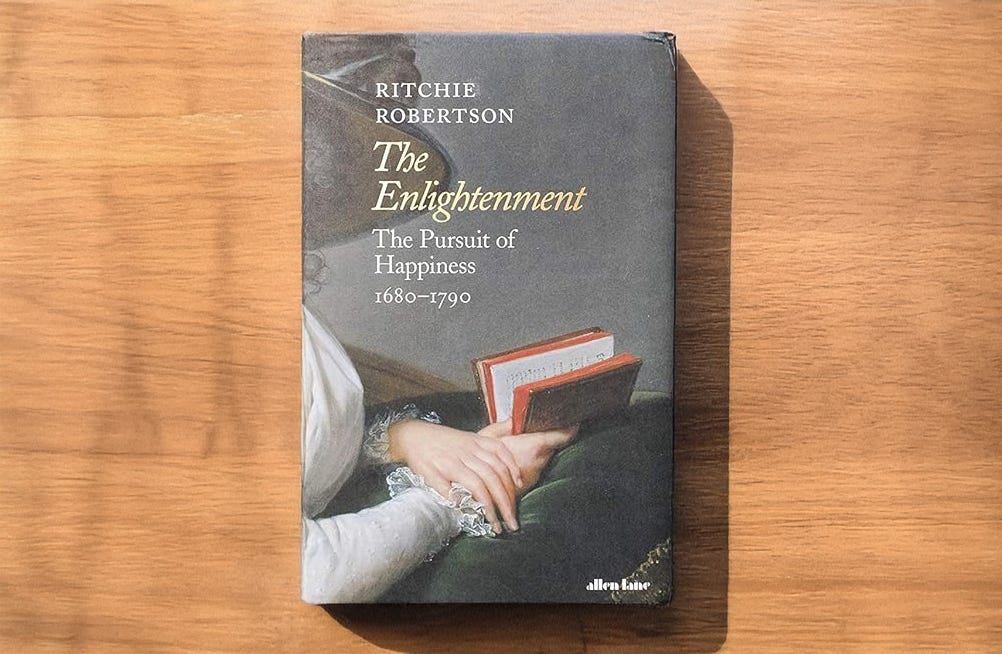
The Enlightenment: The Pursuit of Happiness, 1680–1790 by Ritchie Robertson (Review)
Reviewed by Margherita Bovo
London: Penguin Books Ltd., 2022 (originally published 2020)
1,008 pp., $18.99
The Enlightenment was a cultural current almost everyone has heard about—yet today it is not a major concern for many scholars nor for people interested in history and philosophy. Misleading stereotypes about thinkers of this movement include that they advanced a cynical version of reason, aimed to erase emotions, supported mechanistic theories, and hated religion. Some descriptions of the age allude to the widespread interest in science or mention that philosophers were often involved in politics, but it is hard to find an accurate explanation of the reasons that led to such phenomena and the ways thinkers acted in those cases. Today, most scholars and people interested in philosophy regard the Enlightenment as a two-dimensional, cold, and outdated cultural movement that is less relevant than other movements, such as postmodernism. Ritchie Robertson’s The Enlightenment: The Pursuit of Happiness, 1680–1790 (2020) acknowledges these problems and strives to avoid them. The work is written in a precise, nonacademic style that helps anyone curious about the Enlightenment approach the subject.
Robertson starts by declaring that his aim is to give a “rounded picture of the Enlightenment” and to focus on the practical consequences of reason (xvii). He deals with many facets of the Enlightenment, starting with happiness, reason, and passion in the first chapter, then the Scientific Revolution, toleration, religion, apostasy, science, sociability, practical disciplines, aesthetics, society, history, cosmopolitanism, the forms of government, and revolutions in the following thirteen chapters.
The way Robertson introduces the Enlightenment is both accurate and original. His first key argument is that, according to most Enlightenment thinkers, “the goal of life was happiness” and that it could be found in this world here and now, despite the fact that suffering is real (1). Robertson explains how philosophers from the Enlightenment conceived of happiness and the way they aimed to reach it, which led to “a commitment to understanding . . . the causes and conditions of human betterment in this world” and the rejection of anything that caused irrational fear, such as superstition and ignorance (37). They recognized that men, instead of being guided by “blind faith,” should be guided by reason (21). In his Preliminary Discourse, for example, Jean Le Rond d’Alembert claimed that, to build a useful system of knowledge, one must grasp that human understanding does not start with abstractions but with sense data; reason does not work against the senses but is based on and requires them.[1] Further, Enlightenment thinkers generally understood that gaining knowledge does not require renouncing emotions.[2] For instance, René Descartes, Alexander Pope, and Chevalier de Jacourt remarked on the importance of passions in human life and the possibility of their coexistence with reason. During the Enlightenment, human beings were not considered “first and foremost rational, endowed by God with the gift of reason in contrast to the animals” (261). The conception of humankind developed during the 18th century was more secular and rounded, and it aimed to account for not only reason but all the human passions and vices. Contrary to popular belief, Enlightenment views on morality broadly did not posit an idealized fantasy of men as behaving emotionlessly despite often leading to the conclusion that reason was the proper means of understanding emotions and dealing with desires.
This respect for reason fed the Scientific Revolution, the development of which Robertson covers extensively. This series of discoveries began with thinkers such as Descartes, Francis Bacon, and Isaac Newton who sought to understand the world around them without reference to a mystical deity. In their Encyclopedie, Denis Diderot and Jean Le Rond d’Alembert continued the revolution by applying the Baconian and Newtonian scientific approaches to nature to find a way to learn about reality after rejecting the biblical narrative (60–63). Robertson points out that Voltaire (1694–1778), who is often remembered only for his literary production and his battle against Christian fanatics, was one of the first thinkers to advance Newtonianism in France and continental Europe (62).
Many thinkers at this time used science as a weapon against myriad forms of mysticism, though Robertson is aware that during the Enlightenment “scientific knowledge was [viewed as] the enemy of superstition, but not of religion” (83). However, he does not omit that thinkers challenged both the Old and New Testaments. According to Voltaire, for example, St. Paul was an authoritarian figure; he also noted that the miracles Jesus allegedly performed were impossible (191). At the same time, not every Enlightenment thinker was willing to believe that the world was governed by brute matter only, which was sometimes seen as the alternative to a religious view of the world.[3] Deism (the belief in the existence of an impersonal God that created the universe but does not interfere with human life) was more popular than atheism, though many atheists and some Deists were wary of Christian dogma creeping into Deistic teachings. Deists’ main goal was to find a way to free men from the fear of the unknown and from the violence of fanatics. Humans were beginning to understand that they did not have a reason to fear a God above—their actions could be judged according to rational criteria rather than biblical dogmas or governmental decrees.
As Robertson concludes, it became clear that authorities could not rely on personal beliefs as the only standard to judge someone’s actions without the support of concrete evidence. Toleration, as it was usually discussed then, was not relativism, but the rejection of the imposition of dogma on individuals. Thus, despite popular portrayals to the contrary, there was much disagreement between Enlightenment thinkers about moral issues.[4] For instance, Cesare Beccaria (1738–1794) argued that punishing suicide (as many states did at that time by fining the relatives of those who ended their lives) was pointless. Charles Louis de Secondat baron of Montesquieu (1689–1755) claimed that it is unjust to deprive someone of an escape from an intolerable life, whereas Immanuel Kant (1724–1804) firmly condemned suicide.[5]
The Enlightenment was also a time when individuals interacted in new social frameworks to communicate ideas (277). The 18th century has been called “the sociable century” because coffeehouses, salons (often run by women, who were starting to find their own intellectual dimension and autonomy more frequently than in the past), and scientific or philosophic societies were venues for key discussions (365). Robertson’s work provides a reliable description of the Republic of Letters, a community of scholars who interacted at a distance via letters and newspapers, trying to find other means besides printed books to spread and discuss ideas while avoiding censorship. The Republic of Letters chose Latin as their international language and aimed to share their discoveries with one another and with people all over Europe. This is an instance of the Enlightenment ideal of being “a cosmopolitan or ‘citizen of the world’” (601). To learn about the world meant, in part, to write a secular history, which could reconstruct the development of the Earth and of human beings starting from empirical evidence rather than religious stories about past events. Voltaire was a prominent figure in this field. In his Essai Sur les Mœurs et L’esprit des Nations (1756), he aimed to write an integrated history including both Christian and non-Christian cultures and to prove false the chronology put forth in the Bible (556–58).
The Enlightenment was, overall, a movement that saw philosophy as an instrument for living in this world and used it to promote practical changes in reality as well as to introduce innovations not only in history, science, metaphysics, and morality but also in industry, agriculture, and education. This attitude was embodied by the Encyclopedie, “a vast panorama of knowledge” that aimed to understand and communicate the way the human mind works, as well as how truth can be achieved and applied in any field from art to politics to manual labor.
The conclusion of the book deals with the objections the Enlightenment faced, mainly from the left. It also offers a valid yet short rejection of Theodore Adorno and Max Horkheimer’s Dialektik der Aufklärung (Dialectic of Enlightenment), a work published in 1944 that became the main reference point not only for those who criticize the Enlightenment but also for those who are approaching it for the first time and looking for a guide. This work contributed to creating a false image of the Enlightenment that led to hostility toward it in the contemporary world. Roberston points out that stating that such a movement led to totalitarian regimes or to horrific events such as the Holocaust, as that book does, is utterly implausible (769–70).[6] He remarks that many critics, Adorno and Horkheimer included, define the Enlightenment too narrowly, ignoring the diversity of views and approaches that nevertheless fall not only in the period of the Enlightenment but within its spirit of rational inquiry and curiosity. According to Robertson, Horkheimer and Adorno “produced a scattergun assault on many aspects of modernity” rather than focusing on the Enlightenment itself (775). Moreover, they built a narrative that uses capitalism as a strawman while acknowledging the horrors of Nazism and fascism—but ignoring the atrocities of Soviet socialism (775).
Robertson’s book focuses on the ideas that underpin what the Enlightenment was, including the most famous (such as those about reason, science, and religion), and also those concepts developed during the 18th century that aren’t often associated with it (including happiness, cosmopolitanism, and the renovation of history as a formal discipline). Robertson puts every key idea in relation to the historical and philosophic context of that time and gives many examples of arguments by philosophers of that age. He focuses on the most famous thinkers of the Enlightenment, such as Voltaire and Kant, but he provides a more rounded description of their ideas than one often finds. In this book, Voltaire is remembered not only for his literary works and his battle for tolerance but also for his works on history and science. Robertson mentions Kant as a very influential thinker of that age and a supporter of what he considered to be reason but also makes clear that many of his ideas contradicted the values of the Enlightenment (31).
The author also describes the ideas of lesser-known thinkers of that age—including Pierre Louis Maupertuis (1698–1759), Ludovico Antonio Muratori (1672–1750), and Émilie du Châtelet (1706–1749)—and the influence each of them had. Further, the book deals with the way the Enlightenment developed not just in France and England (the two nations generally associated with this age) but in many other European countries, including Germany and Italy. Robertson takes the Enlightenment era very broadly in this work, which includes several philosophers from the 17th century (e.g., Descartes and Spinoza), yet this might help readers understand the steps that led to the movement in the 18th century, avoiding a common depiction of that age as an isolated moment in human history.
The Age of Reason is much more complex than many philosophy books claim and much more valuable than some of its detractors claim. The tools it provided to fight superstition, understand human beings, and improve life are still useful today—and always will be. Ritchie Robertson is fully aware of this when he reminds the reader that “freeing people from false beliefs” was the “overriding purpose of enlightened thought and activity” (xvii), which is a task to keep in mind now, in a time when freedom of thought and of research are “under threat” (780). His book, with its nuanced portrayal and clear writing, is a valuable way to rediscover the power of the Enlightenment.
[1] The first of the two introductions to the Encyclopedie. Cfr. Jean Baptiste le Rond d’Alembert, Discours préliminaire à l’Encyclopedie, Édition électronique (ePub, PDF) v.: 1, 0: Les Échos du Maquis, 2011, Discours préliminaire à l’Encyclopédie, 6–7.
[2] Max Horkheimer and Theodore Adorno, Dialectic of Enlightenment (New York: Seabury Press, 1972), 23.
[3] According to materialism, matter and its movements are the only cause of all phenomena, including thoughts and emotions.
[4] Andrej Elzanowski, “Moral Progress: A Present-Day Perspective on the Leading Enlightenment Idea,” Argument: Biannual Philosophical Journal 3, no. 1 (June 2023): 9–26, Moral Progress: A Present-day Perspective on the Leading Enlightenment Idea, 14–15.
[5] It is important to note that Kant was not an Enlightenment thinker, yet he is commonly associated with this cultural movement.
[6] Horkheimer and Adorno, Dialectic of Enlightenment.


