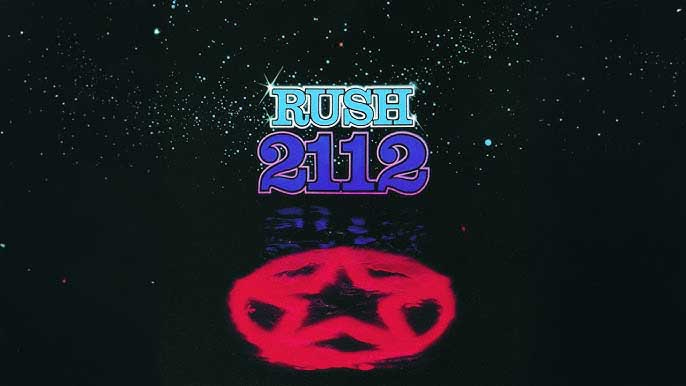
Rush’s “2112” is no ordinary rock song. Released in March 1976, it’s a twenty-one-minute epic composed of seven movements telling a complete story about the mind-destroying natures of tyranny and collectivism. It’s a song that wouldn’t exist if not for the band’s dogged dedication to their artistic integrity. If their record label had had its way, “2112” would never have been recorded—yet it’s the song that propelled Rush toward stardom.
By the release of their third album—1975’s Caress of Steel—Rush had clearly identified the kind of music they wanted to make. The album featured more musically intricate and thematically varied songs than their first two, including two lengthy compositions: the twelve-minute Tolkien-inspired “The Necromancer” and a twenty-minute, six-movement epic titled “The Fountains of Lamneth” that tells the story of a man’s adventures searching for the titular fountains. Unfortunately, the album’s indulgent experimentation was not well received by audiences, and it peaked at 148 on the U.S. Billboard 200.[1]
Following Caress of Steel’s lackluster reception, Rush’s label considered dropping the band and pressured them to return to the Led Zeppelin-inspired sound of their first album and to focus on songs that would be suitable for radio play.[2] Rush refused, determined to continue developing the long-form musical storytelling concept they had begun building on Caress of Steel. Guitarist Alex Lifeson later said
I remember having these conversations about, “What are we going to do? Are we going to try to make another mini-Led Zeppelin record or are we going to do what we are going to do and continue forward and whatever happens, happens?” That’s what we honestly decided to do. We fully intended to go down in flames but we were prepared to do that. We just couldn’t compromise what we felt was our musical integrity and who we were becoming, the identity that we were starting to develop amongst the three of us.[3]
The resulting album, 2112, opens with a twenty-minute rock opera of the same name that takes up the entire first side of the original vinyl release. The song “2112” begins with a four-and-a-half-minute instrumental overture that vocalist Geddy Lee ends by singing the biblical phrase “and the meek shall inherit the Earth.” This establishes the song’s setting, a world in which society has been designed around the needs of “the average”—those with no skill, courage, or ambition. The second movement, titled “The Temples of Syrinx,” fleshes out the song’s setting:
We’ve taken care of everything
The words you hear, the songs you sing
The pictures that give pleasure to your eyesIt’s one for all and all for one
We work together, common sons
Never need to wonder how or whyWe are the priests of the temples of Syrinx
Our great computers fill the hallowed halls
We are the priests of the temples of Syrinx
All the gifts of life are held within our walls
This sets the stage for the third movement, “Discovery,” in which the song’s unnamed protagonist discovers a relic from an earlier civilization, “the elder race of men.” At this point, listeners familiar with Ayn Rand’s novella Anthem will probably notice the inspiration Rush took from that story; the album’s liner notes acknowledge a debt to “the genius of Ayn Rand,” which drummer and lyricist Neil Peart added after noticing the similarity between the song’s story and Rand’s work.[4]
Whereas Anthem’s hero discovers an electric lightbulb, the protagonist of “2112” discovers a guitar. This is where the song really begins to shine, as Lifeson’s guitar playing mimics the character’s gradual experimentation with the instrument, building from tentative plucking to fitful strumming through to triumphant chords and sweeping scales.
As the song’s story progresses, the protagonist takes the guitar before the elders of his society expecting them to appreciate and reward his discovery. Instead, they reject it, telling him:
Just think about the average—what use have they for you?
Another toy that helped destroy the elder race of men!
Forget about your silly whim—it doesn’t fit the plan.
Once again, Lifeson’s guitar work leads a musical depiction of the shock and sadness the protagonist feels after this rejection. It’s worth noting, however, that no instrument takes a back seat in Rush’s music—the bass rarely follows the guitar but, rather, plays separate melodic lines to add depth and variety to the sound. Similarly, Peart’s extensive use of his 360-degree drum kit—replete with tubular bells, chimes, and electronic instruments—adds far more to the sound than mere rhythm.
The conclusion of “2112” is where the story differs most significantly from Anthem, and it is far too climactic and satisfying to spoil here. But it is worth noting that the song’s fifth movement, “Oracle: The Dream,” provides a counterpoint to the dystopian setting with an exhilarating dream sequence in which the protagonist imagines what the liberated human mind is truly capable of:
I stand atop a spiral stair
An oracle confronts me there
He leads me on light years away
Through astral lights, galactic daysI see the works of gifted hands
That grace this strange and wondrous land
I see the hand of man arise
With hungry mind and open eyes
The song “2112” is such an experience that the album’s second half almost feels like an addendum to it, but several of the shorter songs also stand out for their thematic and musical richness. A notable example is “The Twilight Zone,” which, like the TV series from which it takes inspiration, invites listeners to “enter a world of imagination” aided by an appropriately eerie and gentle guitar tone.
The most powerful song of the second half, however, is its last, “Something for Nothing.” The song’s energetic chorus is a powerful reminder for anyone wanting to achieve something meaningful in life that success requires pride and hard work:
No, you don’t get something for nothing
You don’t get freedom for free
You won’t get wise with the sleep still in your eyes
No matter what your dreams might be
As though the song wasn’t energetic enough, after the second chorus and guitar solo, it moves to a higher note for a post-chorus section stressing the importance of pride in oneself in living a productive life:
What you own is your own kingdom
What you do is your own glory
What you love is your own power
What you live is your own story
The fact that this incredible album was made at all is a testament to Rush’s integrity. Their experience of being pressured to breach that integrity would later inspire them to write “Spirit of the Radio,” a song about the widespread artistic compromise in the music industry, in which Lee sings,
One likes to believe in the freedom of music
But glittering prizes and endless compromises challenge the illusion of integrity
Fortunately, in Rush’s case, the integrity wasn’t an illusion. It helped them achieve widespread recognition for 2112 and establish them as a leading band in the progressive rock genre. Only once their label had accepted that their music had an audience and began expecting them to produce in the same style consistently did Rush decide the time was right to explore a more pop-inspired sound. It’s this determination to create the music they wanted to make when they wanted to make it that enabled the members of Rush to produce the masterpiece that is 2112.
[1] “Rush’s “Caress of Steel” Reissued on High-Quality Vinyl,” No Treble, February 25, 2015, https://www.notreble.com/buzz/2015/02/25/rush-caress-of-steel-reissued-on-high-quality-vinyl.
[2] Karl Paloucek, “Hey, Rush: It’s Time to Deal with ‘Caress of Steel,’” Remind, August 14, 2024, https://www.remindmagazine.com/article/18033/rush-caress-of-steel-bands-worst-album-cult-favorite-revisited.
[3] Rob Bowman, “2112 40th Anniversary Linernotes,” Power Windows, https://2112.net/powerwindows/211240anniversary.html (accessed January 7, 2026).
[4] Anthem Entertainment, “Neil Peart on Rockline for Roll The Bones,” Power Windows, https://www.2112.net/powerwindows/transcripts/19911202rockline.htm (accessed January 7, 2026).


