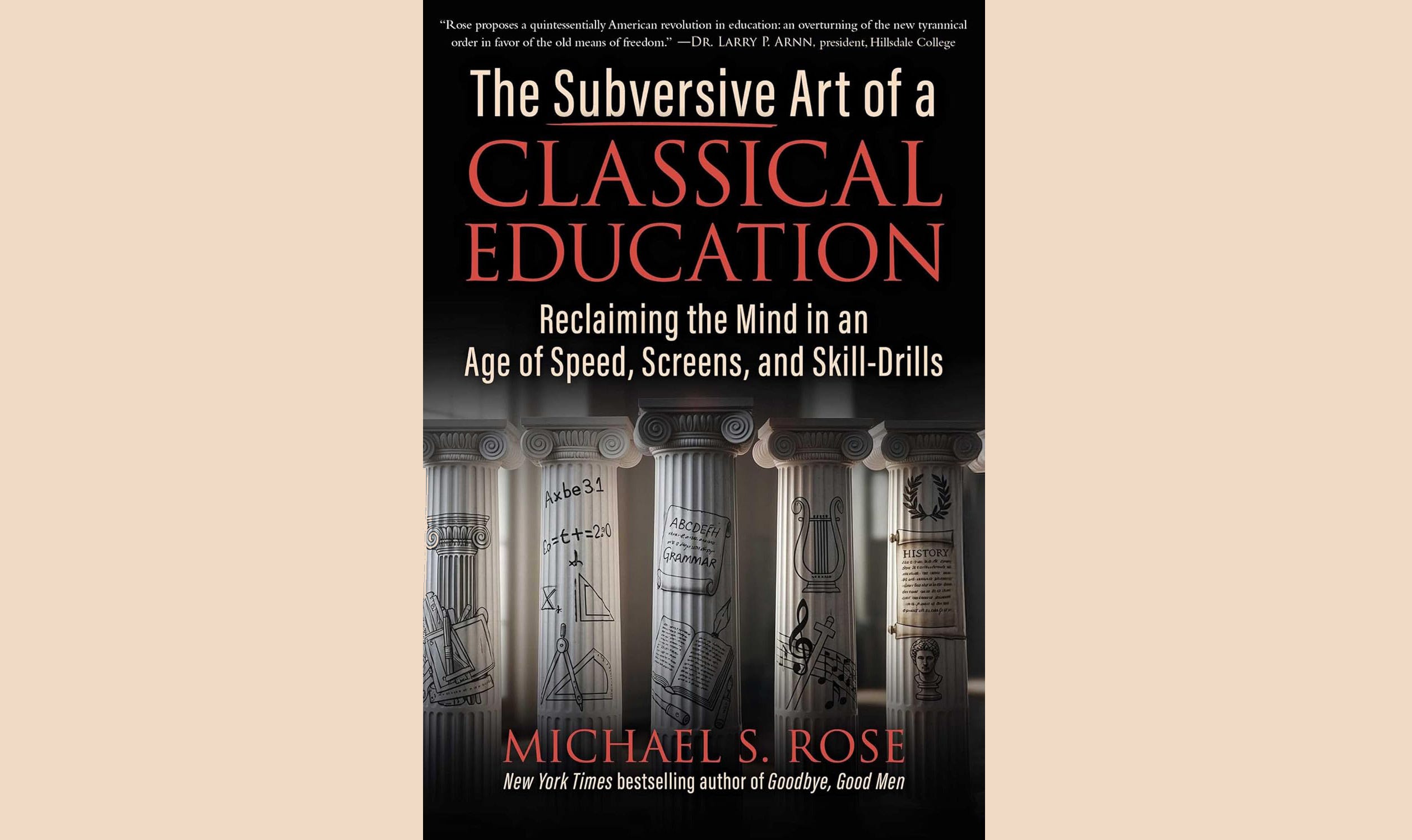
The Subversive Art of a Classical Education by Michael S. Rose
Reviewed by Tim White
New York: Regnery, 2026
312 pp., $32.99
Michael S. Rose’s new book, The Subversive Art of a Classical Education: Reclaiming the Mind in an Age of Speed, Screens, and Skill-Drills, is the most interesting sort of paradox: the sort that would be most beneficial to those least likely to recognize its value. Beautifully written and skillfully argued, the book is an oasis to parents and educators already well-aware of the dire state of education in America, but the very language that makes it so impactful to the initiated may make it significantly less accessible to those who most need to hear what Rose has to say.
Rose, headmaster at Cincinnati Classical Academy and a respected leader of the modern classical education movement, knows his craft inside and out. This is immediately clear from the very first page, whereupon he laments the near-total abandonment of evidence-based grammar instruction in schools today:
The grammar revolutionaries—for so they fancy themselves—have declared independence from the tyranny of the semicolon, the oppression of the properly placed modifier, and the authoritarian regime of the complete sentence. . . . What these revolutionaries fail to understand is that grammar is not a constraint upon expression but its very possibility. The irony that shadows their rebellion is that in casting off the supposed chains of grammatical structure, they have not liberated thought but confined it to a smaller, meaner province, where clarity is impossible and precision unknown. (3–4)
It is surely no accident that Rose chose to address grammar in the first of the book’s thirty chapters. Although proper grammar is not a sufficient condition of clear communication, it is a necessary condition, and it is one of the most often (and most unjustly) maligned subjects in most schools today. I, too, would have opened with grammar had I written a similar book, and for the same reason that Rose almost certainly did: to simultaneously invite those readers who already are or can be persuaded of the book’s theme while actively repelling those who have preemptively rejected it.
However, it is in the second chapter that the book’s potential fault line becomes apparent. Rose writes with energy, passion, and linguistic fluency that color his prose toward the ethereal; his explanations and descriptions are enchanting to those who can parse them easily—and seemingly pretentious to those who can’t. Rose’s writing is emphatically not pretentious, but it is likely to be read that way by those who have not themselves enjoyed the benefits of a classical education in some form. He writes:
To diagram a sentence is to examine the intricate architecture of thought itself, exposing the hidden scaffolding where subject leans into predicate and clauses weave their filigree of nuance and intent. It is an exercise both maddeningly meticulous and beautifully transcendent, where the mundane grammar of daily speech unfurls into a vast latticework of logic and interdependence. Here, prepositions cling like ivy to their objects, modifiers dangle precariously, and conjunctions bridge the chasms between ideas, all laid bare, stark and luminous, under the unforgiving precision of diagrammatic lines. (11)
I find this passage beautiful because I know exactly what it means—but I’m not one who needs to be convinced of either its truth or its elegance. I worry that readers not already well-versed in both grammar and diagramming sentences will, by the fact of their not having been inducted into the inner sanctum of these nearly forgotten sciences, struggle to digest the very argument whose purpose is to clarify their value.
Fortunately, Rose’s writing is not consistently exposed to this risk of self-sabotage. A few pages later, he elucidates a point in plainer language that is more likely to land as intended with whom I presume to be the book’s target reader:
The student who has mastered sentence diagramming possesses something that no algorithm can replicate: insight into the architecture of thought itself. Yes, the sentence diagramming student develops the ability to identify parts of speech but more importantly the capacity to see how they relate to create meaning. He slowly develops the wisdom to understand why certain structures serve certain purposes better than others. This understanding cannot be programmed because it is not merely about following rules but about grasping the principles that give those rules their purpose and power. (16)
The contrast in accessibility between these two passages is striking. Throughout the remainder of the book, Rose continues to alternate between these two styles. This intermittent (and likely unintentional) conceptual gatekeeping is arguably the book’s only significant flaw. In every other respect, it is masterfully written and densely packed with value for readers who are ready to meet Rose on his terms.
The Subversive Art of a Classical Education is divided into six parts, each dealing with a particular, widespread, and deeply poisonous aspect of modern pedagogy to which classical education is the proposed antidote.[1] The first of these parts, titled “Subversive Acts of Language,” unapologetically reasserts the now-unfashionable ideas that language has objective meaning; that clear communication is possible only to those who understand this; and that any educational theory or framework that fails to offer students a rigorous foundation of linguistic precision has, by that fact, already failed. Readers who follow and generally accept Rose’s propositions in this section are conceptually cleared for takeoff and are likely to find enormous value in the remaining sections as well.
The second part, “Subversive Acts of Engagement,” covers slow reading, memorization, handwriting, and poetry, emphasizing the importance of learning foundational skills manually before introducing tools or technology meant to facilitate the execution of those skills. To this end and among other strategies, Rose advocates teaching students to read with print books before allowing them to read on screens, noting that
digital interfaces. . . treat all text as functionally equivalent: as information to be processed rather than as an encounter to be experienced. This flattening of textual hierarchy represents a profound loss, not merely of critical distinction but of appropriate response to the different types of claims that different texts make upon us. (48)
Here, Rose highlights one of many differences between most kinds of print books and nearly all modern web copy, the latter of which is almost always “optimized” for scannability and searchability at the expense of depth, clarity, nuance, and often any significant meaning at all. Importantly, Rose is not anti-technology; he argues only that, in many cases, pedagogically safe and responsible use of technology requires both thoughtfully cultivated habits and a certain foundation of more tactile experiences.
Part three, “Subversive Acts of Mind,” focuses on the subjects of thinking as such, geometry, storytelling, history, and the foundations of Western civilization. The most notable common thread running throughout this section concerns the fact that sustained thought necessarily incurs difficulty and discomfort—and that this is a feature of thought, not a bug. Rose pulls no punches when he laments the widespread failure of modern teachers to accept this fact and to reiterate it to their students: “We have accomplished the remarkable feat of reducing ‘critical thinking’ to a slogan, a catchphrase, a marketing term—everything except the actual act of thinking critically” (93).
If the book’s first part, “Subversive Acts of Language,” is its heaviest hitter in intellectual terms, then the fourth part, “Subversive Acts of Beauty,” is the emotional heavyweight champion. Rose’s chief argument in this section is that irony and insincerity are insidiously corrosive to children’s minds in an educational context because the consistent acceptance of both inculcates a belief that can be enormously difficult to reform in adulthood: the belief that the very values that make life worth living don’t matter. Rose argues here that children must be shown how and why to engage sincerely with beauty in art, music, and even science without embarrassment or apology. He notes:
There is something quietly rebellious in defending beauty today, precisely because it confronts the dreary utilitarianism of the age. It dares to say that man is not merely a producer and consumer. It asserts that his spirit longs for what is lovely. The arch and the dome, the statue and the song, still speak with a power that spreadsheets and memes cannot match. Beauty is not a luxury. It is a signpost pointing beyond ourselves. To exclude it is not progress but forgetfulness. It is a forgetting of who we are and what we need. (153)
Part five, “Subversive Acts of Digital Resistance,” rejects the notion that it is paranoid or old-fashioned to be concerned about the dangers of technology and instead advocates stringently evidence-based evaluations of the particular ways in which we allow children to use digital devices. In this section, Rose pushes back hard against “technological determinism”: the increasingly common (if usually subconsciously held) belief that things such as smartphones, social media, and generative AI are now inevitable facts of life that we must accept and use uncritically. He instead advocates “technological discernment,” which is exactly what it sounds like: the idea that any given form or use of technology must prove itself to be the best means of achieving our rational goals in education and in life more broadly; we must not merely assume it to be the best means, and we must not deny or downplay its risks, especially where child development is concerned.
The sixth and final part of the book, “Subversive Acts of Reclamation,” is conceptually the broadest. Here, Rose identifies five methodological pillars of classical education and argues for their continued importance in the modern world: the view of teaching as an explicitly philosophic endeavor, the nonnegotiable use of clear language, the unique value of Socratic dialogue, the advantages of a liberal-arts approach to education, and the importance of teaching in such a way that children can not only learn effectively but love doing so. Whereas most of the book is clearly valuable to both parents and teachers, the final part speaks mostly to the latter; it leans more heavily on principles of formal pedagogy and encourages teachers to further study particular texts.
One of Rose’s smartest decisions was to end every chapter with a list of books recommended to those who wish to dive deeper into that subject. Each reading list offers a healthy mix of material—some aimed at professional educators, some at parents, and some at curious laymen. Even the book itself serves as a testament to the importance of the words within; the hardback edition features an elegant black case with beautiful silver foil, and the rich, cream paper—along with the unassailable choice of Garamond for the body text font—lends tactile credibility to both Rose’s ideas and the seriousness with which he defends them.
The Subversive Art of a Classical Education is, without question, one of the most important, valuable, and well-written books on the subject. Despite its sophistication sometimes limiting its intelligibility to its target audience, it remains an expertly argued and beautifully crafted handbook for those who have chosen to undertake one of the most sacred responsibilities possible to man: custodianship of a child’s mind and soul.
[1] Classical education is a specific pedagogical model traditionally focused on Latin and Greek history, language, and culture; art and music; and writing and rhetoric as moral civility. Math and science are generally taught well and thoroughly but are somewhat less emphasized than these other subjects.


