


Directed by Georgia Oakley
Written by Diana Reid
Starring Daisy Edgar-Jones and Esmé Creed-Miles
Distributed by Focus Features
Running time: 131 minutes
Rated PG for thematic elements, partial nudity, and brief violence
Few adaptations of Jane Austen’s works have been as universally beloved by Janeites as Ang Lee’s 1995 Sense and Sensibility. The performances of Emma Thompson (who also wrote the screenplay) and Alan Rickman, the warm color palette, and delightful score add to a faithful adaptation many fans doubted could be matched. But the new adaptation of this work, starring Daisy Edgar-Jones and Esmé Creed-Miles, is a strong contender.
Sense and Sensibility focuses on the Dashwood sisters, raised in the household of their recently deceased father, a landowning gentleman. The ladies inherited only a small amount of money upon his death, which, along with the machinations of an unscrupulous half brother and his wife, means that they’re left with a much-diminished lifestyle. This is where the action starts; soon, the ladies move to a countryside cottage owned by distant relatives (a cousin named Mrs. Jennings and her son-in-law). The main drama of the story revolves around the titular sense of Elinor—who represents the rationalism that had been dominant in the Enlightenment of Austen’s youth—and sensibility (or sentimentality) of Marianne—who represents the then-new Romantic movement and its emotionalism. Both women are faced with complex romantic prospects, which they approach differently. The sisters learn from one another the proper relationship between reason and emotion and the balance between sharing and discretion.
This rendition’s greatest technical strength—and an important means by which it stays faithful to the source material—is the acting. Each actor’s line delivery matches his or her character brilliantly, such that even characters who have only a few minutes of screen time still leave a distinct impression of who they are. Among the supporting characters, the most memorable performance is that of Fiona Shaw as Mrs. Jennings. From the first moment we see her to the last, she flawlessly portrays the matron’s jovial, expressive, and at times oblivious yet always well-meaning demeanor. She adopts a chortling laugh that will forever echo in my mind when I think of Mrs. Jennings or any character who resembles her.
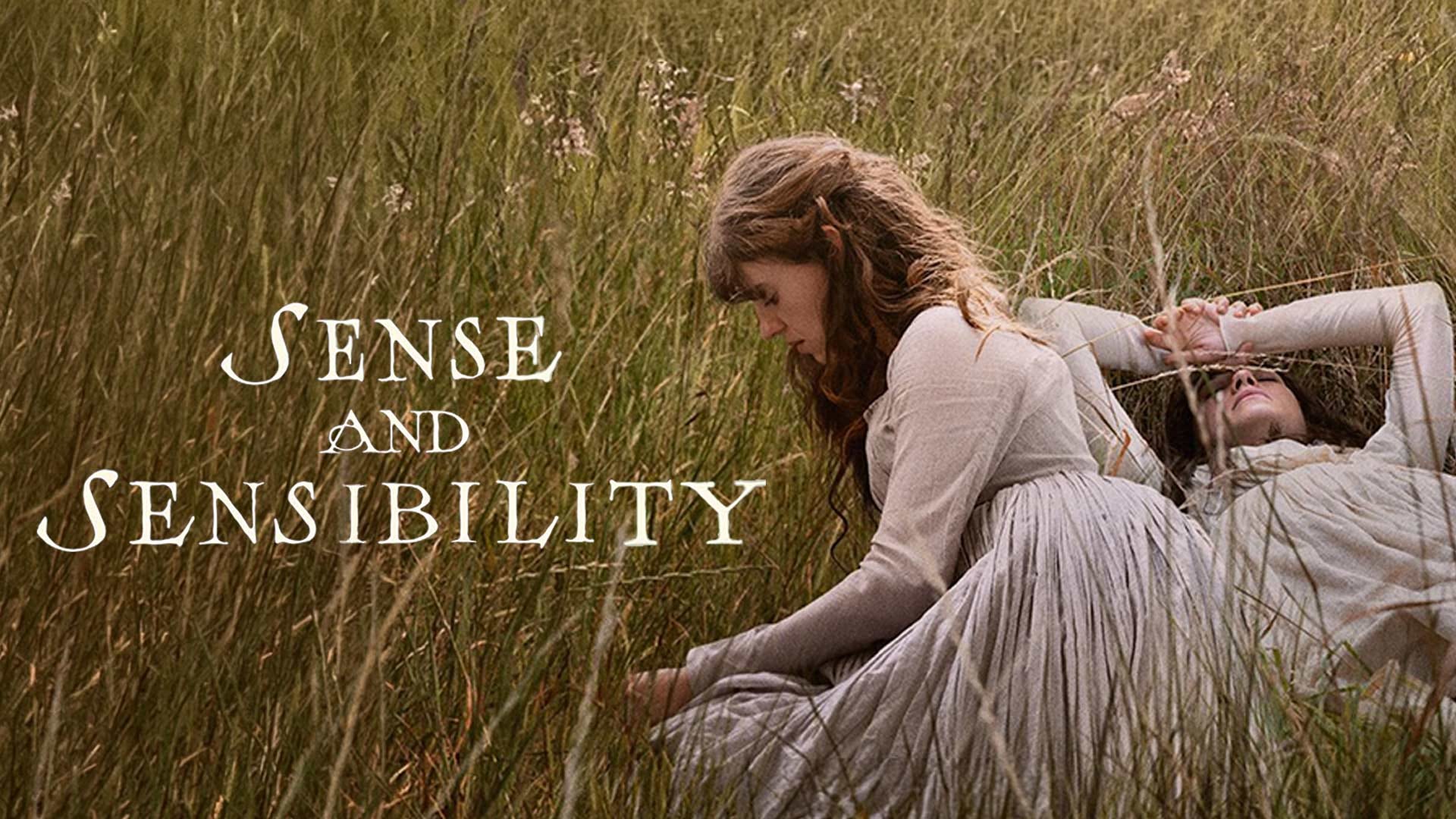
Also admirable are the performances of those playing the primary Dashwood family—both individually and as a group. Elinor’s steadfast resolve and prudence (Edgar-Jones), Marianne’s passionate abandon (Creed-Miles), Mrs. Dashwood’s fanciful hopefulness (Caitríona Balfe), and Margaret’s earnest, adolescent spunk (Bodhi Rae Breathnach) all come through wonderfully and at times comically, often eliciting laughter from those in the cinema I attended. The love and care between the sisters are noticeable and touching throughout. The costuming also highlights their distinctive characters; in a few scenes, Marianne is dressed in floaty purplish dresses and wearing loose (arguably overly messy) hair, whereas Elinor is sometimes seen in a crisp white dress with a navy vest, her hair carefully pinned back.
The superb acting and solid screenplay do much to tell the story; they are supported by a varied score that helps to give voice to the characters’ emotions. In one scene, stoic Elinor has received devastating news but says nothing, and her face moves little while others continue chatting. The camera tightens in on her face while the strings in the background overwhelm the voices of her companions, showing us wordlessly her internal state—agitated, hurt, and unable to attend to the world around her.
Janeites who prefer a textually (as opposed to spiritually) faithful adaptation will doubtless be troubled by notable changes to two of the central romantic relationships. At the risk of being accused of blasphemy, I argue that one is for the better in the sense of narrative impact. Elinor’s love interest, Edward Ferrars (George MacKay), has long been engaged secretly to a penniless, maneuvering woman named Lucy Steele (Ceara Coveney). In the novel, Edward formed this engagement himself when he was young and is unwilling to call it off because he has given his word, despite knowing how adamantly his mother would disapprove of the match. His steadfastness, however misguided, is part of what Elinor admires about him. In the new movie, Edward formed the engagement under his mother’s guidance when Lucy had plenty of money, but then her family unfortunately loses it all. Edward doesn’t want to cause her further hardship and thus maintains the relationship against his mother’s wishes. In other words, the filmmakers have taken young Edward from being misguided and foolish to being more consistently a man of his word, regardless of and even in opposition to his mother’s ambition—doubling down on the characteristic Elinor most likes about him. In so doing, the film increases the drama of her inner conflict: The reason she loves him is the reason she can’t have him.
The other significant change concerns Marianne’s relationship with the quiet Colonel Brandon (Herbert Nordrum). At first, she dismisses his suitorship because she believes him to be without passion for art, nature, or romance. But toward the end of the novel, she falls gravely ill, and his steady care and attention to her and her family—along with her newfound integration of reason with her passion—leads her to give him a chance. Austen’s treatment of the ending has long been decried by critics as more resigned than romantic (such critics are arguably wrong on this point). The movie attempts to correct this by having Colonel Brandon act in a fit of passion to defend Marianne’s honor. Although this gives her a more obviously happy ending, it somewhat softens the lesson Marianne must learn about others: that unrestrained passion, regardless of its grounds, is not necessarily the measure of either a person’s character or of his enjoyment of life.
The vibrant acting, the warmth among the Dashwoods, the humor of Mrs. Jennings, the intensified resolve of Edward, and the courage of Colonel Brandon combine to create a film that’s bursting with life and memorable characters. This effect is slightly hampered by a tendency to use filters that give the film a grayish color palette more often than makes sense given the plot. Nevertheless, the characters’ intense emotions and deep commitment to what they regard as the right way to live outshines this minor defect.
This adaptation may not win over Janeites who prefer a movie that deviates little from the original—but those who love her characters may well be able to enjoy the vividness with which they are portrayed here. Moreover, any moviegoer who appreciates a story with warm family relationships, character growth, and a thought-provoking exploration of the proper approach to romantic relationships will get a lot out of this delightful film.