Editor’s note: This article is adapted from a live talk and has been lightly edited. It retains the cadence and idiosyncrasies of an oral presentation.
If I were to ask you to name the greatest American entrepreneur of all time, you’d probably think of all the business titans, those some people call the “robber barons”; most people are going to think of names such as Rockefeller, Carnegie, J. P. Morgan, maybe Cornelius Vanderbilt. More recently, you might say Elon Musk, perhaps Steve Jobs.
One name that does not get enough credit is Walt Disney.
I want to convince you that Walt Disney is, in fact, the greatest American entrepreneur of all time. That’s largely because, unlike all the capitalists I mentioned, Walt transformed or created from scratch multiple entirely different industries, inventing new products and business models.
The Rockefellers, Vanderbilts, Fords—they started with large industries: Rockefeller was in oil, Ford transformed automobiles, Carnegie worked in railroads and then steel. If I could describe the industry Walt built or transformed, it was as intangible as storytelling—yet he built a multibillion-dollar company out of it. He proved that creativity itself could be a business.
Now, in any endeavor, creativity obviously helps, enhances, and accelerates your business. Rockefeller clearly applied creativity to the refining process. He applied creativity to his business model and the trust structure that made Standard Oil so effective in how it refined by-products from oil—everything from kerosene to gasoline. Vanderbilt employed creativity in the business model of lowering the fares on all his steamships and operating at a lower cost than everyone else to get people on his boats where he could sell them other things. He basically pioneered what we now consider the idea of a loss leader. If you’ve ever enjoyed a $1 hot dog at Costco, thank Cornelius Vanderbilt for that business model. It’s the same with Morgan in financing, Carnegie, all these guys. It wasn’t just automobiles that became the lasting legacy of Ford—it was the assembly line.
Further, until Disney, if you wanted to succeed in business, you needed either capital or access to people who would loan you capital. Walt proved that to build a business, you don’t need a ton of money to start a factory or to buy a bunch of inventory or land or to lay railroad track. Creativity, in some instances, can be a substitute for capital in capitalism. Of course, even the word capitalism was a name given to our free-market system by its opponents. It was supposed to be a pejorative, assuming that the only people who can thrive in a capitalist system are people who inherit wealth. Walt’s journey proves that to be complete nonsense. It’s especially spicy because his father was a card-carrying member of the American Socialist Party.
Walt and his brother, Roy, founded the Disney Brothers Studio together in 1923. He had previously started his first studio, which ended up going bankrupt before he was eighteen, and he had a choice: declare bankruptcy or escape via a paperwork loophole, which required saying that he was a minor and didn’t know what he was signing when he took on all this debt. He chose to go through formal bankruptcy because even though people were telling him that he could get out of this, he believed in doing business the right way and that his reputation and brand as a person mattered.
The first main contribution that Walt made, not just to the entertainment industry but to business as a whole, is this idea of brand—that your brand matters. He’s not the person who invented the idea of a brand—that had existed more than a hundred years before. If you went to a general goods store in the mid-19th century and said, “Hey, I want some flour and some eggs,” there would just be a giant barrel of flour or boxes of eggs. People didn’t really know what eggs they were getting or where the flour came from. Eventually, the store owners started realizing that if they could create a brand and say, “You’re buying this brand of toothpaste or you’re buying this brand of soap,” people would pay a price premium. What they were buying was certainty that this is the soap I get when I buy this brand, or this is the quality of flour I get when I buy this brand. It was a risk-mitigation strategy that gave a sense of quality control. If I go to any store in the country that carries this brand of soap, I know I’m going to get this certain quality of soap, eggs, flour, and so on.
Walt applied that to the idea of a person. He wanted the name Walt Disney to mean something. After he went bankrupt in Kansas City, he moved to Hollywood. He didn’t have money for a suitcase, so he literally fashioned one out of cardboard and tied it together. Yet, with the money he scrounged up, he bought a first-class ticket to California. He showed up and wanted to get into the moviemaking industry, but he had no contacts. He was the founder of a failed film company. He wanted to get into feature moviemaking, but he realized that he didn’t have any advantage there. So, he went into animation because he figured that it had a lower barrier to entry: less competition. But what he really wanted to do was make feature-length movies.
So, he gets into animation and quickly realizes that it’s hard. At the time, there was no such thing as a feature-length cartoon. Animated movies were typically five-minute shorts that played before a feature-length movie. Today, if you go to a movie, you have all the previews before the actual movie starts. Back then, before the actual movie, there’d be cartoons—a bunch of juvenile, amateur, slapstick humor. There wasn’t any storyline. It was just dumb cartoons for five minutes to give you a quick giggle before the movie started. They were not serious, and not a lot of thought went into them. Because of that, the movie distributors were not willing to pay a premium for these cartoons because they didn’t really affect ticket sales. What cartoon they threw before a movie did not change who was going to see it or how many people would show up.
Walt realized that if he could find a way to create a character—to create a brand—people would go out of their way to see a movie because his cartoon is attached to it. Then he would have a little pricing power in his negotiation with the distributors because he could show data and say, “Hey, people want to see this character. Therefore, I’m going to charge you more for the rights to use my cartoons.” Prior to Walt realizing this, the idea of branding didn’t really exist in Hollywood. Walt was the first person to realize that if a Walt Disney picture plays before a movie, it means something.
Today, if we hear that there’s a new Walt Disney movie, without any context, we sort of know what that movie will be about—or at a minimum, what it’s not going to be about. It’s probably going to be family friendly. It’s not going to have a bunch of sex, violence, or gore. It’s probably aimed at children. If someone asks me, “Tim, what’s your favorite Warner Bros. movie?,” I’d be like, “I don’t know. I have no idea which movies from my top-ten list are Warner Bros. films and which are not.” It’s probably the same for MGM, Paramount, all the other studios; I don’t know which movies are made by which studios. You could copy and paste the intro into any movie, and I would have no idea. But when you see the Disney Animation logo from the ’90s—my childhood—all sorts of nostalgia just floods. I think of seeing The Hunchback of Notre Dame, Pocahontas, or Toy Story in theaters. That logo and that brand mean something.
I have firsthand experience in this. When I was in college, I joined the Disney College Program. They are obsessed with the brand. I was probably the most overqualified person to ever take a minimum-wage job at Disney World because I went there not wanting money. I wanted to learn how they trained their employees, who are, by the way, called “cast members.” Everything follows this theme of “the show.” You don’t take your breaks in a break room—there’s “onstage” and there’s “backstage.” I had to go to “costuming” every day to pick up my costume because they don’t have uniforms; they have costumes. Everything at Disney is about this theme and this brand of “the show.”
I spent the first three days learning the company’s history—even though I only had a minimum-wage job working in attractions, which is a fancy way of saying I pressed the “on” button when you go on a ride. I had to go through three full paid eight-hour days on the history of the Walt Disney Company because they want someone in a minimum-wage job to know, if someone asked me, “Hey, what year was Mickey Mouse created?” I’d be like, “1928.” “What year was Disney Studios incorporated?” “1923.” “What year did such and such movie come out?” And I would know. They wanted even the lowest-level employees to be trained on the history and heritage of the company because an advantage to this day that Disney has over other entertainment companies is that sense of heritage and that brand. Can you imagine a Starbucks barista having to go through three full eight-hour paid days of training on the history of Howard Schultz? No other companies do anything close to this. Even janitors have to go through this—and by the way, at Disney, there are no janitors. There are “showkeepers.” They keep the show clean. Even a janitor has to go through three days of “traditions” training.
On the first day, I was almost fired. I was sent home because I showed up “in violation of the Disney look,” which is the standards they have for the brand—you have to have this all-American, clean-cut look. So, no tattoos; men aren’t allowed to have earrings; and your hair has to be a totally natural color—you can’t show up with pink or purple hair. That also means no facial hair for guys. Probably for women, too. If I showed up right now, my stubble would absolutely get me kicked out. They’d be like, “Go to Universal.”
I showed up, and I knew all this. Even before I got the job, I had read all sorts of biographies about Walt Disney and watched every documentary. I was obsessed with the man. But I got sent home on my first day because the manager came up to me and said, “You’re in violation of the Disney look.” And I was like, “What?” He said, “You have stubble.” I didn’t know what to say because it’s 7 a.m., and I shaved the night before at 10 p.m. because I knew that you had to shave before you went in. But apparently my “7 a.m. shadow” was too much. And so, they sent me home. He gave me a disposable razor and said, “Go shave.” I was mortified, like, “OK, what do I do if I work a fourteen-hour shift?” Because often during spring break, you work six or seven hours, take a long lunch break, and then work a whole shift after that. I said, “By the end of my shift, I will logically be in violation.” He just put his arm on me and said, “We’ll talk about that later. For now, you need to go shave.” Can you even imagine a modern corporation taking that level of seriousness with their employees’ look for a minimum-wage job? I was standing in the dark all day. People wouldn’t be able to see. But that’s how seriously Disney takes its brand.
Throughout the 1920s and throughout the entire company’s history, Walt and Roy were constantly almost broke. No matter how much money Walt made, his ideas on how to spend the money were always so much greater than the amount of money he made that they were almost always going out of business. No matter if they were talking hundreds of thousands of dollars, millions, tens of millions, eventually hundreds of millions, Walt would find a way to reinvest the money. It was Roy’s job to find a way not to go bankrupt. Roy eventually became the CFO, but at the start, he worked as a bank teller. They started this company together, but neither of them had any formal business background. What they knew was that they could crack through; they could find a way to carve out a name for Disney Brothers Studios. If they could convince distributors that their cartoon characters were better than the alternatives, they could charge more.
Walt worked really hard to develop a character called Oswald the Lucky Rabbit. Most of you have probably never heard of Oswald the Lucky Rabbit because it was stolen from Walt in a paperwork contract hostile takeover when he got into negotiations with his distributor in New York. They just knew more about contracts than Walt did, and he didn’t realize that he had signed away the rights to Oswald. When a contract got into a particularly fierce negotiation, he found out basically overnight that the distributor had not only hired away all his animators from underneath him but also owned the rights to Oswald, this character that was ascending in popularity.
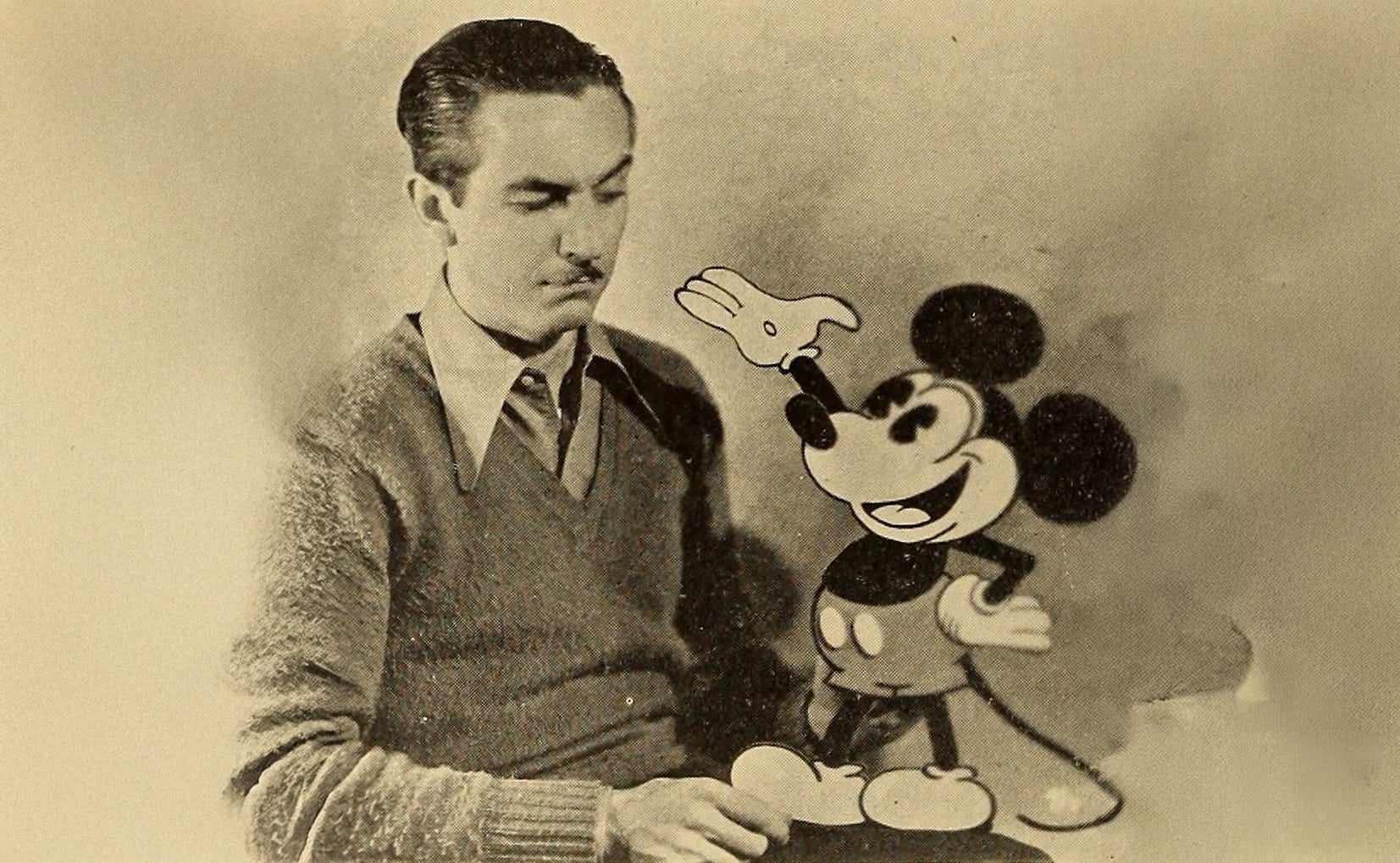
So, as the story goes, he’s on a train ride home to California from New York City, and he calls his wife, Lillian, and says, “I think I have an idea. I’m going to create this new character. It’s going to be a mouse. I’m going to name him Mortimer.” And Lillian says, “Oh, my god, that is the literally worst name I have ever heard in my life. Please do not name him Mortimer.” And Walt, whose family is Irish, says, “What about Mickey?” And so, they said, “OK, that’s fine. We’ll name him Mickey.” The idea was that Mickey was going to be this mouse who was really Walt in animated form. It’s this spunky, punchy, all-American character who you just can’t help but root for. He’s always doing things and getting into things he shouldn’t be, but he finds a way. He has this can-do, all-American attitude of “I’m going to figure out how to get what I want in life.” And in the early Mickey shorts, Walt is the voice; it’s just him in falsetto.
They come out with Mickey Mouse, and cash starts flowing in. Walt has finally achieved this brand where he can charge more money from the distributors because people are calling movie theaters and saying, “Is there a Mickey Mouse cartoon before this movie?” And if there’s not, they’re going to another theater because they want to see Mickey before the movies. This had never happened before. It caught the whole industry off-guard because people didn’t care about cartoon shorts, in the same way that none of you in this room, me included, would ever call AMC before going to a movie and say, “What trailers are playing before the movie?” They’d be like, “I don’t know.” You’re like, “Well, that’s going to affect whether I go here or to Regal.” People were doing that because they wanted to see Mickey Mouse cartoons.
Then the Great Depression hit. The Disney Brothers Studios was largely saved from the worst parts of the Great Depression, at least relative to other studios, because they never overexpanded in buying movie theater chains. Almost every other studio did. They figured, when times were good in the roaring twenties, “We’re going to vertically integrate, and we’re going to make these movies, but we’re also going to own the physical movie theaters.” Disney, whether it was his wise business strategy or frankly lack thereof, didn’t want to do that. He wanted to put all the money back into making better Mickey cartoons so they could add more detail. He would hire actual artists to train the animators to become better artists. If you go back and watch cartoons and anything animated from the 1920s and ’30s, you’ll notice that Mickey Mouse and anything coming out of Disney Animation at the time, which includes The Three Little Pigs, is just better than the animations from any other studio out there. The art is noticeably better. The animation is smoother, more lifelike. That’s where Walt put all his money. This is another trend we’ll see time and time again in the company’s history: He never cared about profit in the way we may think of it. He thought of profit as the fuel with which he could fund more of his ideas. He didn’t do things for profit—he did things for excellence. He knew that if his vision of excellence in his head could be achieved in real life, then money would follow because people would want to pay to participate in that. Automatically, because of that mindset, whether he knew it, he had a longer-term vision for a lot of his business endeavors than short-term profit.
Disney was one of the only studios that wasn’t really hit hard by the Great Depression, but they were still struggling because people were going to fewer and fewer movies. And so, the Mickey character was doing well, but the overall economy was not. We think unemployment is bad now, at about 4 percent, but we had 25 percent unemployment during the Great Depression. Roy was struggling to figure out how to make more money because Walt kept finding ways to spend it. So, Roy contacted a guy named Kay Kamen, who became legendary in the Disney mythology. Kamen came up with the idea of merchandising: “What if we license some of our brand assets to other manufacturers, other companies, and then split the profits?”
So, he reached out to a company called Ingersoll-Waterbury, and asked, “What if we license Mickey Mouse to appear on a watch?” The watch cost $3. This is back in 1933, the height of the Great Depression, so it’s about $75 if you adjust for inflation, which wasn’t really affordable to the average person. Ingersoll was going out of business. The Disney company was also flirting with bankruptcy in 1933, despite all the millions of dollars Walt had made. And Ingersoll said, “All right, it can’t hurt if we do this, and no one buys it. It’s not like it costs a ton of money to make a couple thousand watches.” So, they try it. The first day, they sell eleven thousand watches. Within a couple years, they’ve sold so many watches that Ingersoll-Waterbury—which had been going out of business—had to scale up from just shy of three hundred employees to just shy of three thousand. It ten timesed the size of the company solely because of the Mickey Mouse watch. They had to add new factories and shifts. Over time, they sold twenty-five million of these watches. Now, most people have probably never heard of Ingersoll-Waterbury, but you might know of the company that they later changed their name to: Timex. The Mickey Mouse watch literally saved and made the company Timex that we know today. It also saved Walt Disney Studios.
The Mickey Mouse watch partnership brought in such a flood of money that Walt was able to pursue a new way of spending it all: making a feature-length cartoon. Again, until this time, people thought of cartoons, even Disney shorts, as five-minute previews before the actual movie. There had been no such thing as a feature-length cartoon. Today, there are plenty of movies—Disney movies, DreamWorks movies, and other studios that have made feature-length cartoons. At the time, it was regarded as preposterous that someone would sit down and watch a seventy-five-minute cartoon. But he announced, “We’re going to make a feature-length cartoon.” It’s important that this happened in the middle of the Great Depression because most historians agree that there is no way that Walt would have been able to assemble the talent and basically absorb all the best artists and animators in the country had it not been during the Great Depression. Any animator worth their salt, if they were working at another company, wanted to work for Disney because they wanted to be part of history. This was like being a rocket scientist in the 1960s—you would work at NASA, or you’d go find a new job, because why would you even want to be a rocket scientist in the 1960s and not work at NASA? That’s what the Disney studio felt like in the 1930s.
He started making this movie, and the critics labeled it immediately as “Disney’s folly.” They expected it to fail. Every critic out there was like, “Clearly, this is going to suck, and no one is going to sit through a seventy-five-minute cartoon.” “It’s hilarious that he’s even trying.” And it’s a shame that they said this about someone as accomplished as Walt, because at this time, he has already won Academy Awards. His name was a very respected one because of The Three Little Pigs and Mickey Mouse. He was globally famous. People would line up even in Europe to meet him. But virtually everyone thought he was just throwing his reputation away on this “stupid” feature-length movie.
He picked a fairy tale by the Brothers Grimm—Snow White—to be his first animated film. He estimated that it would cost about $250,000. But eventually they had to go to Bank of America and get loans. Then they had to go back and get more loans, and they had to go back and get even more loans. It got to the point where banks weren’t going to loan them money anymore because the project ballooned from $250,000 to $1.5 million. Keep in mind, this had never been done before. It’s like when Elon Musk promises that we’re going to be on Mars in two years, when instead it might be fifteen years, but you know, close. He has no real idea what the project scope is because it’s never been done before. Finally, one of the bankers from Bank of America called him in early 1937 and said, “The board of Bank of America is making me fly out. You need to show me what you have. Whatever rough cut you have, I need to see it, so we know what we’re funding.” Keep in mind that every time they sent $100,000, that’s like the modern equivalent of sending millions. This has never been done before, so the bank might lose all its investment. If you owe the bank $100,000, that’s your problem; but if you owe the bank $100 million, that’s the bank’s problem. They were getting nervous. They were pumping a ton of money into this, and they had no idea what they were even investing in.
So, the banker goes and sees this movie. After, he doesn’t mention it. They’re making small talk. They’re walking back to the banker’s car for him to catch his flight back to New York. Walt is getting really nervous because the guy hasn’t even brought up what he thinks of the film. They’re just small-talking all the way to the car. The banker opens the door and sits in the backseat. A professional driver is about to drive him off—and just as an aside, he looks up at Walt and says, “Oh, by the way, that picture of yours: that’s going to make a pile of money.” Then he shuts the door, drives away, and they continue funding it.
Snow White and the Seven Dwarfs came out in December 1937. No animated film longer than fifteen minutes had ever been attempted. Snow White’s about seventy-five minutes long. All sorts of artistic techniques that had never been attempted in a film are present in this movie. Even how the color palettes in Snow White feel aesthetically is different from the cartoons at the time. They tried to avoid really bright colors because that was common in most shorts back then. Walt realized that people wouldn’t watch a seventy-five-minute movie of constantly bold colors. It needed to be a little bit more earthy, a little bit more muted so that when they use color, you notice it. He also went out of his way to make sure that it wasn’t just a musical. There’s music in it, but the music feels natural and inherent to the plot. It’s not like Snow White steps up and suddenly sings a song, because that’s what most cartoon animated features were—this slapstick, juvenile, amateur approach to filmmaking that didn’t really have a sense of plot. Walt was obsessed with story as well. That’s what made Snow White work: It was a story.
His studio was the first ever to have a story department, where he spent millions of dollars a year employing story artists who weren’t animators. Their full-time job was making sure that the story worked, that the characters had character arcs, and that the plot was going somewhere—that an adult could watch it and enjoy it because it actually had a story. I think to this day, that’s what separates most Disney and Pixar films from their competition. Kids like them, of course, but there’s usually a plot arc and character development, so adults get something out of it as well. Walt understood that if this was going to work, yes, kids have to like it, but who’s going to drive the kids to the movie theater? Parents. So, adults also have to like it.
Snow White debuts in December 1937 at the Carthay Circle Theater. All of Hollywood’s top brass shows up. Shirley Temple’s there, Clark Gable, everyone who’s who in Hollywood is at this premiere. No one knows how it’s going to go because no one has ever seen a feature-length cartoon before. Imagine what it’s like being Walt Disney in that theater that night: He’s either about to achieve his lifelong dream of making a feature-length animated movie, or he’s about to be utterly humiliated and go completely bankrupt because, at this point, he had mortgaged his house. Keep in mind, at the time when they started creating the movie, he was a decamillionaire already. He had more money than he knew what to do with, but he put everything back into making Snow White. They even mortgaged the future profits of Mickey Mouse and other characters at the Disney studio.
If this doesn’t work, Disney is going out of business, and Walt’s going to be working for the bank the rest of his life to pay off the debt. I can’t even fathom what that would have felt like when that movie started, how nervous he was standing in the back of the room, like, “Are people going to like this? Are they going to applaud?” They get to the end of the movie and, spoiler alert, Snow White dies. The movie’s like a hundred years old, so that’s on you if you haven’t seen it. She eats a poisoned apple. There’s this horrible scene where you see the hand of Snow White drop the apple, and she’s dead. This shocks the crowd because up until this point, there has never been an animated movie that has any sense of pathos or feeling or substance. People were expecting jolly dwarfs dancing around to music. And that’s what act one and two of this movie are. But the final third of the movie starts to get serious, and you realize, “Oh, this is not a movie just for five-year-olds.” Walt looks over, and there’s this scene where Snow White is in her glass coffin. She’s dead, and the dwarfs are crying. Walt said that they had only the best people animate that scene because he realized it was going to make or break his entire career. If this scene worked, and they could get people to feel something, the movie would work. If it didn’t, the movie wouldn’t work. Walt looks over and into the crowd and sees Clark Gable crying; and in that moment, Walt is just, “We did it. This movie is going to work.” The whole theater was crying. Every animator, Disney himself, and everyone in the theater testified that everyone was just losing it because they didn’t expect the movie to have this much pathos.
Snow White went on to make $8 million off a budget of $1.5 million. If you adjust that for inflation and other variables such as how so many of the people who saw this movie were children who were getting in cheaper than a normal ticket price, it would have made about $1.5 billion in today’s money. And this was in the middle of the Great Depression. Today, it would be a top-ten movie of all time. Yet foreign markets were largely locked out because in the mid- to late-1930s, Hitler took over Europe and started shielding Nazi Germany from any Western influence, including Disney movies. The Asian market—China, Japan, etcetera—didn’t really exist for all intents and purposes. So, comparing global box-office numbers from today to then, there are many people who make a compelling argument that Snow White is the greatest box-office hit of all time, and it’s not even close.
Walt risked everything to make this movie happen. This is a theme throughout Walt’s life—he was never satisfied with making a bunch of money and just enjoying it. His money was fuel for the next crazy project he dreamed up. This is why I respect him so much, because as an entrepreneur myself, honestly, I can’t fathom taking that level of risk. When you finally achieve a nice life—you can fly first class, you can buy a new car, and you finally afford to buy your own house—Walt takes multiple mortgages against his house. He sells his Moon Roadster. He cashes out his life insurance policy. Had he died of a heart attack from the stress, his family would have been broke.
But it works. And he doesn’t just do it once; he does it multiple times throughout his career. It reminds me of Howard Roark from the book The Fountainhead, who says, “I don’t build in order to have clients, I have clients in order to build.”[1] Walt is a real-life Howard Roark. If you have read The Fountainhead, the more you study Walt, the more you’ll see that the parallels are crazy. Throughout his life, he’s finding ways to reinvest his profits into doing cooler things, and often it doesn’t work.
That’s the takeaway I see as a business owner that gives me hope—everything you do isn’t going to be awesome. Everything is not going to be a hit. He makes Snow White, and it is just rolling in the dough. He spends all the money building a brand-new, state-of-the-art campus in California. It was like the Google of its time, one of the first corporate centers to have air conditioning. He has a cafeteria where employees can get food. There are volleyball courts and softball fields. The Disney studios in Southern California in the 1930s and ’40s after Snow White were Silicon Valley before Silicon Valley. He pays for Pinocchio. He pays for Dumbo. He pays for Fantasia. All these movies lost money in the 1940s. Every movie he does for about ten years after Snow White bleeds money. By the end of the 1940s, he was broke again.
He made all this money and reinvested all of it, and it didn’t quite work, but the business model saved them. The Disney company today is really an artifact of Walt’s vision of how he thought about business. Let’s use some modern numbers. The Disney company last year made about $91 billion in gross revenue. Only about 10 percent of that was box-office revenue. Walt understood early on that he needed to build characters and brands that transcend an individual movie and has lasting value over time. It all starts from making movies, characters, and experiences that emotionally resonate with people. The Walt Disney Company makes about five times more money on merchandising and experiences as it does at the box office. If you’ve ever gone on a Disney cruise, if you’ve gone to Disneyland or Disney World, or your child has Moana figurines, Mickey Mouse plush toys, Star Wars action heroes, or all the various toys in licensing, the company makes five times as much money on that as on movie revenues.
Disney went public in 1957. Unlike most publicly traded stocks today—which are basically Ponzi schemes in which the investors want to sell the stock for a higher price than they paid for it by finding someone dumber to buy the stock at a higher price—Walt did not do this as a liquidity event. He did it for the old-fashioned reason: They needed money to grow. Because even in the mid-1950s, after they’d technically started Disneyland—this is after Cinderella saved the company in 1950 from the “lost decade” of the 1940s—even after all this, they were still broke because Walt kept coming up with creative ways to spend the money. So, they had to go public. Roy had run out of banks and institutional investors, life insurance companies, and whatnot to loan them money. There were no larger financial institutions that could extend the Disney company any more credit. They had to offer equity to the general public. But Walt did not want to do this. He understood the loss of control, but Roy eventually told him there’s no other way.
If you had invested $10,000 in the 1957 initial public offering, that $10,000 would be worth a little bit more than $30 million today. Now I know most of you are probably thinking, well, yeah, but the stock market has grown a ton since then, plus inflation. What did the general market do during that time? Well, if you invested $10,000 in a broad-based S&P index fund, which didn’t actually exist back then, but we can extrapolate what it would have been worth based on overall market returns, $10,000 invested in the broad market today would be worth about $8 million. So, the Walt Disney Company outperformed the market over fifty-plus years by more than four times. That’s crazy. It’s one of the greatest retail investments in the history of American capitalism.
Disney understood that if you create a brand, characters, and stories that people resonate with, they will have long-lasting effects beyond the initial movie. Hollywood operated back then and still operates on a venture-capital model where about 75 percent of movies lose money, even with all we know about audience polling and testing. Only 25 percent of films make any profit whatsoever. The average movie today costs between around $20 million and $50 million. Disney took a different approach and still does. They’re willing to spend $50 to $200 million on a movie because, even if it breaks even, they want to take bigger bets. If they establish larger-than-life characters that transcend that movie so that people are thinking of them—so the characters have cultural staying power fifty years later—the company will make its money back in the long run.
I mentioned earlier that Dumbo was one of the movies that came out in the early 1940s, and it lost money. It was a commercial failure, as were Bambi, Fantasia, and Pinocchio. But I took my daughter Rose to Disney World for the first time earlier this year, and we went on the Dumbo ride. That day, she also happened to be wearing a Dumbo dress. A hundred years later, Disney is still taking my money from a character in a movie that apparently lost money. The question becomes: Did it really lose money? Disney is always playing a longer game than its competitors. Walt was always looking for ways to bring his visions into reality because he was not OK with the cognitive dissonance of an idea existing in his mind and him not being able to make it real. I think the only entrepreneur who even comes close would be Elon Musk. I’ve told many people that Musk is basically Walt Disney with a higher SAT score. Walt and Roy had multiple shouting matches about Walt spending all their money over the years, and Roy threatened to quit multiple times because he was like, “Why can’t we just take two years and enjoy some of the profits and not spend it all immediately?” Walt was not OK with that.
Next, he planned, envisioned, and funded Disneyland (in California), which was the first-ever example of a theme park, as opposed to just an amusement park. There were also carnivals, but they were sketchy and not family friendly. Walt envisioned: What if there was a park that was clean, where you would want to bring your young family, and that had a theme? The theme was obviously Disney characters, movies, the ideas of imagination, wonder, and fantasy. Again, people labeled it Disney’s folly because they thought there’s no way this is going to work. They’re spending so much capital on this. Even at the time, as rich as he was by the mid-1950s, he didn’t have money for it. He cashed out everything: his life insurance policy, the mortgage on his house, and it still wasn’t even close to enough. They got a huge loan from Bank of America. It still wasn’t enough. They had to get ABC to fund the remainder of Disneyland. ABC at the time was one of the three major networks: CBS, NBC, and ABC. ABC was getting its butt kicked across the board. It was a distant third to NBC and CBS. None of the major shows on TV at the time were ABC shows. So, they asked Walt, “Hey, could you make a show for us basically for free? If you do, we will pay for the remainder of the park’s construction.” The result was The Wonderful World of Disney, which many of you probably recognize. I just watched The Sandlot on TV with my daughter this past week. It was the Sunday night movie on The Wonderful World of Disney, which is still going seventy years later.
So, they built the park. It opened, and it was an absolute smash hit. It was printing money. The first day was an epic disaster, though. The asphalt wasn’t all dry, so people’s shoes were melting into the pavement. There was a plumber strike because the union was negotiating with them, and the plumbers intentionally sabotaged a lot of the plumbing to cause a disaster. But Walt and his team figured it out. The park made tons of money. It’s just another example of Walt investing everything in an idea that he thought would work.
Where we’re standing right now (near Disney Springs) is what Walt called the Florida Project. Most people don’t realize that Disney World was never supposed to be just a theme park. Disney imagined, “What if I could build a for-profit city in a special economic zone that could prove to the whole world how mighty American capitalism can actually be, without the constraints of normal government planners and oversight?” He got a special charter from the state of Florida to start a private for-profit city. To this day, the water, road system, and emergency services in and around Disney World are managed by the Disney company, not the state of Florida. It was never supposed to be just a theme park; it was supposed to be a sprawling complex where Disney would build, own, and operate the hospitals. There would be a university system, housing, transportation, and parks. He was actively recruiting all the top companies at the time; he wanted Ford, GM, and GE to move their headquarters or R&D departments here because he wanted it to be the most futuristic city in the world with the smartest minds and the most cutting-edge research. He wanted to prove that there was a better way of running a city.
But in 1966, Walt discovered that he has lung cancer. He was a lifetime smoker, and he passed away in December 1966. That vision died with him. The executives didn’t know what to do because Walt had all the vision and creativity of his company in his mind. So, they turned it into another theme park. Many of you have probably been to EPCOT. What most people don’t realize is that EPCOT is an acronym. There’s a reason it’s always capitalized. EPCOT stands for “Experimental Prototype Community of Tomorrow.” It was supposed to be a functioning private, for-profit city that would show the world the magic of the American free enterprise system, almost a permanent world’s fair with actual people living and working there full-time. But that dream died with Walt.
What is your favorite Disney movie of all time? I heard Cars, Aladdin, Mulan, and Snow White. I’ve asked this of many audiences, and every time people shout out tons of movies. But when I do this, no one ever names a Disney movie that came out in the twenty-five-year period from when Walt died in 1966 to when The Little Mermaid came out in 1989—the start of the Disney renaissance period, the 1990s. For about twenty-five years before that, there was a period of creative bankruptcy in the Walt Disney Company in which they didn’t make good movies. The company lost its mojo. That creative driving force that Walt brought to the studio every day was gone. I don’t know if in any other company in the history of the United States, one person has made that much of an impact on the enterprise.
In the last known scene from Walt’s life, he’s lying in a hospital bed in Burbank, California. He’s with his brother Roy, and Roy is rubbing his feet, which have become really swollen. Walt is lying in the hospital looking up at the ceiling tiles. He’s pointing out, “Here’s where I want the hospital. Here’s where I want the athletic fields. We’ll build housing over here. We’ll have garbage chutes that’ll run underground this way so that there’re never garbage trucks or garbage on the streets. Everything’s going to be underground. We’ll have parking over here. We’ll have one amusement park over here just to bring people to visit.” He’s sketching out where everything is going to go in the Florida project. And he grows tired, his eyes slowly close, and Walt passes away on December 15, 1966.
No entrepreneur since has captured the world’s imagination the way Walt Disney has. The company that he started back in 1923 eventually formally changed its name to honor the founder. It’s no longer Disney Brothers Studio. It’s the Walt Disney Company. That’s a good representation of why I think Walt Disney deserves his spot among the greatest American entrepreneurs of all time, if not the greatest American entrepreneur of all time.
This article appears in the Spring 2026 issue of The Objective Standard.
[1] The Fountainhead, directed by King Vidor (Burbank, CA: Warner Bros., 1949).


