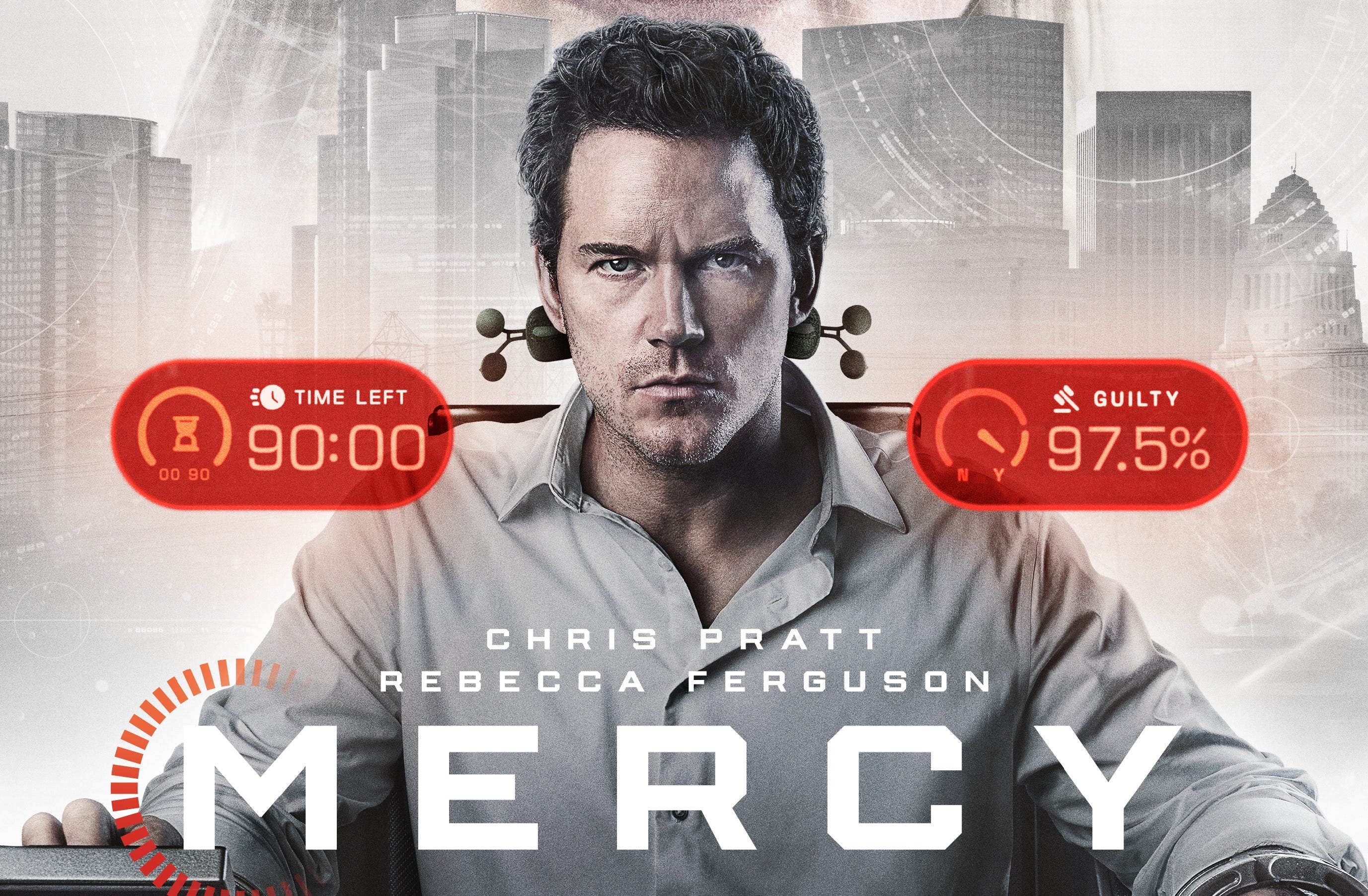
Starring Chris Pratt, Rebecca Ferguson, and Kali Reis
Written by Marco van Belle
Distributed by Amazon MGM Studios
Rated PG-13 for violence, bloody images, some strong language, drug content, and teen smoking.
Imagine that you are wrongly accused of murdering someone close to you. You don’t have an advocate to defend you or a jury to convince of your innocence. Rather, you’re sealed in a room with no access to the outside and given a mere ninety minutes in which to argue your case to an AI that has already calculated with a supposed 97.5 percent probability that you have committed the crime.1 If you can’t get that percentage below ninety-two, you’re dead.
This is the dystopian premise of the new thriller Mercy, set in Los Angeles in 2029. It follows the “trial” of LAPD detective Chris Raven (Chris Pratt), who must fight for his life after being accused of murdering his wife. His opponent is Maddox (Rebecca Ferguson), the AI “judge, jury, and executioner” created as part of the Mercy Program, which Raven advocated and spearheaded. His one hope is the vast array of surveillance data to which Maddox has access.
Many viewers and critics have approached Mercy as a warning about how AI and intrusive government surveillance could combine to destroy privacy. Although that risk is conveyed by the film’s setting—a world in which the LAPD, Maddox, and the accused (for the duration of the trial) have access to everything recorded by almost every internet-connected mobile device and camera in the city—that isn’t the film’s fundamental point. Rather, a hint of its main idea lies in the context that gave rise to the LAPD’s decision to create the Mercy Program: an out-of-control violent crime epidemic. Raven and the city’s officials argued that for the city’s residents to be able to live in peace, a fast, efficient, and impartial method of capturing, prosecuting, and executing violent criminals was necessary.
Raven knows—or at least is completely convinced—that he’s innocent, and yet he finds himself judged guilty by a system he thought was infallible. After seeing the evidence, he begins to wonder whether he may have committed the crime and then forgotten through alcohol-induced amnesia. It’s only when he resolves to dive deeper into the mystery and use his remaining time to find the truth that he starts to uncover evidence that innocent people may have been put in front of Mercy and later executed. Raven comes to realize that the Mercy Program has bypassed citizens’ essential right to a fair, public hearing in the name of cutting crime levels, forcing suspected criminals into a “trial” in which Maddox’s “judgment” is supreme.
It becomes clear that Maddox lacks intuition—the human ability to subconsciously combine our experiences (including those we can’t consciously recall), emotions, and value judgments—which can enable us to spot signs that evidence may be misleading. Contrary to Maddox’s expectations, his rigorous exploration of seemingly unrelated evidence, guided by intuition, ultimately helps him uncover the surprising truth. At the end of the film, Raven—having discovered that both Maddox’s errors and human mishandling of evidence have led to unjust executions—remarks that both humans and AIs are capable of error. Although Maddox appears, unlike a human, to exercise flawless logic, she can miss signs and wrongly attribute importance to evidence because she lacks both a subconscious mind and a capacity to integrate emotions and value judgments with her logic.
Many reviewers have criticized Mercy for not exploring the rectitude of using AI in a criminal justice process and have called it a pro-AI film, but it is by exploring Maddox’s lack of intuition (her inability to experience “gut feelings”) that the film reaches its core idea: Whatever level of crime a society may be facing, a decision over a person’s life and freedom cannot be entrusted to a single judge. Rather, that person must have the means to defend himself to other human beings in a context that is open to scrutiny and challenge. The film conveys this idea successfully thanks to its captivating mystery and series of plot twists. It also delivers a compelling character arc for Raven during the film’s hundred-minute run time. He goes from a grieving alcoholic to a character who heroically struggles to uncover the truth about the previous Mercy Program trials and prioritizes justice over his loyalty to his friends in the process.
The fact that the film is interesting and entertaining is reflected in its audience reception, which contrasts dramatically with its critical ratings. At the time of writing, it has an 81 percent audience score on Rotten Tomatoes against a 20 percent critic score.2 The negative reviews that dominate mainstream-press articles about the film focus heavily on its relatively low budget, resulting in a limited range of locations (most of the story takes place in the Mercy Program’s chambers, with the events under examination displayed through a holographic interface) and a reliance on CGI for action sequences. They also deride the choice of Pratt for lead actor and the film’s limited exploration of Raven’s marriage and alcohol issues.3 Some of these are reasonable things to mention in a review, although Pratt was much better than one might expect from some of his past roles, and Raven’s backstory added value to the main storyline. The fundamental problem with these reviews, however, is that they fail to engage with the film’s core moral idea.
If there’s anything substantive to criticize about Mercy, it’s that despite her lack of intuition, Maddox acts too much like a human being. It’s realistic that by 2029, AIs will have become terrifyingly believable when imitating human emotion and mannerisms; and for much of the film, Ferguson’s performance believably captures an AI doing a very close approximation of human behavior. But it’s clear toward the end that Maddox is not merely imitating: “She” experiences doubt and chooses to act against her programming out of what appears to be emotion—sympathy for Raven’s evident heartbreak over his wife’s death and his frustration at knowing he’s innocent, as well as dismay over realizing that she’s made errors. She is shocked that Raven’s “gut feeling” about an aspect of the case turns out to be correct despite apparently contrary evidence, and she recognizes this as a sign that the way she evaluates cases is flawed and that humans possess an ability she lacks. She does not understand that the human brain can integrate evidence and spot patterns subconsciously as well as consciously—and this flaw is why she is unable to fairly judge those who are put in front of her despite her extensive resources and processing capabilities.
Although this portrayal leans into the common misconception of the technology we now call “AI” as potentially sentient and conscious (which there is no reason to believe it is or is likely to become), it does not impede the film’s ability to deliver both an exciting story and a relevant idea about the nature and importance of a proper justice process. Mercy is a far better film than its critical reception suggests, and anyone who values an entertaining story conveying a life-serving theme about justice is sure to enjoy it.
This article appears in the Spring 2026 issue of The Objective Standard.
The standard for how Maddox quantifies this probability is not made clear.
“Mercy,” Rotten Tomatoes, https://www.rottentomatoes.com/m/mercy_2026 (accessed February 9, 2026).
Clarisse Loughrey, “Mercy Review—An AI Judge Decides Chris Pratt’s Fate in This Absolutely Dismal Dystopian Dreck,” The Independent, January 22, 2026, https://www.independent.co.uk/arts-entertainment/films/reviews/mercy-movie-review-chris-pratt-rebecca-ferguson-b2905313.html; Maxance Vincent, “‘Mercy’ Review: The Spirit of Albert Pyun Lives On in This Horrendous Knockoff,” FilmSpeak, January 23, 2026, https://filmspeak.net/movie-reviews/2026/1/23/mercy-review-the-spirit-of-albert-pyun-lives-on-in-this-horrendous-minority-report-knockoff; Wilson Chapman, “‘Mercy’ Review: This Movie about Chris Pratt Sitting in a Chair Is the Platonic Ideal of a January Release,” IndieWire, January 21, 2026, https://www.indiewire.com/criticism/movies/mercy-chris-pratt-movie-review-1235173548.


