


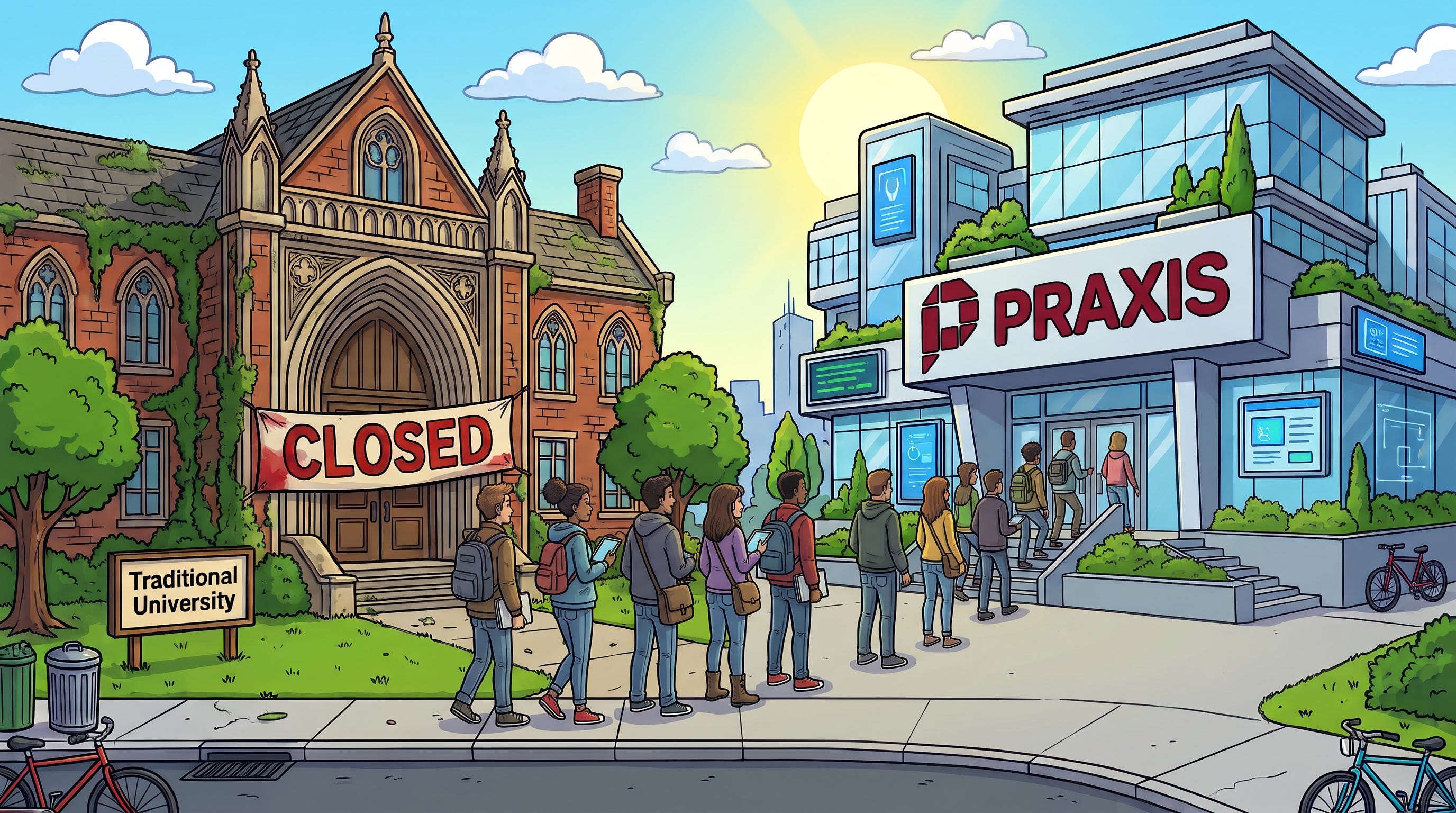
Joshua Sternberg is an enrollment adviser working with prospective participants of Praxis, a college-alternative educational program. A graduate of the program, he got a job in software sales through Praxis.
Thomas F. Walker: Thanks for joining me. Praxis positions itself as a “college alternative.” Why do we need an alternative to college education?
Joshua Sternberg: We need an alternative to traditional college education because there’s a gap in the market that needs to be filled. What college today is really good for is being in a good place to drink with your buddies, go to football games, have a good time for four years, and essentially delay adulthood. The cost of that is that it takes about twenty years to pay off your student-loan debt. The average federal student borrower owes about $40,000, and only about half of bachelor’s graduates land a job that needs their degree within a year of graduating. That’s underemployment, not unemployment. College hasn’t been serving people who are looking to actually get a career started, and that fact is backed by the statistics. That’s what Praxis is here to solve—to equip people to begin jobs. We have an entrepreneur track that helps people start their own businesses. We also have a track that helps people get into a job, and we even guarantee them a job offer if they complete the full program.
Walker: It’s a short, cheap program compared to a three- or four-year college degree, being less than a year. How are you able to deliver that much value in such a short time?
Sternberg: The interesting way to answer that question is to peek into the history of college. The first universities trained people for a few learned professions: the church, law, and medicine. Harvard, the first college in the American colonies, was founded partly to make sure New England’s churches had educated ministers. College was never designed to prepare most people for most jobs. Then, in the forties and fifties, a college degree made you stand apart. In our grandparents’ day, fewer than 7 percent of people had a college degree, so you stood out, and you were special. Nowadays, about 38 percent of people have a college degree, so it’s simply not standing out anymore.
To focus on your question of how we’re able to offer it affordably, it’s because we’re not focused on the fluff. We don’t have a hundred-acre facility; we don’t have a forty-person staff to maintain lawns. Our staff is concentrated on getting you the skills that you need to get a job, so our full program costs $7,500, far less expensive than college.
Walker: How can you guarantee a job? I was also wondering: As well as offering something unique to students that they’re lacking at college, are you also offering something unique to employers that they find college graduates are missing? I know they often find that they have to supplement education in terms of people’s writing ability, mathematical ability, and the like.
Sternberg: I’ll take the employer side of the question first. The struggle that employers face is that people send them résumés like it’s junk mail. Most recruiting employers can tell you how many résumés they’ve looked at, how hard it is to tell them apart, and how little a résumé can tell you about someone. For example, if you say that you have a college degree, that doesn’t help much because it could be an irrelevant degree. It could also mean that you got that degree by the seat of your pants, and you barely studied. Maybe you used AI and Google to answer most of the questions. Obviously, that’s not a blanket statement, but typically a college degree doesn’t help them find out what they want.
At Praxis, we teach a process of proving what you can do. Our students, instead of creating résumés (although that is something you typically have to do), create projects. If I wanted to work for you, Thomas, I would look up your company, I would see what you need and what I could improve. For example, if I wanted to be your social media manager, I would look at all your company’s social profiles, and then I would create social posts, videos, images for Instagram. Then I would send you an email in which I also would attach a video of myself, saying, “Hey, Thomas, I am super enthused about what you’re doing over there, and I think that I can make a huge impact on your social media team. Here’s proof: four posts that I created for you. Feel free to use these, and I think these can make a huge difference in your business.” That’s what we teach our students, instead of the typical résumé, and the reason that we offer a job-offer guarantee is because we’re so confident in that process that we’re willing to stake our money on it and say, “If you don’t get a job offer using this process, we will give you your money back.”
Walker: On your website, you talk a lot about the fact that you teach critical thinking; you “teach people how to think, not what to think.” Can you talk about how that enables your students to decide what they’re passionate about and find lines of work that they will actually be good at and motivated to succeed in?
Sternberg: The traditional school system looks like this: You sit in a class, and you are told to memorize a certain amount of information and certain types of information. There’s not much room to ask questions. We have a lot of great teachers in our education system, but the system fundamentally is that way. On the other hand, we teach our students by doing projects that help with critical thinking. Instead of being told what to do, you’re given a problem. For example, if we need a marketing campaign for a company, you’re taught to think about how to get that done. You’re taught to think things like, “What do people want to see that would get them interested in my product?” “Where can I post these things?” Then you do the work—you actually build a marketing campaign, and you have to use your brain to think and create it from scratch. That’s what Praxis means; it comes from the word praxeology—to do, as opposed to merely theorizing.
Walker: Praxis is Greek for “action,” if I remember correctly?
Sternberg: That’s right.
Walker: How did Praxis start its journey of providing this alternative approach to education? What brought you to where you are today as a company?
Sternberg: The inspiration came from the two entrepreneurs who began the company, Isaac Morehouse and T. K. Coleman. They teamed up about ten years ago because they saw the gap in the market that college was leaving. Because they’re entrepreneurs who love to be on to the next thing, they transitioned Praxis into new leadership, and they started new projects of their own.
We’ve noticed that when people join our program, they become part of our community, and they essentially become ambassadors for what we do. A tremendous number of our students come from referrals from our current alumni. We see Praxis continuing to build that community in the future. For example, in our alumni community just the other day, an alumnus from our program posted, essentially, “Hey. The company that I’ve been working at since I graduated Praxis is looking to hire a bunch of salespeople. Can we get something going?” Even after finishing the program, you get lifetime benefits because you’re part of that network of people who’ve gone before you, who are on your level and are all enthusiastic about improving their careers. We see that scaling into a much bigger community, and we see ourselves being a real problem for college in the future.
Walker: When you talk about a gap in the market, I imagine a situation in which there are some people for whom college is potentially right, such as those who want academic careers. And then there are some who are better off going straight into trades. So, could you give me a sense of the person in between, the one whom Praxis is for? How does someone know whether this is the right path to take?
Sternberg: I love that question, because that’s part of what I do in my job as an enrollment adviser. I talk to parents and kids and help them decide. A couple months ago, I got on the phone with a kid who was interested in going into the medical field. I said, “Go to college.” You really can’t go into that career, realistically speaking, without going to college. So, one of the things that I would advise people is: If you’re considering college, there are websites out there that will help you see the underemployment rate of each degree. Go on one of those websites, look at the degree that you’re interested in, and see the underemployment rate—the odds that you won’t actually be working in that career if you study it. Careers such as chemical engineering and nursing have low underemployment rates, so if you want to go into those careers, if you’re passionate about one of them, I would highly recommend going to college. You’ll probably get a job. On the other side, majors such as liberal arts and criminal justice have really high underemployment rates. If you’re interested in those, I would suggest you take a second look. If you’re looking to go for fun, maybe that’s all right, but if you’re looking to go into a career in that, the odds are against you. So, that’s the first thing I would check. The next is: Are you the kind of person who wants to work outside? Do you like working with your hands? If that describes you, go to trade school. There are a lot of great trades. You can make crazy good money in the trades. The training for those is a lot shorter than college.
For Praxis, I would say, “Are you unsure about what you want to do?” That describes a lot of our people—they just don’t know what they want to do with their futures. If that’s you, Praxis can help you get started in a career in which you start making money, and you have a huge opportunity to get promoted and make more money while you gain experience and work out what you’re interested in doing. I like to use a chess analogy: If you’re in the middle of a chess game, it doesn’t really matter how you got there. All that matters is that you make the best move possible where you are. So, a lot of times for a lot of people, that’s starting to make money and gain skills right now, as opposed to in four years if you go to college. Instead, you’ve had a job via Praxis for four years, and you have a lot of money. So, Praxis is for those people who want to get started making money and for people who don’t know what they want to do next.
Walker: As part of your program, do you provide tools for people to work out what they want to do?
Sternberg: Absolutely. The best way to answer that is to go into how our program is structured. We have two phases. The first is Incubate, and that’s $850. The purpose of Incubate is to help you decide which direction you want to go, and whether Praxis is even right for you. Before you commit the full $7,500, you can commit $850, so your risk is much lower. In those six weeks, you build the habits and skills every career needs, such as networking, taking feedback, and pitching the value you can bring to a company. You can ask yourself, “Is this right for me?” You may well come to the end of it and say, “You know what? College is right for me.” No harm, no foul. You haven’t committed $7,500. If you do go on to Accelerate, the first two months give you hands-on experience in areas of business such as sales, marketing, operations, and customer success, which is different from customer service. Instead of responding to problems as they come in, you own a set of client accounts and work alongside those clients to make sure they’re equipped to succeed. The resource we have that I’m most proud of is that every one of our students gets not just the leadership from our head instructor, but they also get assigned a personal mentor. That’s someone who has gone through the program and graduated a few years earlier and is coming back to give advice not only on how to complete the program, but also on working out what they’re interested in and which direction to go. Incubate builds in time for that. Participants have one-on-one calls with their mentor, and the last week is about reflecting on what they value, what motivates them long-term, and which companies and careers inspire them. That’s super important, helping people decide what they want to do, and it’s something that we put a lot of our resources into supporting.
Walker: Are there any restrictions on who can apply, such as age or location?
Sternberg: Yes. Our audience is 17–25-year-olds. We are meant to be a college-alternative program, so this program isn’t designed for people later in their careers, maybe with twenty years of work experience trying to relaunch into something else. And typically, it’s more of a step back if you have twenty years of experience. We also can’t generally allow people younger than seventeen into the program because it’s hard to offer full-time employment. No one really wants to offer full-time employment to a sixteen-year-old. There are a lot of government rules about child labor. We sometimes make exceptions on either end that mean people can participate in the program, but they may not be able to take advantage of the job-offer guarantee. In terms of location, anyone can join us globally, but the job-offer guarantee only applies to U.S. citizens.
Walker: What’s next for you guys? How do you see either your organization or this college-alternative movement generally growing in the future?
Sternberg: We’ve seen more growth in the last quarter than in the previous couple years, and we hope to see that continue. We hope to see more students coming in, getting passionate about what we do and about building our community. We really believe the reason that more people haven’t decided to go away from college is simply a lack of awareness. There’s a huge social stigma that you have to go to college to be a success. College can help you be a success, but it is not a guarantee. Once more people know about what we do and the options out there—not only Praxis, but other college alternatives, too—we anticipate that colleges are in for a rude awakening
Walker: I hope we can move toward a more diverse way of learning because such a large proportion of people going to college is damaging both to people who should go to college and don’t stand out like they should and to people for whom it’s not really the right choice in the first place.
Thanks so much for joining me. Is there anything else you want to let readers know, such as where they can find you?
Sternberg: The best way to stay in touch with us is to follow us on social media. We have regular live webinars in which you can learn more, and you can go on our website and book time with one of our advisers to speak to them for fifteen minutes about your child or yourself if you’re interested, which can help you decide whether Praxis is the right decision for you.
Walker: Thanks very much.
Sternberg: Thank you.