


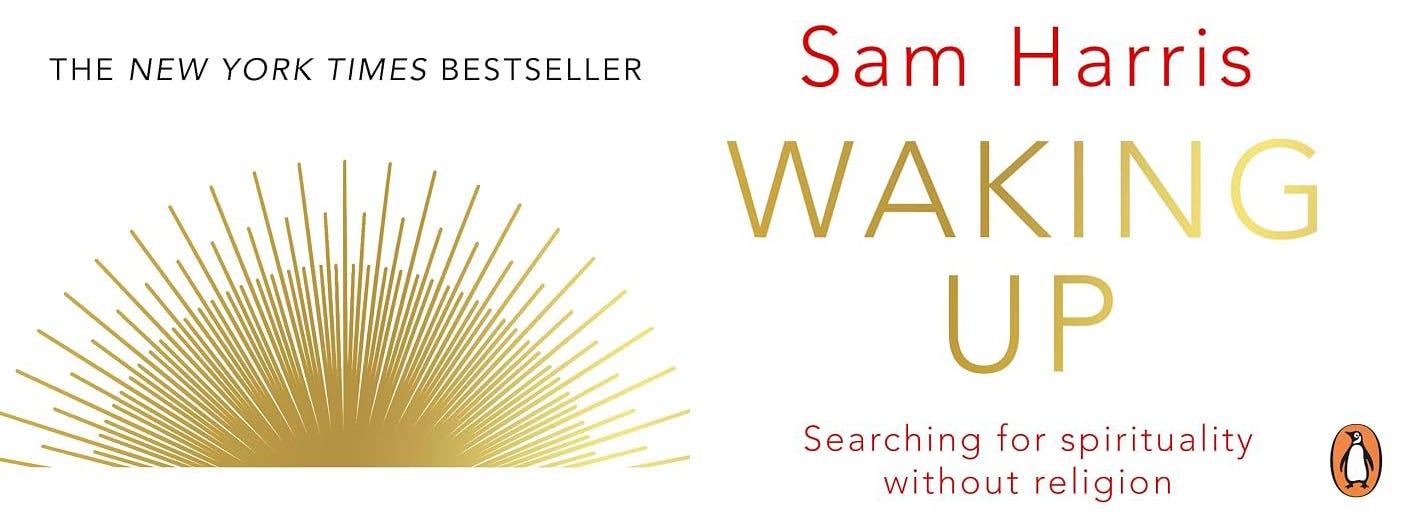
In Waking Up: A Guide to Spirituality Without Religion, Sam Harris presents his theory of spirituality as an alternative to those that are faith based. But the core premise Harris relies upon throughout the book is equally as faith based as the religions from which he attempts to distance himself.
Harris, a neuroscientist and philosopher, is famous for his biting critiques of religion (primarily in his response to 9/11 in The End of Faith), for which he became known as one of the “Four Horsemen” of “New Atheism.” New Atheism is a movement of atheists united by a shared distrust in religion and a stated respect for rationality as a secular source for purpose, meaning, morality, spirituality, and other values often credited to religion. The Four Horsemen, the central intellectual leaders of this movement, also included philosopher Daniel Dennett, orator Christopher Hitchens, and biologist Richard Dawkins.1
In the first chapter of Waking Up, Harris acknowledges that “spirituality must be distinguished from religion” (8). He goes on to argue that spirituality doesn’t require accepting the baseless metaphysical claims religionists assert, such as the notion that a man walked on water, turned water into wine, and arose from the dead. What is spirituality, then? Harris believes the answer largely can be found in Buddhism.
Harris, like many people, acknowledges that Buddhism is a mixture of good and bad ideas, and he accepts those he considers good while rejecting those he considers bad. He thinks “its central teachings are entirely empirical . . .” and “[u]nlike the doctrines of Judaism, Christianity, and Islam, the teachings of Buddhism are not considered by their adherents to be the product of infallible revelation. They are, rather, empirical instructions: ‘If you do X, you will experience Y’” (28, 30).
Despite being cautious to distance himself from faith-based spirituality, Harris accepts the baseless Buddhist notion that the purpose of spirituality is “self-transcendence,” which Harris interprets as “cutting through the illusion of the self,” that being “what is meant by ‘spirituality’ in the context of this book” (9).
To “self-transcend,” he advocates for a specific kind of meditation called vipassana. One of its aims is to achieve “mindfulness,” which he describes as “a state of clear, nonjudgmental, and undistracted attention to the contents of consciousness, whether pleasant or unpleasant” (35). He argues that various values (e.g., family, health, wealth, mastery, etc.) require keeping “the machinery of happiness running day after day” (i.e., continuous effort), which are “forms of happiness [that] aren’t good enough” because “our feelings of fulfillment do not last” (45). Harris argues that meditation can “uncover a form of well-being that is inherent to the nature of our minds” (124).
Why Harris thinks that “our feelings of fulfillment” aren’t “good enough” because they’re temporary is unclear. The mere fact that positive states can be short-lived doesn’t mean they “aren’t good enough”—aren’t good enough, for what? He never clarifies his standard. Plus, doesn’t meditation require continuous effort, too? Doesn’t this mean that the benefits of meditation “do not last” and, therefore, aren’t good enough either? Harris sits on the fence with this issue: “I remain agnostic as to whether anyone has achieved such [well-being] permanently” (45). Harris reckons that because most kinds of happiness are fleeting, they aren’t of much value—and the happiness that is good enough is the “kind” that can be maintained without any effort after a certain point.
Those who perfect “self-transcendental” meditation, Harris claims, will become “spiritual masters” who will no longer “feel that there is an inner self who is a thinker of [one’s] thoughts” (45). In fact, he believes that the “inner self” is a chief source of unhappiness whose solution is meditation: “Taking oneself to be the thinker of one’s thoughts . . . is a delusion that produces nearly every species of human conflict and unhappiness. . . . The practice of meditation is a method of breaking the spell of thought” (101).
In asserting all these claims, Harris never raises or answers obvious questions. If there is no self, who will meditate? Who will be mindful? Who will “no longer feel that there is an inner self”? Who will feel happy as a result of “self-transcendence”? Who is undergoing “delusions” and/or “illusions” in the first place?
Harris is telling us that spirituality (a positive, life-serving value) requires recognition of the “fact” that you don’t exist—that there is no “you” capable of understanding, practicing, or receiving the benefits of spirituality. How could such a spirituality be of value to you, then? Given that so many people use the concept of “I,” Harris included, what does he think it refers to? To him, “‘I’ is itself a feeling that arises among the contents of consciousness” (104).
If “I” is merely a feeling in consciousness, whose consciousness are we talking about? Does Harris believe that consciousness can exist apart from the one who possesses it? Harris elaborates: “[Saying the self is illusory] is not to say that people are illusory. I see no reason to doubt that each of us exists or that the ongoing history of our personhood can be conventionally described as the history of our ‘selves’” (91). He continues by pointing out the many changes we undergo in our lives (e.g., marriage, illness, professional success, etc.)—and he argues, “It is convenient to ascribe these changes to the self. That is not the self I’m talking about” (92). To him, the self is “the subject of experience in each present moment—the feeling of being a thinker of thoughts inside of one’s head, the sense of being an owner or inhabitant of a physical body, which this false self seems to appropriate as a kind of vehicle” (92). Directly after this, he continues:
Even if you don’t believe such a homunculus exists—perhaps because you believe, on the basis of science, that you are identical to your body and brain rather than a ghostly resident therein—you almost certainly feel like an internal self in almost every waking moment . . . [and] this self is nowhere to be found. It cannot be seen among the particulars of experience [or] when experience itself is viewed as a totality. However, its absence can be found—and when it is, the feeling of being a self disappears. (92)
Harris assumes that when people refer to the self, they point to a “ghostly resident” that one should be able to see directly. Given that this is impossible, he denies the self and equates it with a “feeling.” But the fact that some define the self this way doesn’t mean that is what the self is. The self is a concept that refers to the integrated unity of body and mind, two interdependent parts that we can isolate mentally for thinking purposes but cannot actually isolate without the death of the other part. Harris calls the self either “a feeling” or a “ghostly resident” to dismiss it. Both are strawmen.
Harris’s spirituality, in essence, consists of using your mind to “transcend” past yourself via meditation or psychedelics so that you might achieve a permanent, “effortless” state of happiness and escape the suffering produced by “[t]aking oneself to be the thinker of one’s thoughts.”
The reason Harris reaches so bizarre a conclusion about spirituality is because he abuses concepts throughout the book. His core fallacy is denying the concept of self while using it and concepts that logically depend on it: “I,” “you,” “consciousness,” and so on.2 For example, he writes, “[Meditating] with sufficient attention to realize that no inner self exists, is a very sophisticated skill. . . . [I]t can be a powerful tool for self-regulation and self-awareness” (47, emphasis added). If there is no self, how can you “self-regulate” or be “self-aware?” He even admits that he uses these concepts despite not thinking they refer to anything of substance: “I will invoke a variety of concepts that have yet to do much useful work in our study of the natural world . . . but do very heavy lifting throughout the course of our lives: concepts such as self and ego and I” (83). How can concepts do “very heavy lifting” if they aren’t useful? Harris never explains.3
This fatal flaw undermines spirituality. Spirituality is the identification, pursuit, and achievement of the nonphysical values that our mind (i.e., spirit) requires.4 For example, a man who climbs rocks outdoors with friends does so, in part, to pursue nonphysical values such as a flow state, camaraderie, humor, joy, and beauty. He climbs to serve a particular aspect of himself. If “we” have no self, “we” have no spirit—and spirituality is made impossible. Harris can’t escape that spirituality requires a spiritualist.
Harris does touch on some topics that are interesting in their own right (e.g., the split-brain phenomenon and the effects of psychedelics). However, one can easily read about these elsewhere without Harris’s hogwash.
Waking Up promises a rational alternative to faith-based spirituality that fails because it relies on a faith-based assumption: that the self is an illusion. Because of his headin-the-clouds self-denialism, Harris has written a work that is both self-refuting and self-destructive—and he finds himself standing shoulder to shoulder with the very religionists he decries.
The “New Atheism” movement failed, in part, because they failed to offer a rational alternative to faith-based morality. They effectively offered the same morality that religion offers, minus God. The article “The Mystical Ethics of the New Atheists” explains: https://www.theobjectivestandard.com/p/mystical-ethics-new-atheists.

Why does Harris deny the self? In Waking Up (and elsewhere), he expects the self to be an unchanging entity that he can directly perceive inside of him. Because he cannot, he denies it because it doesn’t fit his preconceived notion of what it should be. Harris wants the self to be a percept—a directly perceivable object—when it is a concept—a mental integration of objects that share distinguishing characteristics. The self is a concept that refers to the unity of our body and mind; it is neither a homunculus in our head or body steering us about, nor is it an “illusion” as Harris claims.
I unpack what spirituality is and consists of in my LevelUp 2026 talk “The Elements of Secular Spirituality”:
