Author’s note: This article contains spoilers for Richard Bach’s Jonathan Livingston Seagull and for Ayn Rand’s The Fountainhead and Atlas Shrugged.1
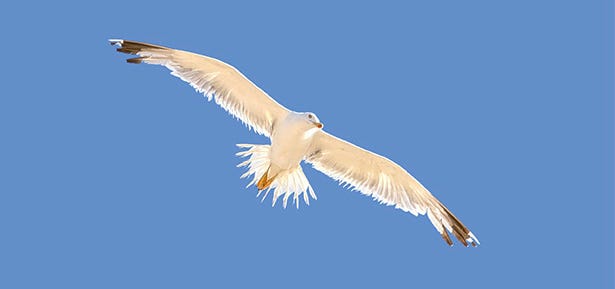
Can a seagull inspire you to strive for excellence, intelligence, and skill? This one can.
The life of Jonathan Livingston Seagull, the eponymous bird protagonist of Richard Bach’s novella, is a powerful metaphor depicting the virtue of independence and the importance of personal achievement. As the story unfolds, however, these values are substantially undercut by mysticism and supernaturalism.2 Even so, the good outweighs the bad and makes this short book a thought-provoking and worthwhile read.
To live a life of meaning and joy, a conceptual being—whether a human or an anthropomorphic bird—must do more than merely survive. He must choose and pursue both material and spiritual values. Crucial among the latter is self-esteem, which Jonathan Gull earns through his relentless pursuit of excellence in flying.
Through Jonathan, Bach shows that striving for excellence can and should be joyful, not dutiful. By pursuing mastery in something we love to do, we place our aims and efforts in service of our happiness.
Jonathan sees that there is more to life than “look for food, sleep, and repeat.”
Most gulls don’t bother to learn more than the simplest facts of flight—how to get from shore to food and back again. For most gulls, it is not flying that matters, but eating. For this gull, though, it was not eating that mattered, but flight. More than anything else, Jonathan Livingston Seagull loved to fly. (14)
His family and flock, however, didn’t see the sense in it.
“See here, Jonathan,” said his father, not unkindly. “Winter isn’t far away. Boats will be few, and the surface fish will be swimming deep. If you must study, then study food, and how to get it. This flying business is all very well, but you can’t eat a glide, you know. Don’t you forget that the reason you fly is to eat.” (14–15)
Although Jonathan tried for a few days to behave like the other gulls—“screeching and fighting with the flock around the peers and fishing boats, diving on scraps of fish and bread”—that was not for him. Soon, he “was off by himself again, far out at sea, hungry, happy, learning.” (15)
Jonathan’s passion for his art resembles that of the architect Howard Roark in Ayn Rand’s The Fountainhead (published twenty-seven years before Bach’s book). “I don’t build in order to have clients, I have clients in order to build,” Roark explained.3 And he cared not a whit about what others thought of his ways. He lived by his own mind and for his own aims. Likewise for Jonathan: He doesn’t fly in order to eat, he eats in order to fly. And he goes by his own judgment regardless of what others think or feel about it.
Jonathan’s pursuit of his own self-interested purposes in the face of opposition is a joy to behold. He speaks in explicitly moral terms about it and encourages others to look and see what he has discovered. For instance, addressing the Council Flock (the Elders and assembled gulls), he says,
Who is more responsible than a gull who finds and follows a meaning, a higher purpose for life? For a thousand years we have scrabbled after fish heads, but now we have a reason to live—to learn, to discover, to be free! Give me one chance, let me show you what I’ve found. (35)
Bach, at times, not only champions such self-interested purposes through his characters—he also, in one instance, explicitly rejects faith. “Forget about faith!” insists Jonathan’s teacher Chiang. “You didn’t need faith to fly, you needed to understand flying. This is just the same.” (59).
Unfortunately, the referent of “this” in that last sentence is the “trick” of knowing “that his true nature lived, as perfect as an unwritten number, everywhere at once across space and time” and that this nature enables him to surpass all limits including the laws of identity and causality. After accepting that he could transcend all such limitations, Jonathan closed his eyes and magically, instantaneously traveled to “some planet . . . with a green sky and a double star for a sun.” (58–59)
Of course, had the story intentionally and forthrightly involved magic and magical beings as part of its plot, as do, for example, Harry Potter and Lord of the Rings, this could be unobjectionable, even delightful. Bach, however, does not establish such context. Rather, through his characters, he both indirectly and directly claims that reality and its laws can be transcended.
The story doubles down on this irrationality when Fletcher, Jonathan’s student, crashes into a cliff. “The trick, Fletcher, is that we are trying to overcome our limitations in order, patiently,” says Jonathan. “We don’t tackle flying through rock until a little later in the program.” (86)
Again, the problem isn’t that the novella includes mystical or supernatural elements. Good fiction can involve magic, time travel, or other fantastical premises as part of its world. When Harry Potter and his wizard friends run through the brick wall at “Platform 9 ¾,” we know it’s magic being performed by magical beings—and no one pretends it’s not magic. It’s part of the established setting of a magic-laden world. Here, however, Bach is not calling such events “magical” or treating them as magical. He is treating them as natural and non-magical—as the way reality is. Jonathan and Chiang are not presented as magical seagulls; they are presented as regular seagulls who transcend reality by, to paraphrase Ayn Rand, placing an “I wish” over an “it is”—and succeeding.
Although Bach initially presents Jonathan and Chiang as characters driven by curiosity, disciplined practice, and rational self-improvement, as the story progresses, they become increasingly nonsensical. For instance, Jonathan would advise his students, “Your whole body, from wingtip to wingtip . . . is nothing more than your thought itself, in a form you can see. Break the chains of your thought, and you break the chains of your body, too.” (76–77) And “Don’t believe what your eyes are telling you. All they show is limitation. Look with your understanding, find out what you already know, and you’ll see the way to fly.” (92)
Such contradictory aspects of the book undercut the qualities that otherwise make it wonderful and inspirational. If the gulls could master flying through the power of will or thought alone—with no need for rationality, independence, or recognition of the actual facts and laws of reality—then none of these qualities would be necessary, and the story would lose all value to a rational mind. The laws Bach has Jonathan and other independent-thinking gulls transcend are the very laws that enabled them to master their pursuits and achieve their aims. Bach’s heroes, for the most part, don’t violate the laws of aerodynamics; they genuinely, rationally understand them and train accordingly. They don’t will or think their way past physical constraints; they use their minds and train their bodies in accordance with the facts and thereby develop techniques that enable them to optimize their abilities within the constraints of reality. To paraphrase Francis Bacon, they command nature by obeying it—not by transcending it.
As I said earlier, the book is mixed. And the more important elements are its positive parts. So let’s return to those.
Whereas traditionally gulls think life is just about flying for food and staying alive, Jonathan shows that by thinking about our nature and testing our limits, we can choose meaningful aims and expand our horizons. His path demonstrates that the choice to think—to take ideas, alternatives, and consequences seriously—is the most fundamental and important choice in life. This is the path that most of the other seagulls have not taken, and it’s why their view of what is possible is so limited. As Jonathan says: “Instead of our drab slogging forth and back to the fishing boats, there’s a reason to life! We can lift ourselves out of ignorance, we can find ourselves as creatures of excellence and intelligence and skill. We can be free! We can learn to fly!” (27)
His desire for and pursuit of constant advancement shows that, if we choose to question assumptions about our limitations, we can learn which limits are real and which are not. If we choose not to question, not to think, and instead to blindly accept what we’re told about who we are and how we can and should live, we place ourselves in cages of our own evasion. “‘Why is it,’ Jonathan puzzled, ‘that the hardest thing in the world is to convince a bird that he is free, and that he can prove it for himself if he’d just spend a little time practicing? Why should that be so hard?’” (90–91)
Jonathan sees the Flock’s premise—that the main purpose of life is eating to stay alive—as a widely accepted dogma that blinds the birds to the true meaning and purpose of life: the achievement of excellence in something you love to do. He disproves that dogma by choosing his aims, constantly improving his skills, and enjoying the process of creating a beautiful life.
His defiance of the Council Flock represents profound love of life; a refusal to let conformity quash the joy of living. Independent thinking and the pursuit of personal values—not group think or tradition worship—lead to a rational confidence in one’s ability to live, to learn, and to flourish in freedom.
[Jonathan] spoke of very simple things—that it is right for a gull to fly, that freedom is the very nature of his being, that whatever stands against that freedom must be set aside, be it ritual or superstition or limitation in any form.
“Set aside,” came a voice from the multitude, “even if it be the Law of the Flock?”
“The only true law is that which leads to freedom,” Jonathan said. “There is no other.” (83)
After being banished from the Flock for violating its norms, Jonathan lives by himself, using his mind and loving his life. But he eventually discovers that he is not alone. His adventures lead him to a community where his values and standards are shared: the seagulls’ “heaven.” There, he meets birds who organize their daily lives around mastering the art of flying—and loving it.
Here were gulls who thought as he thought. For each of them, the most important thing in living was to reach out and touch perfection in that which they most loved to do, and that was to fly. They were magnificent birds, all of them, and they spent hour after hour every day practicing flight, testing advanced aeronautics. (53)
The heaven in the novel is not really a heaven, but a community of thoughtful, purposeful seagulls held together by shared values and the pursuit of measurable achievements such as flight distance, speed, altitude, difficulty of maneuvers and techniques, precision, and control level. In this regard, the seagulls’ heaven is reminiscent of another literary heaven for freethinkers: Galt’s Gulch in Ayn Rand’s Atlas Shrugged (published thirteen years before Bach’s book). Whereas the seagulls’ heaven is a place where seagulls are free to think, to pursue their passions, and to achieve all that they can in a culture that sees all of this as virtuous, so too for people in Galt’s Gulch. As Rand puts it, the Gulch is a refuge for “the men of the mind.”4 In both stories, the heroes are those who recognize and uphold the principle that their minds are sovereign, that their lives belong to them, and the only proper laws are those that secure individuals’ freedom.
In the final analysis, although the book is mixed, it is beautiful and inspiring. My advice: Dismiss the irrational aspects of the novella as noise, and focus on the signal—its rational elements and the glory they convey. Although Bach betrayed his own hero to some extent by tarnishing him with mysticism, we can treat Jonathan as he deserves to be treated: as a rational, independent, purposeful, heroic bird who does the best within a story he couldn’t completely control. If we do, Jonathan can inspire us to think and fly high.
This article appears in the Spring 2026 issue of The Objective Standard.
Richard Bach, Jonathan Livingston Seagull (New York: Scribner, 1970); Ayn Rand, The Fountainhead (New York: Signet, 1943); Rand, Atlas Shrugged (New York: Random House, 1957).
Mysticism is the notion that human beings can gain knowledge through non-sensory, non-rational means. Supernaturalism is the notion that there is a realm other than the natural world or that there are events not governed by natural law.
The Fountainhead, directed by King Vidor (Burbank, CA: Warner Bros., 1949).
Ayn Rand, Atlas Shrugged (New York: Random House, 1957), 1015.


