


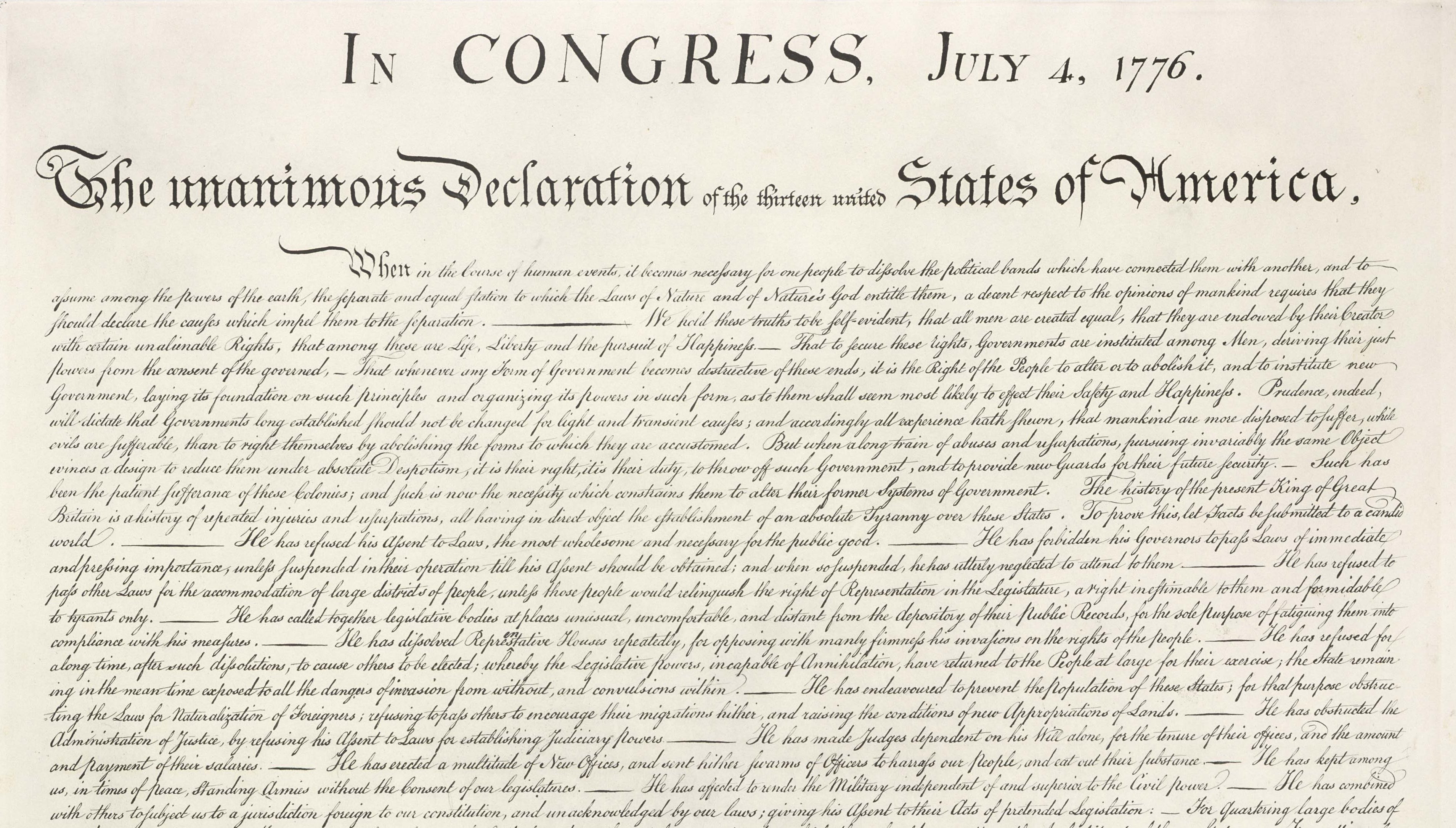
Editor’s note: This is part one of a three-part adaptation of a chapter from Timothy Sandefur’s book Proclaiming Liberty: John Adams, Thomas Jefferson, and the Declaration of Independence, reproduced with permission of the Cato Institute.
When Thomas Jefferson showed his draft Declaration of Independence to the other members of the “committee of five,” on June 22, 1776, his colleagues were probably impressed. The 33 year old Virginian was the youngest member of the committee—in fact, the second-youngest member of the Continental Congress—and he had arrived with two documents in hand: a reply he had written to a disingenuous “peace” proposal that Prime Minister Lord North had sent over to the colonies, and a pamphlet entitled A Summary View of the Rights of British America, which Jefferson had written two years earlier, summarizing the American colonists’ complaints against Parliament. They were impressively enough. But Jefferson’s latest production was a brilliant exercise in concise argument and controlled passion. After a dozen years of protests and remonstrances against London’s treatment of the colonies, the Americans had finally had enough. This time, they would not be petitioning King George for help, let alone pleading for respect from Parliament—whose authority over the colonies the Americans entirely denied. Instead, this new Declaration would be a political testament to the world by a nation that had attained its political maturity.
“When in the course of human events,” Jefferson began, “it becomes necessary for a people to advance from that subordination in which they have hitherto remained, and to assume among the powers of the earth. . . .”
The Premises
Jefferson’s opening lines struck the committee’s chairman, John Adams, as close, but not quite right. For one thing, referring to Americans as “subordinate” seemed unduly meek. As for the word “independent,” while noble enough, it was less striking than the more forthright “separate.” Thus Adams, along with the other committee members—Benjamin Franklin, Roger Sherman, and Robert Livingston—made several small changes to Jefferson’s vocabulary and the specific complaints listed in the document before they submitted the completed draft to the entire Congress for further editing on June 28. Since then, many scholars have examined each word of the Declaration trying to decipher just who changed what—with notably little success. However the committee of five made its decisions, the version they turned over to Congress began:
When in the course of human events, it becomes necessary for one people to dissolve the political bands which have connected them with another, and to assume among the powers of the earth the separate and equal station to which the laws of nature and of nature’s God entitle them, a decent respect to the opinions of mankind requires that they should declare the causes which impel them to the separation.
In the centuries since independence, many intellectuals have quarreled with Jefferson’s invocation of the “laws of nature and of nature’s God.” Some have even argued that classical liberal natural law theory was not really an animating factor in the revolution, and that Jefferson added these phrases only to make the uprising palatable to foreign nations, particularly France. The conservative historian Russell Kirk, for example, claimed that “the Francophile Jefferson” included this passage as a ploy to persuade Parisian philosophes to ally with the Americans.1 According to Kirk, natural law played no real role in the revolution; the Patriots were actually seeking to preserve the colonies’ traditional autonomy, not to vindicate the radical doctrines of equality and freedom. These assertions echoed the views of South Carolina Senator John C. Calhoun, who in an 1850 speech defending slavery tried to brush off the Declaration’s language about equal rights by claiming it was “inserted in our Declaration of Independence without any necessity.” The revolution really centered on the “breach of our chartered privileges,” Calhoun said. Classical liberalism had “[no] weight in constructing the governments which were substituted in the place of the colonial.”2
These claims were nonsense. In 1776, France was governed by an absolute monarch who considered himself the representative of God on Earth, and ruled over his people with a degree of absolutism that exceeded the pretensions of George III by an order of magnitude. Nothing would be less likely to attract Louis XVI’s admiration than to announce that every person has inherent rights that no just government may contradict, or that kings are servants rather than masters of the people. Nor was the Continental Congress particularly careful to ensure that King Louis even saw the Declaration. Although Congressmen certainly hoped for foreign support, they were so negligent in sending an official copy to France that it only arrived in November, well after newspapers had already reported it—hardly an oversight they would have made if their foremost concern had been impressing the French.3 In any event, the colonists had been asserting the natural law principles of equality and liberty since at least the “Boston Pamphlet” of 1772, published by Samuel Adams and his Massachusetts colleagues. Kirk’s idea that the Declaration included such language only to obtain “sympathy in France’s climate of opinion” was absurd.4
As for Calhoun’s assertion that those principles played no role in the new state governments, the first line of Virginia’s Bill of Rights is enough to disprove that. Virginians pronounced in that document—adopted a month before the Declaration of Independence—that “all men are by nature equally free and independent and have certain inherent rights.” Parliament’s refusal to honor the colonies’ charters, and its insistence on legislating for Americans directly, did initiate the crisis with Britain in 1764. But by the summer of 1776, London had made clear that those charters were not worth the parchment they were inscribed upon. That forced Americans to take the drastic step of abandoning their “chartered privileges” and asserting their human rights, instead.
In any case, as Thomas Paine later observed, the distinction between natural rights and the rights of English tradition is to some degree illusory. “The error of those who reason by precedents drawn from antiquity, respecting the rights of man, is that they do not go far enough into antiquity,” he wrote. American Patriots may have appealed to precedents of their seventeenth-century ancestors, but those ancestors had appealed to precedents from the fifteenth or fourteenth centuries, and so on back in time. “If we travel still farther into antiquity,” Paine argued, “we shall come to the time when man came from the hand of his Maker. What was he then? Man.”5 In other words, the cherished rights of English legal tradition must rest upon the nature of man, rather than mere collective agreement—and those objective and universal rights must always underlie all political institutions if those institutions are to be legitimate. Now that Britain had declared Americans ineligible for the protections of British law, Americans had little choice: they could only lay claim to universal principles and rights.
While there was nothing new about Americans asserting their natural rights in 1776, there was a novel phrase in the Declaration’s opening paragraph: its reference to “one people.” This was what is now called “the American people,” a phrase seldom used before the imperial crisis. Before the 1760s, colonists rarely even called themselves “American,” and would hardly have considered themselves the same “one people” as the residents of other colonies. Now, however, the Declaration announced that they had forged a national identity.
That bothered Thomas Hutchinson. The disgruntled former royal governor of Massachusetts, now living in London after being relieved of his governorship two years earlier, published a pamphlet published in November 1776 responding to the Declaration point-for-point. He started by attacking the idea “that the colonies are one distinct people.” That was an “absurd notion,” he wrote.6 Americans were and always had been Britons. That was an ironic claim from a man who once said it was “impossible the rights of English subjects should be the same, in every respect, in all parts of the dominions.”7 But in any event, he was wrong. Americans truly had become a distinct people by 1776. Over the century and a half since colonization started, they had developed unique characteristics and mores, as well as distinct systems of government and even religion. To use the language of a later age, they had “grown apart.”
We hold these truths to be self-evident: that all men are created equal, that they are endowed by their Creator with certain unalienable rights;
Jefferson originally wrote “sacred and undeniable,” but changed this to the more succinct “self-evident,” possibly at Franklin’s suggestion. Ever since, scholars have disputed whether equality and liberty actually are self-evident truths. Much of this quarrel results from confusion over the term “self-evident.” The phrase refers, in the words of philosopher Thomas Reid, to “propositions . . . which appear evident to every man of sound understanding who apprehends the meaning of them distinctly and attends to them without prejudice.”8 The fact that throwing a lit match into water will extinguish it is self-evident, for instance, because anyone with enough experience to know what these words mean will need no demonstration to prove it. But rules can be self-evident, too. The principle “innocent until proven guilty,” for example, or “two wrongs don’t make a right,” are also self-evident. Self-evidence is therefore not the same as what philosophers call “analytic truths”—a phrase that refers to conclusions logically implicit in the premises of a syllogism—but neither is it the same as the experimental demonstrations of the physical sciences. The fact that gravity is proportional to mass is not a self-evident truth. The fact that rocks fall to the ground when dropped is.
The Golden Rule is self-evident, because it requires no investigation to justify it beyond an ordinary acquaintance with human nature. Because we know that every person is an essentially self-directed, self-responsible, self-interested being seeking to survive and thrive, we expect others to resent being harmed and appreciate being helped, just as we would. Consequently, the basic principle of interpersonal morality—to treat others as one wishes to be treated—is self-evident to anyone sufficiently acquainted with human beings to form a mature judgment. The principle that “all men are created equal” is equally self-evident; indeed, it is implicit in the Golden Rule. No ordinary adult is marked out as so far superior that he is entitled to run the life of another in the same way that a parent is (self-evidently) responsible for his child’s welfare. And because each person is responsible both to himself and others, each is equally entitled to freedom.
By “created equal,” the Declaration obviously does not mean that people are equal in terms of talents, skills, or character, or that they should be made equal through the redistribution of wealth or by compelling some to labor for others. It just means that nobody is entitled to dictate how others may live. Put another way, “equality” is fundamentally connected to “inalienable rights.”9 The natural equality that characterizes human nature is the possession of the same basic freedom. People are born into unequal circumstances—some rich and others poor. They may use their rights in ways that make them unequal—some may work hard and prosper, while others invest their resources foolishly and suffer. None of this is relevant, however, to the Declaration’s contention that they are equally entitled, indeed required by nature, to manage their own lives.
Jefferson modeled the equality clause on the Virginia Declaration of Rights, written by the celebrated elder statesman George Mason, which observed in its first section that “all men are by nature equally free and independent and have certain inherent rights.” Striving for concision, Jefferson realized that Mason’s phrasing (“equally free and independent”) could be collapsed into “created equal,” and that “by nature” and “inherent” are technically redundant. He also moved the term “inalienable,” which occurs elsewhere in the Virginia Declaration, into this opening sentence.
“Inalienability” was crucial to refute Thomas Hobbes’ argument that when people establish government, they surrender to it all of their rights. Hobbes concluded from this premise that rebellion against government is never justifiable, even if rulers abuse their power. Although few in America or Britain openly embraced Hobbes’s philosophy in the 1770s, some did contend that rebellion against government was never acceptable. Many Quakers and Anglicans in particular argued that Christianity required passive obedience in all circumstances. Others claimed that as a legal matter, the colonists had surrendered their claims to self-government when they accepted royal charters in the seventeenth century and acquiesced in Parliament’s legislation in the years after that. By asserting inalienability, Jefferson replied that the colonists could not be bound by any previous agreement that intruded too deeply into the liberty to which everyone is entitled.
That among these are life, liberty, and the pursuit of happiness;
Jefferson’s decision to modify John Locke’s traditional trio of rights—life, liberty, and property (or “estate”)—has led to confusion over the years. Some have asserted that substituting “pursuit of happiness” for “property” signaled that property is less important than other rights. But Jefferson and his colleagues viewed the right to buy, sell, own, and use property as indispensable to personal freedom. The real reason Jefferson used “pursuit of happiness” is more subtle.
In writing the Virginia Declaration, George Mason had identified the basic rights as “the enjoyment of life and liberty, with the means of acquiring and possessing property, and pursuing and obtaining happiness and safety,” a phrase that was more comprehensive, but also wordier. Steeped in the ideas of such philosophers as Aristotle, Epicurus, and Cicero, who held that “happiness” or “flourishing” is the purpose of existence, Mason, like Jefferson and Adams, thought the ultimate good of human activity is the well-lived individual life. The reason to acquire and possess property is that it helps one flourish. Thus, in simplifying Mason’s philosophical assertions, Jefferson was saying that people have specific rights because they have the more general right to pursue happiness.
One aspect of this right that scholars too often neglect is its foundational connection to economic freedom. Most Americans in 1776 owned few or no tangible assets; especially immigrants, who often reached American cities penniless, as Franklin had in Philadelphia more than fifty years before. Immigration to America surged in the mid-eighteenth century, with perhaps 400,000 Europeans arriving between 1740 and 1770, many owning nothing but their labor.10 Locke considered labor a kind of property, and the Scottish moral philosopher Adam Smith agreed in Wealth of Nations, published just four months before the Declaration. “The property which every man has in his own labor, as it is the original foundation of all other property, so it is the most sacred and inviolable,” Smith wrote. “The patrimony of a poor man lies in the strength and dexterity of his hands.” To deprive someone of the right to use his labor to earn a living “in what manner he thinks proper” is therefore “a manifest encroachment upon the just liberty both of the workman, and of those who might be disposed to employ him.”11 Jefferson had been among the most outspoken critics of British trade restrictions, arguing in his Summary View that mercantilism unjustly deprived workingmen of their right to earn a living. In short, the phrase “pursuit of happiness” refers to freedom of opportunity. It encompasses the principle that people have the right to use their liberty to obtain property and thereby enjoy happiness in peace.
Another subtle but important innovation in the Declaration’s phrasing is its use of the word “liberty” in the singular, rather than the plural form. In ancient legal documents such as Magna Carta, kings gave the people lists of specific “liberties”—using the plural because the monarch was granting only a finite number of rights. Reversing this idea, the Declaration asserts that people naturally enjoy “liberty”—a word that literally means an infinite number of freedoms—and that government’s powers, not individual rights, are finite and limited.12 Jefferson himself later defined “liberty” as “unobstructed action according to our will, within the limits drawn around us by the equal rights of others,” with the caveat, “I do not add ‘within the limits of the law’; because law is often but the tyrant’s will, and always so when it violates the right of an individual.”13 Whereas ancient legal documents presumed that the king owned all rights and could parcel them out as he chose, the Declaration views the individual as presumptively free, with the people giving the government its powers piecemeal. As James Madison put it, in an essay contrasting Magna Carta with the Declaration: “In Europe, charters of liberty have been granted by power. America has set the example . . . of charters of power granted by liberty.”14
That to secure these rights, governments are instituted among men, deriving their just powers from the consent of the governed; that whenever any form of government becomes destructive of these ends, it is the right of the people to alter or to abolish it, and to institute new government, laying its foundation on such principles and organizing its powers in such form, as to them shall seem most likely to effect their safety and happiness.
The notion that government is an essentially contractual relationship, in which the authorities derive their powers from the consent of the governed, was commonplace in eighteenth-century British thought. Even Loyalists thought the king and Parliament derived their powers from the consent of the governed. They simply argued that Americans were represented in Parliament, in an abstract sense, or that by emigrating to America, their forebears had surrendered the right to vote.15 The Declaration sets that debate aside. It invokes consent as the justification for the right of revolution. Since government officials are servants, not masters, the people have the right to alter or abolish unsatisfactory governments, and to create whatever alternative they think will better serve their needs.
There’s an important limit, however. Only “just powers” derive from the consent of the governed; the people have no right to give their government unjust powers. Just as they cannot rightly commit robbery or murder, so they cannot deputize the government to do so. That explains why the Declaration’s closing lines assert that the new states may only do “acts and things which independent states may of right do.” The principle that government’s powers are cabined by the universal principles of justice runs throughout the Declaration’s text, which refers to justice more than to any other value except liberty.16
Consent therefore plays a dual role, both justifying and limiting government power. As Jefferson later said, the people “are inherently independent of all but moral law.”17 The people cannot consent to tyrannical or despotic governments, even if they were so deluded as to try. Nor can they excuse evil government actions by “consenting” to them. Implicitly recognizing the risk of the “tyranny of the majority,” the Declaration sees democracy as an instrumental good—not as an end, but as a means to achieving a higher political value: the preservation of individual freedom. As Jefferson later said, while “the will of the majority is in all cases to prevail, that will to be rightful must be reasonable,” and must recognize that “the minority possess their equal rights, which equal law must protect.”18
The Declaration’s implicit prioritization of rights over democracy has proven to be one of its most controversial features, as critics claim that its individualist vision elevates “selfishness” over “community” or “the common good.” But the Declaration recognizes that the preservation of each individual’s freedom is the common good, at least as far as the political realm is concerned. It is the only political ambition that, when achieved, imposes no injustice upon some people for the gratification of others. Nothing about this fact is inconsistent with acknowledging the importance of community, the value of helping the less fortunate, or the need to work together to address social ills such as poverty or pollution. In fact, working to remedy such problems can often be more rewarding in terms of personal “happiness” than the acquisitive and productive activities of the marketplace. But the Declaration recognizes that most of these issues are better addressed through “civil society”—the realm of private charitable and social organizations, which operate on the basis of personal choice and voluntary cooperation—than in the political realm, which is governed by compulsion.
The Declaration’s recognition that preserving individual freedom is the highest political good—the only truly common political good—does not, as communitarians sometimes charge, make it a manifesto for so-called atomistic individualism.19 Rather, it recognizes that social problems are often too complicated to be solved by government, and that efforts to impose political solutions on social problems usually backfire, worsening the original problem and violating the rights of the innocent. Thus the best way to address them is usually through private institutions—charities, churches, trade organizations, and the like—for the same reason that the best kinds of interpersonal relationships are those we freely choose. In short, the Declaration prioritizes the individual’s right to pursue his or her own happiness, while recognizing that this pursuit is often most fruitful in the company of others. That explains why it ends with one of the strongest forms of community bond imaginable: a mutual pledge of life, fortune, and sacred honor.
Prudence, indeed, will dictate that governments long established should not be changed for light and transient causes; and accordingly all experience hath shewn, that mankind are more disposed to suffer, while evils are sufferable, than to right themselves by abolishing the forms to which they are accustomed. But when a long train of abuses and usurpations, pursuing invariably the same object evinces a design to reduce them under absolute despotism, it is their right, it is their duty, to throw off such government, and to provide new guards for their future security.
Jefferson said that he consulted no books or pamphlets when writing the Declaration, but that when his colleague Richard Henry Lee—who had officially offered the motion to declare independence—saw Jefferson’s draft, he “charged it as copied from Locke.”20 If so, Lee had a keen eye. In 1689, Locke phrased his rationale for revolution in quite similar terms. It was “evident in itself,” he wrote in the Second Treatise that “all mankind” are created “equal and independent,” and that although they “are more disposed to suffer, than [to] right themselves by resistance,” the people have the right, “whenever the legislators endeavor to take away, and destroy [their] property,” or “endeavor to grasp themselves, or put into the hands of any other, an absolute power over [their] lives, liberties, and estates,” to “resume their original liberty, and, by the establishment of a new legislative, such as they shall think fit, provide for their own safety and security.”21 In the Treatise’s closing chapters, Locke responded to those who feared this principle would lead to frequent rebellions. Revolutions, he explained, are not justified by “every little mismanagement in public affairs,” or even “great mistakes” by rulers. Instead, the people have a right to rebel only when “a long train of abuses, prevarications, and artifices, all tending the same way,” prove that the authorities are seeking “to reduce them to slavery under arbitrary power.”22
Jefferson had employed markedly similar wording in his Summary View—written only five years after his intense, self-directed crash-course on political theory—and now he used it in the Declaration.23 Of course, these parallels are no surprise; by the summer of 1776, Locke’s wording had been quoted and paraphrased so often in declarations, petitions, and newspaper debates, that most Patriot leaders could recite it by heart.
Although Locke’s arguments for revolution were well known on both sides of the Atlantic, they remained controversial in the 1770s. Legal scholar William Blackstone thought they could justify rebelling against a king, but not against Parliament, which “has absolute, sovereign, and uncontrollable authority.” Acknowledging that “Mr. Locke, and other theoretical writers” had reasoned to the contrary, Blackstone concluded that their views, “however just . . . in theory,” could never be accepted in practice. On the contrary, “as [long as] the English constitution lasts . . . the power of Parliament is absolute and without control.”24
Jefferson took the opposite view. No government that claims “absolute” power can ever be legitimate, because the people can no more surrender their rights to a legislature than they can to a king. Their rights are “inalienable,” meaning that the people en masse always retain the power to change their government and even overthrow it if it becomes abusive enough. In fact, the Declaration calls this not just a right, but a “duty”—a duty the people owe to themselves and their children (whose rights they have no authority to abandon). This duty was so essential that Franklin even incorporated it into a proposed national motto. In the weeks following independence, when Congress considered adopting a new set of symbols for use in official documents, Franklin designed a national seal depicting Moses parting the Red Sea, surrounded by the words “Rebellion to tyrants is obedience to God.”25 His proposal was rejected, but Jefferson liked the slogan so much he had it painted on his dishes. He gave one of the bowls to Adams as a present.26
Such has been the patient sufferance of these colonies; and such is now the necessity which constrains them to alter their former systems of government. The history of the present King of Great Britain is a history of repeated injuries and usurpations, all having in direct object the establishment of an absolute tyranny over these states. To prove this, let facts be submitted to a candid world.
This passage marks the first mention of the king—against whom the entire Declaration was addressed. The document never refers to Parliament by name, calling it only “a jurisdiction foreign to our constitution”—which was consistent with the Patriots’ contention that Westminster never had legislative authority over the colonies in the first place. In their view, Americans were bound to the British political system only by sharing the same monarch, which was why they had consistently professed loyalty to George III, even if they sometimes did so through clenched teeth. They thought the king’s job was to stand above the political system, adjudicating disputes among subjects. Yet George had now declared himself unwilling to do that, thus breaking the reciprocal bond of allegiance and protection. Because that was the sole thread connecting America with Britain, severing it rendered the colonies independent.
Fifty years later, Adams claimed that had he disliked Jefferson’s reference to George as a “tyrant.” He remembered thinking the charge “too personal,” adding that he “never believed George to be a tyrant in disposition and in nature.”27 But by the time he wrote this, Adams’s memory was influenced by memories of the French Revolution and the Napoleonic Wars, which had drawn his sympathies toward England. During the independence summer, he offered no objection to the word “tyrant.”28
In fact, it was appropriate. Tyrants rule by fear and intimidation rather than consent, and by 1776, George had made clear that he intended to subdue the Americans by violence and terror. What’s more, he approved Parliament’s claim to total authority over the colonies—a degree of absolutism that included the power to override fundamental constitutional guarantees. His support for Parliamentary absolutism was not inevitable; he could have chosen otherwise. Yet he insisted on backing up Westminster’s assertions of power with overwhelming force, proving much more belligerent than even most of his subordinates. As historian Andrew O’Shaughnessy observes, George was “the main driving force of the British war for America,” regularly urging violence even when his advisors recommended against it.29
This article appears in the Summer 2026 issue of The Objective Standard.
Russell Kirk, Rights and Duties (Mitchell S. Muncy ed., Spence Publishing, 1997), p. 57.
H. Lee Cheek, Jr., John C. Calhoun, Selected Writings and Speeches (Regnery, 2003), p. 681.
Pauline Maier, American Scripture: Making the Declaration of Independence (Knopf, 1997), p. 130. What’s more, Congress’s Committee of Secret Correspondence, responsible for foreign relations, was staffed by its most moderate members, including John Dickinson, and Dickinson argued that postponing the Declaration was more likely to ensure French support. Declaring independence now, he claimed, would look like treating the French with “contempt.” J. H. Powell, ed., “Speech of John Dickinson Opposing the Declaration of Independence,1 July, 1776,” Pennsylvania Magazine of History and Biography, 65(4) (1941), p. 472.
Russell Kirk, introduction, in Albert Jay Nock, Mr. Jefferson (Hallberg Publishing, 1983), p. xvi. While Jefferson did later become a Francophile, he showed few such proclivities in 1776.
Eric Foner, ed., Thomas Paine: Collected Writings (Library of America, 1995), pp. 461-62 (emphasis added).
Thomas Hutchinson, Strictures upon the Declaration of the Congress at Philadelphia (London, 1776), p. 9.
Journal of the House of Representatives of Massachusetts Journals of the House of Representatives of Massachusetts, 1715-1779 (Massachusetts Historical Society, 65 vols. 1919-1990), vol. 49, pp. 137-43. In fact, Hutchinson argued that there was only “one political band” connecting the colonists with Britain, and that was “the supreme legislative authority” of Parliament, which “has essential right . . . to keep all parts of the empire entire until there may be a separation consistent with the general good of the empire, of which good . . . [Parliament] must be the sole judge.” Hutchinson, Strictures, p. 9. In other words, all Britons were effectively Parliament’s property, to be disposed of solely as it willed.
Thomas Reid, Essays on the Powers of the Human Mind (Edinburgh, Bell & Bradfute, 1803), vol. 1, p. 242. For helpful discussions of self-evidence, see Harry V. Jaffa, Equality and Liberty: Theory and Practice in American Politics (Oxford University Press, 1965), pp. 176-78; C. Bradley Thompson, America’s Revolutionary Mind (Encounter Books, 2019), ch. 3.
As Declaration scholar Harry Jaffa put it, “the equality of all men by nature and the freedom of all men by nature differ as the concavity of a curved line differs from its convexity. They two are distinguishable, but inseparable.” How to Think About the American Revolution (Carolina Academic Press, 1978), p. 40.
Aaron Fogleman, “Migrations to the thirteen North American Colonies, 1700-1775: New Estimates,” Journal of Interdisciplinary History 22(4) (Spring 1992), p. 698.
Adam Smith, Wealth of Nations (Liberty Fund, 1976), vol. 1, p. 138.
John Phillip Reid, The Concept of Liberty in the Age of the American Revolution (University of Chicago Press, 1988), p. 120. Or, in Locke’s words, a person’s freedom to “dispose, and order as he lists,” his “actions, possessions, and his whole property, within the allowance of those laws under which he is, and therein not to be subject to the arbitrary will of another.” Peter Laslett, ed., John Locke: Two Treatises of Civil Government (Oxford University Press, 1963), p. 348.
Joyce Appleby & Terence Ball, eds., Jefferson: Political Writings (Cambridge University Press, 1999), p. 224.
Jack Rakove, ed., James Madison: Writings (Library of America, 1999), p. 502.
This was the theory of “virtual representation,” which was much debated at the time, but was never taken seriously by the colonists. John Phillip Reid, The Concept of Representation in the Age of the American Revolution (University of Chicago Press, 1989).
The Declaration refers to “safety” or “security” three times; “happiness” twice; “life,” “truth,” “friendship,” and “kinship” once each. It invokes variants of “justice” four times, and variants of “freedom” or “liberty” six times.
Merrill Peterson, ed., Jefferson: Writings (Library of America, 1984), p. 1426 (emphasis added).
Peterson, ed., Jefferson: Writings, p. 493.
See, for example, John Marsh, The Liberal Delusion (Arena Books, 2012), p. 51.
James Norton Smith, ed., The Republic of Letters (Norton, 1995), vol. 3, p. 1876.
Laslett, ed., John Locke, pp. 310-11, 460-61, 466.
Laslett, ed., John Locke, pp. 460, 463.
Julian P. Boyd, The Declaration of Independence: The Evolution of the Text (Thomas Jefferson Foundation, rev. ed., 1999), p. 27. In his initial draft, Jefferson wrote that Parliament’s plans revealed a scheme to reduce America under “arbitrary power,” but Adams and Franklin changed this to the more effective “absolute despotism.”
William Blackstone, Commentaries on the Laws of England (A. Strahan, 1809), vol. 1 p. 162.
L. H. Butterfield, ed., Adams Family Correspondence (Belknap, 1963), vol. 2, p. 96.
Edmund Quincy, Life of Josiah Quincy (Boston: Fields, Osgood, & Co. 1869), p. 386; Catherine Drinker Bowen, “John Adams His Bowl,” The Atlantic, May 1946, https://www.theatlantic.com/magazine/archive/1946/05/john-adams-his-bowl/655353.
Charles Francis Adams, ed., Works of John Adams (Boston: Little, Brown, 1850), vol. 2, p. 514.
Adams himself described the king as a tyrant at the time. See, for example, Butterfield, ed., Adams Family Correspondence, vol. 2, p. 24; Gregg L. Lint, et al., eds., Papers of John Adams (Belknap, 1989), vol. 8, p. 358.
Andrew O’Shaughnessy, “Thomas Jefferson and George III,” Sept. 14, 2004, https://www.monticello.org/exhibits-events/livestreams-videos-and-podcasts/thomas-jefferson-and-george-iii.
