


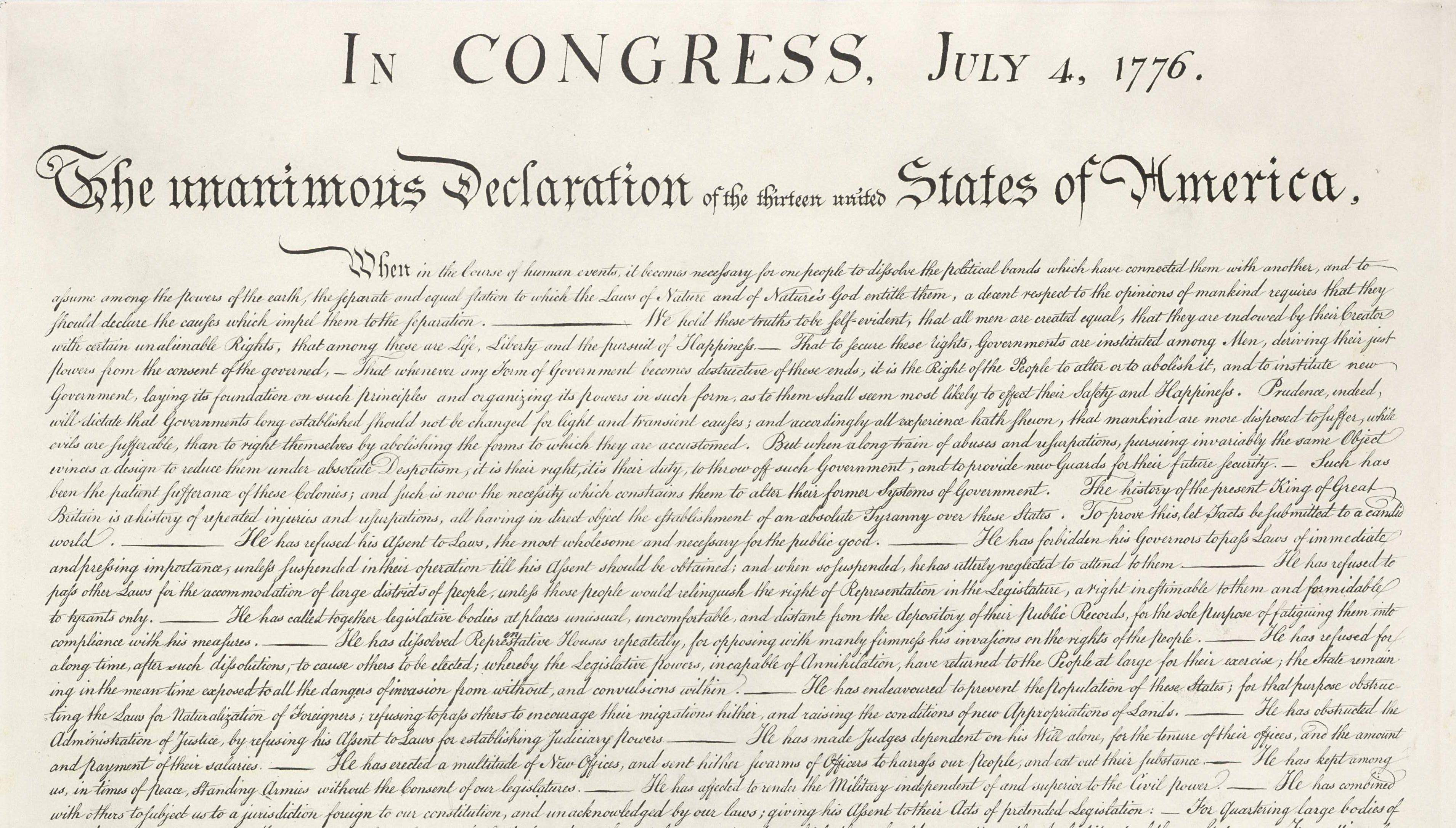
Editor’s note: This article is the third part of a serialized republication of a chapter from Timothy Sandefur’s book Proclaiming Liberty: John Adams, Thomas Jefferson, and the Declaration of Independence, by permission of the Cato Institute. The first two parts appeared in the Summer and Fall 2026 issues.
The King and Parliament
After condemning King George for his own wrongful acts toward his American subjects, Jefferson moved on to criticize his wrongful cooperation with Parliament in the latter’s mistreatment of the colonists. For well over a century, Americans had denied that Parliament had power to pass laws for the colonists—that was a job for their own colonial legislatures. The Declaration maintained that position by refusing even to refer to Parliament by name. Instead, it condemned George for allowing a foreign body to legislate for America.
He has combined with others to subject us to a jurisdiction foreign to our constitution, and unacknowledged by our laws, giving his assent to their acts of pretended legislation:
Parliament was a “jurisdiction foreign to our legislation” because it had no more authority to legislate for America than today’s California legislature has to adopt laws for Florida. Their acts were therefore “pretended.”
The King was another matter. The Americans believed that his job was to stand above partisan arguments and resolve disputes between different factions within society. Thus he should veto Parliament’s unconstitutional legislation. Yet by the 1770s, the king’s veto power had fallen into disuse. Kings had no compunctions about vetoing colonial laws, but had not rejected a bill from the Lords and Commons since 1708. In the Summary View, Jefferson had urged George III to “resume the exercise of his negative power” in order to protect Americans, but the king declined to do so, firmly convinced that Parliament had supreme power over the empire.1 He was therefore to blame for the “pretended legislation” that followed.
• For quartering large bodies of armed troops among us;
The quartering of troops was a key complaint against James II and one of the reasons for his overthrow in 1688. Yet Parliament, ignoring that lesson, had now adopted multiple Quartering Acts, forcing the colonists to provide housing for soldiers, not just for the financial convenience of the military, but to better enable the government to snoop on the Americans. That plainly violated the revered maxim that a man’s home is his castle.
• For protecting them, by a mock trial, from punishment for any murders which they should commit on the inhabitants of these states;
The 1774 Administration of Justice Act, or “Murder Act,” provided that British officials who killed colonists while engaged in official business could be tried in Britain instead of America. Patriots viewed that as a violation of the common law principle of “vicinage,” which says a defendant should be tried in the neighborhood where the crime occurred. The consequence was to effectively strip colonial juries of their powers and to guarantee pro-British bias in any case involving a customs officer who killed an American.
Loyalists such as Thomas Hutchinson considered this complaint silly. In their eyes, the act had been designed to protect government agents against the anti-British bias of colonial juries. The common law, they said, recognizes an exception to the vicinage rule: if there is reason to believe locals are prejudiced against a defendant, a judge can order a change of venue. Hutchinson argued in his pamphlet that that was all the act did.2
But that was sophistry. The Boston Massacre trial had spectacularly proven that even inflamed American juries could administer impartial justice. And in any event, transferring cases 3,000 miles away—forcing defendants and witnesses to undergo expensive and dangerous months-long sea voyages to testify—was far too burdensome. While prejudiced juries might be a risk, colonial judges could already deal with that problem by changing venue to a nearby county. There was no reason to send cases to another continent. On the other hand, if all colonial juries were inherently biased against British officials, that was all the more reason for the two governments to separate.
• For cutting off our trade with all parts of the world;
The 1775 Prohibitory Act forbade the colonists from engaging in trade with any country other than Britain. That act—one of the severest punishments Parliament inflicted on the Americans—sought to starve the people into submission, just the latest in a series of such efforts after the Boston Port Act and the Restraining Acts. The Prohibitory Act went further than those laws by authorizing the Royal Navy, and even private subjects acting under letters of marque, to attack American merchant vessels. In short, the act placed American merchants outside the law.
Historian Andrew Roberts, echoing Thomas Hutchinson’s critique of the Declaration, faults Jefferson and his colleagues for “[giving] George’s acts in suppressing the rebellion as a reason for the rebellion itself.”3 It was fallacious, he claims, to cite Parliament’s punitive measures as justifying the revolt. But the Declaration did not purport to give reasons for rebellion—it gave reasons for independence. That distinction is significant. Americans had already issued many statements justifying rebellion. Now they realized that the two sides could never reconcile, and that they had no choice but to expand a mere rebellion into a permanent division. That made it entirely logical for them to cite London’s punishments as reasons for making a permanent break. By way of analogy, it would indeed be illogical for an employee whose boss disciplines her for improper behavior to claim that the punishment somehow justified her misconduct—but it would be perfectly reasonable for her to cite that punishment as a reason for getting a different job.
• For imposing taxes on us without our consent;
Even as the war progressed, there were those who tried to belittle the American Revolution only as a petty spat over the price of tea. Governor Hutchinson himself tried ridiculing the Patriots for choosing to “rebel rather than pay a duty of three-pence per pound.”4 But colonists had repeatedly explained that the dispute was not about the financial burden. It was about the legitimacy of Parliament’s power. Americans were willing to pay their share toward military protection and other public services—but their taxes should be levied by their elected representatives, not by residents of an island on the opposite side of the Atlantic.
• For depriving us in many cases of the benefits of trial by jury;
This referred primarily to the vice-admiralty courts, originally a separate court system to govern crimes occurring at sea, which Parliament expanded beyond their original jurisdiction in the 1760s. The Sugar, Stamp, and Townshend Acts allowed these courts to try even ordinary cases of tax violations occurring on land, by judges answerable to the crown instead of local citizens. Other laws, too, denied colonists the right to trial by jury. Under the White Pines Acts (adopted in 1711, 1722, and 1729), Parliament restricted the colonists’ right to cut down pine trees in order to preserve them for the Royal Navy to use as masts for sailing ships.5 All white pines located on land “that now belongs or hereafter shall belong to the crown” were declared off-limits, “except only such as are the property of private persons”—and no tree larger than 24 inches in diameter could be cut without a permit, even if growing on private land. Anyone accused of felling a tree without permission could be tried by a justice of the peace, presumed guilty until proven innocent, and punished by forfeiture, plus court costs. Because white pines are among the most common trees in the American northeast, these acts imposed a severe constraint on the colonists. As one scholar notes, rigorous enforcement “would have prevented the settler from clearing his land for the planting of crops. If he built his rude cabin out of white pine, or even sold the logs to purchase ‘English goods,’ the Surveyor-General could bring him to trial.”6 That could easily bankrupt a person.
• For transporting us beyond seas to be tried for pretended offenses;
Not only did the Murder Act enable government officials who killed colonists while enforcing customs laws to transfer their cases to Britain, where juries were more likely to acquit them, but the Treason Act of 1543 and the Dockyards Act of 1772 also enabled prosecutors to order colonists to England for trial if accused of either treason or the damaging of Royal Navy facilities. This, too, violated the principle of “vicinage.”
The phrase “pretended offenses” hinted at the way British criminal law was sometimes so vague that officials could exploit its ambiguous language for political purposes. The most infamous example was treason, a concept so loosely defined that monarchs had for centuries levied the accusation against political opponents precisely because it meant whatever the king said it meant. (That was why, in 1787, the framers of the U.S. Constitution would take care to precisely define the term.) British law was full of such hazily defined words and quasi-legal practices. Impressment, for example, was not sanctioned by any law, but was still practiced, and deemed legal by British courts based merely on the fact that the abuse had gone on for so long.7 As a consequence, someone resisting impressment might defend himself against this quasi-legal kidnapping and find himself accused of the “pretended offense” of murder. He might even be sent to Britain for trial, and, as Boston citizens put it, “whether condemned or acquitted, he will probably be ruined by the expense of attending the trial, and his long absence from his family and business.”8
• For abolishing the free system of English laws in a neighboring province, establishing therein an arbitrary government and enlarging its boundaries so as to render it at once an example and fit instrument for introducing the same absolute rule into these colonies;
This charge was probably added at Franklin’s suggestion. It focused on the 1774 Quebec Act, which instituted the French civil law system, instead of the English common law, in Britain’s newly acquired Canadian province. Denying the Quebecois such longstanding legal protections as trial by jury, the right to counsel, and habeas corpus, the act also provided that the province’s laws would be made by the governor and council chosen in London, rather than by an elected legislature. All of this was due to the fact that British law barred Catholics from holding public office. The act therefore simultaneously violated the religious rights of Catholics and their right to choose their own lawmakers, even while it established the Catholic Church in the province, threatening the freedoms of Protestants. The revolutionaries feared that this set a precedent for future action against them, too—especially if, as rumor had it, the established Anglican Church of England was considering creating an American bishopric. It was easy to imagine Parliament and the Anglican Church taking over Massachusetts or other colonies, stripping dissenting sects of their constitutional rights, and establishing a local autocracy.
• For taking away our charters, abolishing our most valuable laws, and altering fundamentally the forms of our governments;
The revoking or rewriting of colonial charters was a sore subject with Americans; all colonies prized their charters, which promised them the rights enjoyed by native-born Britons. Legislation such as the Massachusetts Government Act—which unilaterally repealed the charter of Massachusetts and replaced the colony’s government with a military dictatorship—proved that Parliament had no respect for these written promises.
In his rebuttal of the Declaration, former Governor Hutchinson ridiculed the idea that charters were “sacred” and “not to be revoked nor altered by the authority of Parliament.”9 To Adams, Jefferson, and their colleagues, such flippancy only proved what they most feared: Parliament had no respect for the British constitution. If it were truly all-powerful, it could not only revoke colonial charters, but repeal Magna Carta, the Bill of Rights, and every other protection the British constitution promised.
• For suspending our own legislatures and declaring themselves invested with power to legislate for us in all cases whatsoever.
This allegation differed from the earlier reference to the king having “dissolved representative houses repeatedly,” because in those situations, governors, acting under royal authority, exercised their power to close houses of the legislature—whereas this section referred to Parliament’s acts, specifically the New York Restraining Act and the Massachusetts Government Act, which effectively shut down those legislatures by statute.
Then, of course, there was the Declaratory Act, truly the source of all other abuses. In the Patriots’ view, Parliament’s assertion of power to legislate “in all cases whatsoever” radically altered the national constitution, laying claim to authority far beyond anything previously accepted in English law. It was also contrary to natural law, since no legitimate government could ever claim power to legislate in all cases whatsoever. Such authority would make Parliament the judge in its own case—the quintessential violation of natural law—and would transform the Lords and Commons into a many-headed tyrant, unlimited in power or principle. Such an unreasonable proposition justified the Americans defending themselves with violence.
He has abdicated government here, by declaring us out of his protection and waging war against us.
Adams had been arguing since the Stamp Act shutdowns of 1765 that the imperial government’s failure to provide Americans with law and order amounted to dissolving their bond of allegiance. But the Prohibitory Act went far beyond the abuses of those days. By expressly declaring that the “rebellious colonies” were no longer “under his Majesty’s protection,” London had ruptured the contract of allegiance and nullified royal authority over America. This again paralleled the experiences of the Stuart age. In 1689, the English Bill of Rights asserted that James II’s attempts to “subvert” the “laws and liberties of this kingdom,” combined with his fleeing the country, was equivalent to abdicating the throne. Now, the Americans asserted that George III’s abuses entitled them to seek new safeguards for their rights.
He has plundered our seas, ravaged our coasts, burnt our towns, and destroyed the lives of our people.
British forces burned Charlestown, Massachusetts, in June 1775, Falmouth, Massachusetts, in October, and Norfolk, Virginia, in January. By then, the Royal Navy had burned or tried to burn more than a dozen other seaside towns. It also forced a score of coastal cities to provide supplies, seizing cargo ships in Savannah, Georgia; raiding communities in places like Noodle’s Island, Massachusetts, and Narragansett Bay, Rhode Island, and firing on towns that refused to comply, including Stonington in Connecticut, Brunswick Town in North Carolina, Newport and Bristol in Rhode Island, and even lower Manhattan.10 Like the imperial Romans, the British might boast of their advanced civilization, but their actual policies were built on arrogance, greed, and brute force.
He is at this time transporting large armies of foreign mercenaries to complete the works of death, desolation, and tyranny already begun with circumstances of cruelty and perfidy scarcely paralleled in the most barbarous ages, and totally unworthy the head of a civilized nation.
George III informed Parliament in October 1775 that he had received “friendly offers of foreign assistance” in putting down the American rebellion and alluded to the possibility of using “my Electoral troops” for that purpose, as well.11 This was a reference to the Electorate of Hanover, the region of what is now Germany over which George also reigned.
Using non-British forces—the so-called Hessians—against British subjects was something Americans, and even many in England, viewed with horror. William Blackstone wrote in the 1760s that if the government finds it necessary to employ soldiers to put down an insurrection, English law required that “the armies with which [this task] is entrusted” be “composed of natural subjects” who “have the same spirit with the people.”12 Otherwise, the king could abuse his power for his own purposes. Foreign soldiers were less likely to know the language, to care about harming civilians, to understand the country’s political dynamics, or to be familiar with local customs—all of which increased the risk of “collateral damage” and even civil war. Yet in 1776, the imperial government ignored these risks. George III’s illegal enlistment of some 30,000 Hessians to overpower his own people therefore demonstrated that he saw Americans not as subjects to be protected, but as servants to be whipped, by any means necessary. British General Henry Clinton, who took over for Thomas Gage in September, even said it was advantageous that Hessians spoke no English, because they would be less likely to be swayed by American talk of liberty: “They have no language but their own,” he wrote. “They cannot desert.”13
That fear of desertion was well grounded. While the word “mercenaries” refers today to military men who choose to fight for money, King George’s mercenaries were more akin to slaves. They had little say in their own fate; their services were bought and sold by European monarchs. Desertion rates were therefore quite high, and in the months after independence, Jefferson helped craft a plan to encourage desertions by offering citizenship, religious toleration, and 50 acres of land to “all such foreigners who shall leave the armies of his Brittanic Majesty.”14 As the war proceeded, he even invited German prisoners of war to dine at Monticello and befriended some of their officers in hopes of encouraging high-level defections.
He has constrained our fellow citizens taken captive on the high seas to bear arms against their country, to become the executioners of their friends and brethren, or to fall themselves by their hands.
Not only had the Royal Navy engaged in impressment for decades—ignoring laws that promised colonists immunity from the practice—but the Prohibitory Act specified that American sailors captured aboard merchant vessels would be “considered . . . to be as much in the service of his Majesty” as if they “had entered themselves voluntarily to serve on board his Majesty’s . . . vessels.” In other words, they would be conscripted into the British military and forced to fight their fellow Americans in battle. (Today, such practices are prohibited by the Geneva Convention.15)
Colonists had long hated impressment. Adams was especially outspoken about its evils. It was “a kind of civil war,” he wrote, “upon innocent, unoffending subjects.”16 Jefferson and Franklin agreed; in 1781, Franklin published a withering review of a book by a lawyer who defended the practice. “If impressing seamen is of right by common law in Britain,” Franklin wrote, “slavery is then of right by common law,” since there was “no slavery worse than that sailors are subjected to.”17 And thirty years after the revolution, then-President Jefferson made impressment one of the reasons for the nation’s embargo against Great Britain, in the lead-up to the War of 1812.18
He has excited domestic insurrections amongst us and has endeavored to bring on the inhabitants of our frontiers the merciless Indian savages, whose known rule of warfare is an undistinguished destruction of all ages, sexes, and conditions.
Lord Dunmore’s threat to free the slaves of rebels if they joined his army terrified Virginians, with their nightmares of “servile war.” But the colonists were even more afraid of Native American warriors, especially in Virginia, where memories of such incidents as the 1622 assault by the Powhatan—who killed a third of the colony’s entire white population—were undiminished. Superbly skilled Cherokee, Iroquois, and Mohawk fighters knew the North American geography well, could travel silently, and had a reputation for brutality. The Huron, Miami, and other tribes practiced cannibalism, mutilation, and the ritual torture of captives.19 When Delaware tribesmen captured some American soldiers in Ohio in July 1782, they stripped the commanding officer naked, beat him with sticks, tied him to a stake, cut off his ears, scalped him, and scalded him to death over the course of several hours by covering him with hot coals and burning gunpowder.20[20]
Jefferson sympathized in principle with Native victims of white aggression. He, like Benjamin Franklin, seemed to think colonists and Native Americans would get along peacefully were it not for foolhardy British interference.21 That may have been naïve, but it indicates that the Declaration’s complaint regarding British “endeavors” to incite the tribes against “the inhabitants of our frontiers” was more a critique of imperial meddling than of the Natives themselves, whom Jefferson, Franklin, and others knew were often engaging in the natural right of self-defense.
Historian Gary Nash nevertheless called the Declaration’s “blanket indictment” of Native Americans “dishonest” and “duplicitous.”22 The indigenous peoples were the victims of white hostility, Nash wrote, and Jefferson’s description of them as “merciless savages” ignored their “morality, generosity, [and] bravery.”23 But this is itself a distortion. Although many colonists admired the Natives’ virtues, they combined that admiration with abject dread of their practice of total war. In their eyes, indigenous Americans were “savages”—a term with less pejorative force then than it has now—who could be “inoffensive” but also astoundingly violent. In September 1780, for example, Cherokee tribesmen under the command of British General Banastre “The Butcher” Tarleton scalped and burned alive 17 captured American soldiers in Augusta, South Carolina.24 Of course, white soldiers were sometimes equally cruel—as when George Rogers Clark tomahawked a group of Native prisoners to death in 1779 to intimidate the British.25 But Anglo-Americans considered their own rules of warfare civilized, because these required avoiding civilian casualties and unnecessary destruction, which Native warriors never professed to do.
As historian Peter Silver observes, tribal tactics were “in the most literal sense, terroristic . . . carefully planned and carried out . . . to induce the greatest fright possible.” Eyewitnesses reported that Native warriors “[fell] on exactly those people—children, women, farm folk obliviously going about their housework and harvesting, sleeping people ‘surprised and murdered in their beds’—who could make no resistance.”26 On July 1, 1776—while Congress was editing the Declaration—the Cherokee began a series of assaults on southwestern settlements, killing and capturing men, women, and children, whom they scalped, mutilated, and burned at the stake.27
Many Americans blamed irresponsible whites for stirring up violence between the two groups, either by attacking tribes without provocation—which led to endless reprisals, as with the Cresap episode—or by literally hiring tribes to attack other whites. British officials were among the worst offenders. In 1775, after Congress negotiated a neutrality agreement with the Six Nations (later called the Iroquois Confederacy), the Patriots were shocked to discover that his Majesty’s Army bribed several tribes into reneging on the agreement.28 Quebec Governor Henry Hamilton was plausibly alleged to have paid Native warriors bounties for American scalps—but not for prisoners.29 Given that Parliament had often claimed that its taxes would provide military protection against Native attacks, it seemed especially perfidious for London to connive to provoke such attacks now.
As for the enslaved, the Declaration’s reference to “domestic insurrections” strikes readers today as hypocritical, since it appears to condemn Governor Dunmore’s grant of freedom to slaves even while proclaiming the rights of humanity. But this accusation of hypocrisy is nothing new. In 1776, Tory writer John Lind—who, like Thomas Hutchinson, published a pamphlet responding line-by-line to the Declaration—ridiculed the Patriots for just that: “Is it for them to complain of the offer of freedom held out to these wretched beings? of the offer of reinstating them in that equality which, in this very paper, is declared to be the gift of God to all . . . ?”30 What Lind overlooked was that Americans did not deny that it was self-contradictory for them to hold slaves while proclaiming liberty to be every person’s birthright. Jefferson went even further, admitting that slaves were justified in violently rebelling against their oppressors. “I tremble for my country when I reflect that God is just,” he wrote, “[and] that his justice cannot sleep forever.”31 When, in 1800, an enslaved Virginian named Gabriel Prosser was arrested for planning an uprising, Jefferson counseled then-Governor James Monroe to deport Prosser and his allies instead of executing them, as state law called for, because they had been justifiably fighting for their liberty.32
The real story of the “domestic insurrections” passage is more complicated than today’s readers often realize. In his initial sketch of the list of grievances, Jefferson wrote that the king and his deputies were “inciting insurrections of our fellow subjects citizens with the allurements of forfeiture and confiscation.”33 This did not refer to slavery at all, but to efforts by British leaders to encourage American Loyalists or neutrals (“subjects,” which Jefferson changed to “citizens”) to help suppress the rebellion. Under Britain’s laws of attainder and forfeiture, Patriots were liable to have their property confiscated for treason—and likely bestowed on informants as a reward. Jefferson was saying that this “allurement” was designed to encourage infighting among colonists. There were, indeed, sections of America dominated by Loyalist opinion, which served as a “fifth column” during the revolution.34 As the war progressed, it turned out to be the Patriots who confiscated Loyalists’ estates and sold them to raise funds for the war effort; Jefferson himself drafted at least one bill of attainder for this purpose.35 But at the time he wrote the Declaration, the fear that Loyalists would sabotage the revolution was a realistic one.
Jefferson had then followed that allegation with a separate clause accusing the king of “prompting our negroes to rise in arms among us; those very negroes whom by an inhuman use of his negative he hath from time to time refused us permission to exclude by law.”36 Coupling the complaint of inciting insurrection with a complaint about the monarchy’s refusal to let colonists ban the slave trade cushioned the charge of hypocrisy by acknowledging slavery to be “inhuman”—again implicitly admitting that slaves who “rose in arms” were justified in doing so—while also saying that the violence and civilian casualties that would likely result from a servile war were things no worthy monarch would intentionally provoke.
In his next draft, Jefferson expanded on this point. Retaining the “treasonable insurrections” clause (regarding Loyalists), he deleted the “rise in arms” clause and replaced it with a final, paragraph-long accusation against the king, into which he poured more vitriol than anywhere else in the document. This indignant passage, longer than any other in the Declaration, condemned the king for fostering and maintaining slavery, using words that made the entire list of grievances seem to rise to this climax:
He has waged cruel war against human nature itself, violating its most sacred rights of life and liberty in the persons of a distant people who never offended him, captivating and carrying them into slavery in another hemisphere, or to incur miserable death in their transportation thither. This piratical warfare, the opprobrium of infidel powers, is the warfare of the Christian king of Great Britain. Determined to keep open a market where MEN should be bought and sold, he has prostituted his negative for suppressing every legislative attempt to prohibit or to restrain this execrable commerce. And that this assemblage of horrors might want no fact of distinguished die, he is now exciting those very people to rise in arms among us, and to purchase that liberty of which he has deprived them, by murdering the people upon whom he also obtruded them; thus paying off former crimes committed against the liberties of one people, with crimes which he urges them to commit against the lives of another.37
This paragraph reiterated the complaint in the Summary View that while the king refused to veto Parliament’s bills, he did veto colonial bills, including those that aimed to restrain the slave trade. The bottom line was clear: the king and his deputies were creating a tragically explosive situation by enslaving people to increase imperial wealth, then unleashing the victims of slavery on white Virginians to increase imperial power.
Jefferson was proud of this passage, and Adams admired it, too. Five decades later, Adams recalled that he was “delighted with its high tone, and the flights of oratory with which it abounded, especially that concerning Negro slavery.”38 The Declaration’s rhetorical momentum rose from relatively minor accusations of failing to approve “wholesome” legislation to a denunciation of the king as a false Christian, a pirate who would embarrass even “infidels,” and a man willing to trick slaves into murdering his American subjects.
Jefferson had come to hate slavery at an early age, thanks largely to the influence of George Wythe, who was now in Philadelphia, ready to add his signature to his protégé’s Declaration. But Jefferson’s wording in this passage indicates how far he had come in his antipathy toward the “peculiar institution.” Even John Locke had considered slavery legitimate in some circumstances; for example, he defended the enslavement of enemies captured in war on the theory that if killing a soldier on the battlefield was acceptable, enslaving him for life—which was less cruel—was also acceptable. But Jefferson rejected that logic. He believed—prematurely, as it turned out—that European civilization was coming to its senses about slavery. Yet the imperial government was obstructing that progress out of greed. Thus Jefferson accused the king of making “cruel war” on Africans by sending British ships to the continent to kidnap its inhabitants, or to buy them from native slave-traders—a “war” in which Britain was the aggressor, and in which the king himself was the “merciless savage” attacking people of all ages, sexes, and conditions.
Bizarrely, recent historians have viewed this paragraph not as proof of Jefferson’s antislavery views, but as evidence of his mendacity. They contend that blaming the monarchy for slavery’s presence in America was so implausible that it proves Jefferson was engaging in a rhetorical sleight of hand. Biographer Joseph Ellis, for example, accused Jefferson of “juggling two incompatible formulations: One is to blame the king for slavery; the other is to blame him for emancipating the slaves.”39 Garry Wills, too, claimed that Jefferson was “twist[ing] language and logic in an unfortunate way,” and that the Virginian actually thought “the king’s real crime [was] his attempt to free Virginia’s slaves.”40
These accusations are off base. For one thing, the Dunmore Proclamation did not free Virginia’s slaves. It only promised freedom to slaves “appertaining to rebels” who were “able and willing to bear arms” for the king—not to anyone enslaved by a Loyalist, or to women, children, the infirm, the elderly, or anyone else unable to fight in the British military.
More importantly, although Jefferson was, indeed, engaged in rhetorical legerdemain, it was essentially the opposite of what Ellis, Wills, and others asserted. The political maneuver Jefferson was attempting aimed not to excuse slavery, but to damn it. Convinced that the revolution offered a rare chance to wipe away the inherited evils of English tradition, he hoped to place Americans irrevocably on the record about slavery’s evil, in a way that would force them to work toward its eventual eradication. He believed that the moment “for fixing every essential right on a legal basis” was now, because, with royal government swept away, there was nothing “to restrain us from doing right” and reforming colonial law “with a single eye to reason.” He feared that once independence was achieved, politicians would lose “the general pulse of reformation,” and citizens would “forget themselves.” Therefore “the shackles . . . which shall not be knocked off at the conclusion of this war will remain on us long, will be made heavier and heavier, till our rights shall revive or expire in a convulsion.”41 The moment must be seized to embed an anti-slavery element into the new nation’s soul.
Jefferson was already planning an ambitious set of legal reforms for his home state—everything from abolishing the established church to reforming the criminal code—and he now took the opportunity to condemn slavery in the Declaration. Knowing that people are typically less willing to admit their own faults than to blame others, he hoped that by asserting slavery’s injustice while simultaneously scapegoating the king, the Declaration would make it easier for his countrymen to view the practice as un-American. They might come to believe that slavery, like an established church, or the cruel punishments of English common law, was an outworn European notions, forced upon Americans more or less against their will.
There were good reasons to think this gambit would succeed. Public consciousness did seem to be awakening to slavery’s evils. In 1785, Jefferson told a British abolitionist that Americans living north of the Chesapeake were becoming hostile to slavery, because the younger generation had “sucked in the principles of liberty as it were with their mother’s milk.”42 John Adams agreed. Slavery was “fast diminishing,” he wrote in 1801.43 Vermont banned it in 1777. Other states passed gradual antislavery laws, which did not liberate those already in chains, but forbade new enslavement, thereby slowly closing down the practice. Pennsylvania did so in 1780; Rhode Island and Connecticut in 1784; New York in 1799; New Jersey in 1804. Massachusetts’s Supreme Court declared slavery unconstitutional in 1783, on the grounds that it violated the principle “that all men are born free and equal.”44 These reforms all went one way: no state chose to implement slavery where it had not existed before. Meanwhile, economists, notably including Adam Smith, were explaining that slavery is economically counterproductive.45 It therefore seemed plausible that with the right incentives, Americans might eliminate it entirely.
Of course, that was not to be. On Tuesday, July 1, the drafting committee presented the Declaration to Congress for clause-by-clause discussion and debate, and Jefferson watched as his fellow delegates whittled away much of its latter half—entirely removing his attack on slavery. No records remain of who said what during these debates, although Jefferson recalled that Adams tirelessly defended every word in the draft, while he remained silent, as always. The “cruel war on human nature” passage was eliminated “in complaisance [sic] to South Carolina and Georgia, who had never attempted to restrain the importation of slaves, and who, on the contrary, still wished to continue it,” as well as some northerners, who, although holding “few slaves themselves,” were “pretty considerable carriers of them to others.”46 After deleting the paragraph, Congress also changed the preceding clause, so that instead of denouncing the king and his governors for inciting “insurrections” by “our fellow citizens”—that is, white Loyalists—the final wording condemned him for “excit[ing] domestic insurrections,” lumping together all types of internal sabotage that the British were provoking.
Watching his Declaration being edited was a maddening experience for Jefferson. When he returned to his apartment, the frustrated author wrote out several painstaking copies of his original version, with marks to indicate the changes Congress had made, and sent them to friends, asking them to agree that his initial draft was better. Fifty years later, he did the same in his memoirs. Jefferson’s disappointment at the failure of his effort to embed a denunciation of slavery into the Declaration remained with him for the rest of his life.
Therefore…
Jefferson had ended his draft Declaration with a long, emotional reproach directed at the British public for failing to rally to America’s cause. “We must endeavor to forget our former love for them,” he wrote. “The road to glory and happiness is open to us, too; we will climb it in a separate state.”47 All of this was wisely removed during the debates on July 2 and 3. The result was more concise and mature in tone.
We, therefore, the representatives of the United States of America, in General Congress assembled, appealing to the Supreme Judge of the world for the rectitude of our intentions, do, in the name, and by authority of the good people of these colonies, solemnly publish and declare that these United Colonies are, and of right ought to be, free and independent states; that they are absolved from all allegiance to the British crown, and that all political connection between them and the state of Great Britain, is, and ought to be, totally dissolved; and that as free and independent states, they have full power to levy war, conclude peace, contract alliances, establish commerce, and to do all other acts and things which independent states may of right do. And for the support of this Declaration, with a firm reliance on the protection of divine providence, we mutually pledge to each other our lives, our fortunes, and our sacred honor.
This final paragraph incorporated the language of Richard Henry Lee’s resolution calling for independence, but added three noteworthy elements. The first were some additional references to God—as “Supreme Judge of the world” and as the Source of “protection.” These religious references play an important role in the Declaration’s overall argument, making it clear that the Americans were no longer looking to Britain in any of these capacities. They will not ask the king to fairly “judge” their intentions—something they had asked in the Olive Branch Petition—or to provide them “protection,” which he explicitly refused. Least of all will they ask him to play any role in legislating for them. They would now make law for themselves.48
Yet the people’s legislative power is limited by a second important phrase: “of right.” Repeated twice in this paragraph, this term connects the moral principles of natural law with the legal principles of constitutional law. Again reflecting its Lockean roots, the Declaration acknowledges that nature’s laws constrain government legitimacy—that is, that all legislatures are subject to moral limits drawn by the rights that all people inherently enjoy. The newly independent colonies therefore claim only rightful lawmaking authority.
It was a longstanding English tradition to use the phrase “of right” or “of right ought to be” in declarations of authority or other laws addressing questions of legitimacy. Because rights or powers could be acquired by long-established custom, the authorities could bless a custom—officially recognizing it as lawful—by acknowledging it to be “of right.” The most prominent example—and one the Declaration’s readers would have immediately thought of—had been in the 1766 Declaratory Act. That law asserted that the colonies “have been, are, and of right ought to be, subordinate unto and dependent upon the imperial crown and Parliament,” and that Parliament “had, has, and of right ought to have, full power and authority” to legislate for “the colonies and people of America . . . in all cases whatsoever.” Now, the Declaration threw this language back in Westminster’s face. “Of right” Parliament had no authority over America.
The third remarkable feature of this paragraph is its concluding acknowledgement of the unity of the “good people” in whose name the Declaration is promulgated. The opening reference to “one people” and the closing reference to the “good people” of “these united colonies” cement America’s national unity. The former colonies are free and independent not separately, but unitedly. When, fifty years later, Jefferson called the Declaration “the fundamental act of union of these states,” he meant it literally: the document announced that the American people were a single nation.49 That proposition proved controversial in the nineteenth century, when southerners began arguing that state “sovereignty” entitled them to secede from the union. But when Congress voted to approve the Declaration, its members knew that they were standing, not as Englishmen asserting the traditional rights of a race whose home was 3,000 miles away, but as members of a new, single national entity, whose rights were those of all mankind.
This article appears in the Winter 2026 issue of The Objective Standard.
Peterson, ed., Jefferson: Writings, p. 115.
Hutchinson, Strictures, p. 22.
Andrew Roberts, The Last King of America (Viking, 2021), p. 303; Hutchinson, Strictures, p. 22.
Hutchinson, Strictures, p. 23; see also Bruce Frohnen, ed., The American Republic (Liberty Fund, 2010), p. 176 (Boucher); Gordon S. Wood, ed., John Adams: Revolutionary Writings 1755–1775 (Library of America, 2011), vol. 1, p. 332.
Joseph J. Malone, Pine Trees and Politics: The Naval Stores and Forest Policy in Colonial New England, 1691–1775 (University of Washington Press, 1964).
Malone, Pine Trees, p. 141.
Blackstone, Commentaries, vol. 2, p. 418.
Votes and Proceedings of the Freeholder and Other Inhabitants of the Town of Boston (Boston: Edes & Gill, 1772), p. 27.
Hutchinson, Strictures, p. 27.
Kevin Phillips, 1775: A Good Year for Revolution (Penguin, 2012), pp. 346-47, 400; David Lee Russell, The American Revolution in the Southern Colonies (McFarland & Co., 2000), p. 85.
William Belsham, Memoirs of the Reign of George III (Dublin: J. Milliken, 3rd ed. 1796), vol. 1, p. 329.
Blackstone, Commentaries, vol. 2, pp. 414-16.
Rodney Atwood, The Hessians (Cambridge University Press, 1980), pp. 24, 204. In fact, historians estimate that about 15 percent of Hessians deserted.
Lyman H. Butterfield, “Psychological Warfare in 1776: The Jefferson-Franklin Plan to Cause Hessian Desertions,” 94(3) Proceedings of the American Philosophical Society, p. 236 (June 20, 1950).
Geneva Convention Art. 130.
Charles Francis Adams, ed., Works of John Adams (Boston, 1850), vol. 9, p. 317.
Jared Sparks, ed., Works of Benjamin Franklin (Boston: Tappan & Whitmore, 1836), vol. 2, p. 334.
Paul A. Gilje, Free Trade and Sailors’ Rights in the War of 1812 (Cambridge University Press, 2013).
Thomas S. Abler, “Iroquois Cannibalism: Fact Not Fiction,” Ethnohistory 27(4) (Autumn, 1980): pp. 309-16; Elizabeth Tooker, An Ethnography of the Huron Indians, 1615-1649 (Government Printing Office, 1964), pp. 31-39; Bruce G. Trigger, The Huron: Farmers of the North (Holt, Rinehart & Winston, 1969), pp. 44-53.
Parker B. Brown, “The Historical Accuracy of the Captivity Narrative of Doctor John Knight,” Western Pennsylvania Historical Magazine 70(1) (1987): pp. 53-67.
See, for example, J.A. Leo Lemay, ed., Benjamin Franklin: Writings (Library of America 1987), pp. 540-58. For Jefferson’s thinking on Indian matters, see David Bergeron, “Thomas Jefferson and his Thinking about Native Americans,” Science Politique 67 (2017): 457-519.
Gary B. Nash, The Unknown American Revolution (Penguin, 2005), pp. 212-13.
Nash, The Unknown American Revolution, p. 215.
Russell, The American Revolution in the Southern Colonies, p. 181.
William R. Nester, George Rogers Clark: “I Glory in War” (University of Oklahoma Press, 2012), pp. 143, 147-51.
Peter Silver, Our Savage Neighbors: How Indian War Transformed Early America (Norton, 2008), pp. 41, 58.
David Narrett, The Cherokees in War and at Peace 1670-1840 (Harvard University Press, 2025), p. 341.
Ethan A. Schmidt, Native Americans in the American Revolution (Praeger, 2014), pp. 129-30.
American forces captured Hamilton, and Jefferson—by then Governor of Virginia—sentenced him to a year and a half in irons for the crime. He later dropped the charges, however, in part because the chief witness proved to have perjured himself, and in part because Washington thought international law required that Hamilton be paroled. Historians remain uncertain as to whether Hamilton paid bounties for scalps, but he certainly did receive them from allied tribesmen. Bernard W. Sheehan, “‘The Famous Hair Buyer General’: Henry Hamilton, George Rogers Clark, and the American Indian,” Indiana Magazine of History 79(1) (March 1983), pp. 1-28. In any case, scalp-buying was a longstanding practice of British colonial administrators. Henry J. Young, “A Note on Scalp Bounties in Pennsylvania,” Pennsylvania History 24(3) (July 1957), pp. 207-18.
An Answer to the Declaration of the American Congress (London: T. Cadell, 1776), p. 107.
Peterson, ed., Jefferson: Writings, p. 289.
William G. Merkel, “To See Oneself as a Target of Justified Revolution: Thomas Jefferson and Gabriel’s Uprising,” 4(1) (2003) American Nineteenth Century History: pp. 1-31.
Boyd et al., eds., The Papers of Thomas Jefferson vol. 1, p. 418.
Phillips, 1775, p. 242.
Leonard W. Levy, Jefferson and Civil Liberties: The Darker Side (Ivan R. Dee, Inc., 1989), pp. 33-41.
Boyd et al., eds., The Papers of Thomas Jefferson vol. 1, p. 418.
Boyd et al., eds., The Papers of Thomas Jefferson vol. 1, p. 426.
Adams, ed., Works of John Adams, vol. 2, p. 514.
Joseph Ellis, American Sphinx (Random House,1998), p. 56.
Garry Wills, Inventing America (Vintage, 1978), p. 74.
Peterson, ed., Jefferson: Writings, pp. 37, 287.
Boyd et al., eds., The Papers of Thomas Jefferson vol. 8, p. 357.
Gordon Wood, ed., John Adams: Writings from the New Nation 1784-1826 (Library of America, 2016), p. 406.
John D. Cushing, “The Cushing Court and the Abolition of Slavery in Massachusetts: More Notes on the ‘Quock Walker Case,’” American Journal of Legal History 5(2) (Apr. 1961), p. 133.
Adam Smith, Wealth of Nations (Liberty Fund, 1976), vol. 1, p. 98.
Peterson, ed., Jefferson: Writings, p. 18.
Boyd et al., eds., The Papers of Thomas Jefferson vol. 1, p. 427.
However, these religious references do not substantiate the oft-heard claim that the United States was created as a “Christian nation.” While the American revolutionaries believed in a higher power—including Jefferson, who, as a deist, denied the existence of the supernatural and believed that a divine Creator had set the universe in motion and then left it alone—the Declaration never purports to connect its political claims to divine revelation. The “laws of nature” it references are comprehensible by reason, and the authority of government derives not from divine command but from “the consent of the governed.” Neither Jefferson, who coined the phrase “separation of church and state,” nor Adams, who ridiculed the notion that the American governments were divinely inspired, viewed this language as committing the nation to a gospel-oriented mission. Adams, for example, wrote that “it will never be pretended that any persons employed in [drafting America’s constitutions] had interviews with the gods, or were in any degree under the inspiration of Heaven, more than those at work upon shops or houses, or laboring in merchandise or agriculture.” Adams, ed., Works of John Adams, vol. 4, p. 292. Instead, the God of the Declaration is equivalent to the binding quality of moral-political principles. He may be the ultimate source of natural moral law, in the same way that He may be the origin of the laws governing work in shops or labor in agriculture—as well as the laws of gravity, economics, or dietetics. But the source of those laws is not relevant to the Declaration’s immediate purpose. What is crucial is that these laws are comprehensible and binding, not by ipse dixit, but because they are the unavoidable consequences of human nature. As a result, the Declaration’s principles do not depend on faith in any logically necessary way.
Smith, ed., Republic of Letters, vol, 3, p. 1925.
