


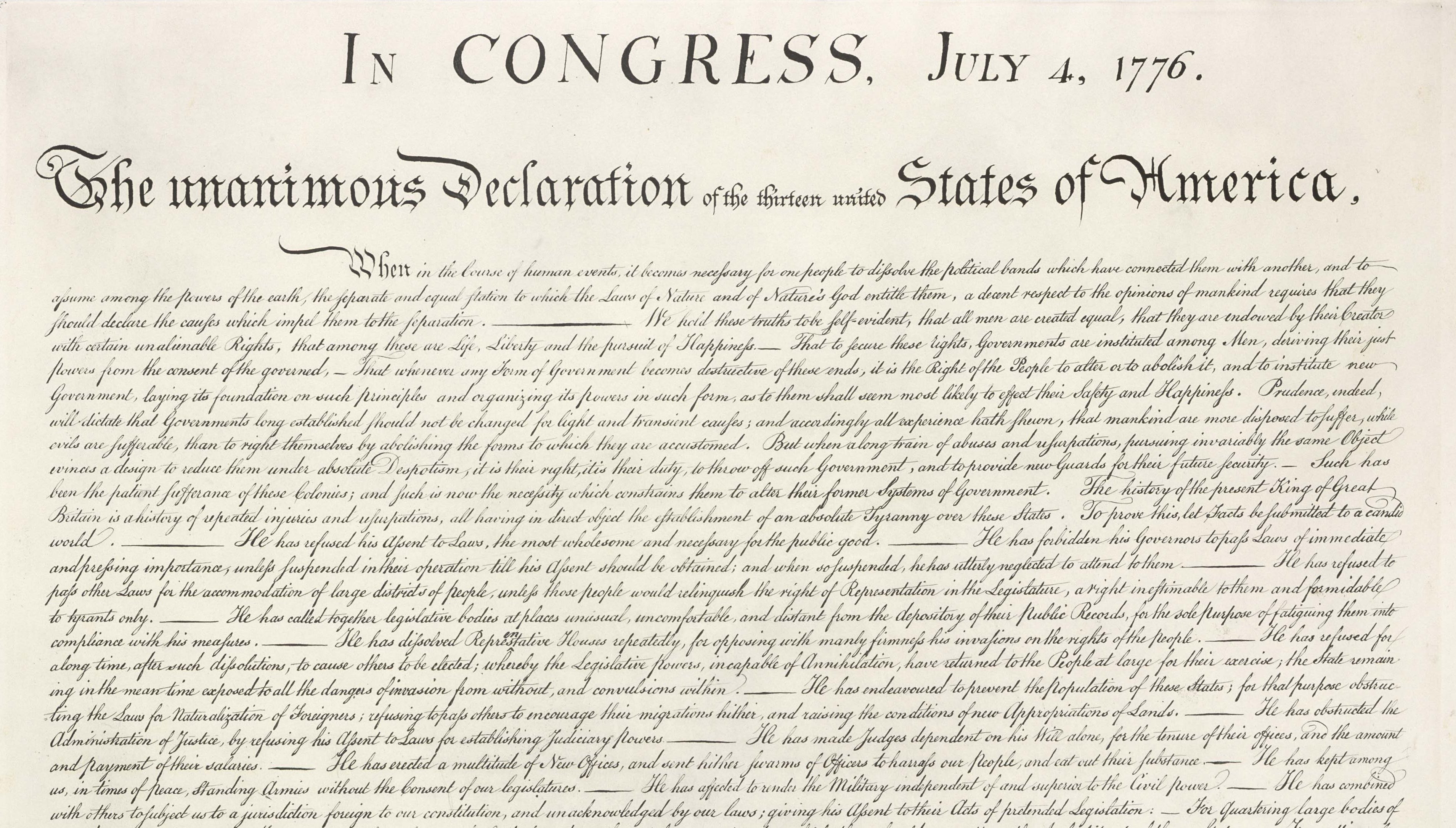
Editor’s note: This article is the second part of a serialized republication of a chapter from Timothy Sandefur’s book Proclaiming Liberty: John Adams, Thomas Jefferson, and the Declaration of Independence, by permission of the Cato Institute. The first part was published in the Summer 2026 issue and the third will appear in the Winter 2026 issue.
The Grievances
Having set out the major premise—that a ruler who violates the principles of justice and seeks to destroy individual liberty is unworthy of allegiance—Jefferson proceeded to the minor premise: the list of incidents that proved George III had violated his subjects’ trust. In framing this list, Jefferson employed the wording he had prepared for the new Virginia constitution, as well as the list of complaints from his Summary View. To these were added grievances from other publications, such as the 1772 Boston Pamphlet. After the committee of five submitted its draft to Congress for editing, the delegates spent two days revising this list. As finally adopted on July 4, the Declaration began:
He has refused his assent to laws, the most wholesome and necessary for the public good.
As soon as the Declaration was made public, critics began complaining that its list of grievances was so broadly worded that it was hard to determine which exact actions the colonists were referring to. But Congress had good reason for avoiding specifics. Countless other resolutions had already listed the laws Americans objected to; the First Congress had even provided citations so people could look them up. To do so again would bog down the Declaration and invite critics to dispute every jot and tittle. The time for such quibbling had passed.
Still, modern readers are sometimes puzzled about which “wholesome” laws the crown blocked. To begin with, colonists objected to the fact that all of their legislation was subject to a London veto. In some cases, kings had ordered colonial governors to reject entire categories of laws. The colonies were not allowed to grant divorces, for example, without royal approval.1 Governors were commanded to block bills to tax European imports or to pay colonial lobbyists in London.2 Worse, the home government had for decades barred the colonies from printing their own money. This created a chronic cash shortage, which forced Americans to barter or use complicated accounting devices to pay their bills, often at a financial loss. This policy of starving the colonists of cash could have cruel consequences in an age when debt was punishable by imprisonment.
But Jefferson had another, more important class of legislation in mind: the king forbade the colonists from adopting laws restricting the importation of slaves. The colonies—especially Virginia—had repeatedly tried to ban or restrict slave imports, only to be overridden by London. To Jefferson and other anti-slavery Patriots, restricting the slave trade offered a potential first step toward eliminating slavery itself. But the imperial government made clear that it would not allow Americans to hurt the Royal Africa Company’s bottom line. London had overridden efforts by Pennsylvania in 1712, South Carolina in 1760, New Jersey in 1763, and Virginia in 1710, 1727, and 1766 to ban or restrict slave imports—and in 1770, King George had ordered all colonial governors “upon pain of our highest displeasure” to veto “any laws whatever . . . by which the importation of slaves shall be in any respect prohibited or obstructed.”3 Thus, as Jefferson complained in the Summary View, George III preferred “the immediate advantages of a few African corsairs”—that is, British slave-catchers—“to the lasting interests of the American states, and to the rights of human nature, [which were] deeply wounded by this infamous practice.”4
He has forbidden his governors to pass laws of immediate and pressing importance, unless suspended in their operation till his assent should be obtained; and when so suspended, he has utterly neglected to attend to them.
The veto meant bills passed by American legislatures had to be shipped to England for review, and, if approved, sent back before going into effect. This took months even if the king’s officers acted quickly. In practice, however, it often took much longer. In 1770, for example, Virginia lawmakers passed a bill to prevent horse stealing; the Board of Trade in London did not get around to approving it until March 1773.5 One New Jersey bill went eight years before being reviewed. A South Carolina law adopted in 1696 was blocked in 1734.6 A New Hampshire statute passed in 1718 was not reviewed until 1769—and then it was vetoed.7 London also required colonial bills to contain “suspending clauses,” postponing implementation until royal approval could be obtained.8 The delays and disruptions caused by this protracted process and the potential of after-the-fact vetoes, rendered colonial lawmaking a frustrating, insulting, and often futile process.
He has refused to pass other laws for the accommodation of large districts of people, unless those people would relinquish the right of representation in the legislature, a right inestimable to them and formidable to tyrants only.
After the French and Indian War ended in 1763, the British government grew increasingly uncomfortable with the American colonies’ rapid expansion. Westward movement in particular seemed to threaten London’s hegemony, because the larger the population, and the more distant from the imperial capital, the more independent-minded Americans would become. “We ought rather to obstruct than encourage” westward movement, wrote one London intellectual, because otherwise “an army of an hundred thousand” would “not be able to control” the colonists, “whose hearts glow with the flame of liberty.”9 The government accordingly began discouraging emigration to America—nullifying colonial offers to pay travel costs for immigrants or to give them free land.10 It also sought to prevent the colonies from reapportioning their legislatures to accommodate people who moved west.
Population growth radically distorted the apportionment of these legislatures. In Pennsylvania, for example, the ratio went from one representative for every 336 adult white males in 1730 to one representative for every 1,301 in 1770.11 Yet the colonies, especially Virginia, Massachusetts, New York, New Jersey, and New Hampshire, were forbidden from taking steps to give frontier towns their own representatives.12 In North Carolina alone, the Colonial Office vetoed thirteen bills providing for the creation of new townships, in order to prevent additional representatives from being added to the colony’s legislature.13
He has called together legislative bodies at places unusual, uncomfortable, and distant from the depository of their public records, for the sole purpose of fatiguing them into compliance with his measures.
This grievance did not appear in Jefferson’s initial draft and was probably added at Adams’s urging. In 1770, he had participated in a months-long dispute with Governor Hutchinson over the Governor’s order that Massachusetts’ legislature relocate from Boston to Cambridge. Four years later, Hutchinson’s successor, General Thomas Gage, moved it again, this time to Salem. But even worse was the situation in South Carolina, royal governor Greville Montagu twice dissolved the colonial legislature, then ordered it to meet in Beaufort instead of Charleston—and then moved it back, all for the express purpose of preventing his political opponents from attending. Such ploys—which doubtless brought to mind the schemes of the Stuart monarchs (especially Charles II, who in 1681 moved Parliament from London to Oxford, because its residents were more supportive of the monarchy)—had no other purpose than to subvert the constitution by silencing the people’s representatives.
He has dissolved representative houses repeatedly, for opposing with manly firmness his invasions on the rights of the people.
Practically all the colonies had their legislatures closed, at least temporarily, by royal governors seeking to silence opposition to London’s authority. Representatives in Virginia and Massachusetts were repeatedly sent home for passing resolutions against unconstitutional taxes and regulations, and Parliament had adopted laws permanently closing the legislatures of New York and Massachusetts. Westminster viewed these actions as unremarkable, because it saw colonial assemblies as subordinate institutions. But to the colonists, who thought their legislatures were miniature parliaments, they were outrageous violations of political autonomy.
He has refused for a long time, after such dissolutions, to cause others to be elected; whereby the legislative powers, incapable of annihilation, have returned to the people at large for their exercise; the state remaining in the meantime exposed to all the dangers of invasion from without, and convulsions within.
This accusation drew a subtle but suggestive parallel between George III and the much-detested Stuart kings, who reigned from 1603 until being overthrown in 1688. Attempting to rule without Parliament was widely viewed as among the Stuarts’ worst offenses; one that justified the English Civil War. Now, King George’s subordinates had repeatedly shut down colonial legislatures, then delayed reopening them for so long as to render it impossible to conduct business. The Massachusetts legislature was closed indefinitely. Virginia’s Governor, Lord Dunmore, had prorogued that colony’s legislature in August 1774 and only called them back into session when forced to, nearly a year later. North Carolina’s governor dissolved the legislature, then fled the colony. In South Carolina, a furious dispute between the governor and the assembly led to so many closures that the colonial legislature adopted no laws at all after February 1771.14
Colonists had responded to these closures by establishing unofficial “conventions” to operate in place of their legislatures, but British authorities refused to acknowledge the conventions’ legitimacy. The Declaration justified them by declaring that the lawmaking power is “incapable of annihilation” because it belongs inherently to the people. If Parliament closed a legislature, “the people at large” were free to establish new ones.
He has endeavored to prevent the population of these states; for that purpose obstructing the laws for naturalization of foreigners; refusing to pass others to encourage their migrations hither, and raising the conditions of new appropriations of lands.
Americans knew immigration was key to economic and social growth. “In Europe,” wrote Jefferson, “the object is to make the most of their land, labor being abundant,” whereas in America, the goal was “to make the most of our labor, land being abundant.”15 The same logic, however, made Britain increasingly suspicious of immigrants. The 1660 Navigation Act expressly barred anyone not English-born from working as a merchant, or from commanding a trading vessel.16 Even ships purchased in the colonies from foreigners were subjected to heavy tariffs.17 Meanwhile, the lack of a uniform naturalization policy led to frustrating inconsistencies. Naturalization in one colony was not valid in other colonies.18
Colonies resorted to naturalizing people on a case-by-case basis, but London then instructed America’s royal governors not to sign any naturalization laws. The empire cracked down still more in the mid-1770s, banning colonial governors from approving naturalizations “upon any pretense whatsoever.”19 It also barred non-naturalized foreigners from owning land in the colonies. This tended to reinforce London’s autocratic rule, since voting rights depended on property ownership. The government followed that up by prohibiting colonies from giving away land to newcomers, as they had done for years in hopes of attracting immigrants. From now on, Parliament said, colonial governments had to sell land to the highest bidder—and sell it with a new tax requirement attached.20
Even that wasn’t enough for some. In May 1774, Governor Dunmore urged the Colonial Office to make sure only “men of credit and ability” bought property on the frontier, because the west was “becoming the asylum” of “disorderly and unruly people . . . who, carrying with them an abhorrence of all authority and control, establish themselves in defiance of both and become the continual plague and embarrassment of every government.”21 Parliament, in short, was using its control over land titles as a choke-chain on America’s rapidly growing population.
He has obstructed the administration of justice by refusing his assent to laws for establishing judiciary powers.
He has made judges dependent on his will alone for the tenure of their offices and the amount and payment of their salaries.
In his first draft, Jefferson accused the king of “suffer[ing] the administration of justice totally to cease in some of these colonies” by “refusing his assent to laws for establishing judiciary powers,” but Congress moderated his language.22 The courts had indeed ceased to operate in Virginia and Massachusetts—in Virginia because Dunmore dissolved the legislature before it adopted legislation to fund the courts, and in Massachusetts because jurymen refused to proceed under a system in which judges were paid directly by the king.
North Carolina courts were also closed, thanks to a years-long dispute regarding laws that enabled American lenders to “attach” the assets of English borrowers who failed to pay their bills. The right to seize assets from British debtors was crucial to American businessmen, who had no other practical way to recover from defaulting borrowers located across the sea. But in 1772, London officials forbade the colony’s legislature from authorizing this practice. Thus when lawmakers defiantly included a foreign-attachments provision in a bill to reform their legal system, royal governor Josiah Martin blocked it. The legislators responded by refusing to establish a court system without the attachment power. It was unfair, they argued, that imperial officials let New York and Pennsylvania adopt foreign-attachment laws, but not North Carolina. An impasse ensued, and North Carolina’s judiciary closed in 1773, not to reopen until the Revolution ended.
These were just some of the many clashes between Britain and the colonies over the organization of their judicial systems. The king had also disallowed the creation of a Pennsylvania Supreme Court unless the legislature narrowed its jurisdiction, blocked New York from empowering justices of the peace to decide cases involving less than £5 in damages, and vetoed a Virginia law that would have barred appeals of lawsuits involving fewer than £10.23 He blocked efforts by Pennsylvania, New York, and both Carolinas to provide judges with lifetime terms, and in 1761, instructed colonial governors to veto all such bills in the future.24 The empire wanted judges to answer to London, not to Americans.
Judicial independence was crucial to the Americans, especially to John Adams, who thought it essential to constitutional government. When London announced plans to pay judges’ salaries directly, he had maintained that this would make it impossible for Americans to obtain justice when challenging the government in court. Judges would inevitably fall prey to a “base servility of spirit” toward their paymasters and engage in “sordid, nauseous, and impious adulations to [their] superiors” rather than deciding cases neutrally.25 Adams would have had little patience for those who today claim that judicial review (the power of a court to declare a law unconstitutional) was an invention of the nineteenth century, or who assert that this practice is undemocratic, and that courts should be “restrained” instead of “active.” In his view, a vigilant and independent judiciary was indispensable to the rule of law and the preservation of liberty.
He has erected a multitude of new offices and sent hither swarms of officers to harass our people and eat out their substance.
The biblical metaphor of “swarms” had become common in America by 1776, to describe the way London was sending over agents to live off of the Americans like locusts devouring the crops of Old Testament farmers. To be governed like conquered foreigners doomed to labor for London’s enrichment, rather than for themselves, was the opposite of the American ideal of personal independence. But former Governor Hutchinson ridiculed this image in his pamphlet responding to the Declaration. He argued that no more than 30 or 40 such “officers” had been sent to America—that is, members of the American Customs Board and their subordinates—and that this was hardly enough to seriously burden the taxpayers.
Hutchinson was ignoring the fact that by “officers,” the Declaration’s authors were referring to the entire cadre of enforcers dispatched by England, which included thousands of soldiers, sailors, and inspectors, all of whom stood to profit from taxes and customs restrictions that the colonists considered unjust. Parliament had also adopted the Mutiny and Quartering Acts which forced colonists to house and supply these troops, who were stationed in America to spy on them. Parliament’s plan to pay governors, judges, and other bureaucrats with taxes taken from colonists—instead of leaving such decisions to local representatives—also meant that virtually every clerk, deputy, hanger-on, and bureaucrat would be paid with substance eaten out of the unconsenting people of America. There seemed no reason to doubt that the swarms of “pensioners” and “parasites” would grow.
He has kept among us, in times of peace, standing armies without the consent of our legislatures.
Jefferson had in mind the military occupation of Boston that began in 1768, but Whitehall had determined to maintain a permanent military presence in North America long before that. Following the French and Indian War, it stationed thousands of troops in the west (supplied and quartered at the colonists’ expense), ostensibly to protect Americans from French incursions or Native American uprisings, but also to block westward migration. Then, during the Stamp Act crisis in 1765, London had sent thousands more soldiers to Massachusetts, New York, and other colonies, and there they remained. This army—answerable exclusively to London—first served to menace the Americans and then, when Thomas Gage was made military governor, it became the official government, transforming the colony into a military autocracy.
He has affected to render the military independent of and superior to the civil power.
General Gage’s appointment as governor, with instructions empowering him to force civilian officials to assist him, meant all government in Massachusetts was effectively run by the army. Gage had implemented martial law, and Governor Dunmore had proclaimed martial law in Virginia, too, as did the governors of Quebec and Nova Scotia. They claimed the Mutiny Acts justified their actions, but one patriot pointed out, that only made things worse, because those statutes contained “no provision for securing the obedience of the military to the civil power, on which the preservation of our constitution depends.”26
The legality of these proclamations was doubtful. It was unclear at the time, whether the principle of martial law was even acknowledged in British jurisprudence.27 Blackstone and others said it was, but only when civilian authorities were incapable of operating.28 And that was not the case. Although Dunmore and Gage claimed that civilian rule had collapsed in their colonies, that wasn’t true. The Virginia House of Burgesses had tried to meet, in fact, only to be prevented by Dunmore’s refusal to come to the capital in Williamsburg. As for Massachusetts, Gage’s presence was the source of disorder.
This article appears in the Fall 2026 issue of The Objective Standard.
Elmer Beecher Russell, The Review of American Colonial Legislation by the King in Council (Columbia University, 1915), pp. 171-73.
Russell, Review of American Colonial Legislation, p. 507.
Leonard Woods Labaree, ed., Royal Instructions to British Colonial Governors 1670-1776 (Octagon Books, 1967), vol. 2, p. 679.
Peterson, ed., Jefferson: Writings, p. 116.
“Journal, March 1773: Volume 80,” in K.H. Ledward, ed., Journals of the Board of Trade and Plantations: Volume 13, January 1768 - December 1775, (London, 1937), British History Online https://www.british-history.ac.uk/jrnl-trade-plantations/vol13/pp342-351 (Fo. 50).
Dudley Odell McGovney, “The British Privy Council’s Power to Restrain The Legislatures of Colonial America: Power to Disallow Statutes: Power to Veto,” University of Pennsylvania Law Review vol. 94 (1946), p. 72.
Charles M. Andrews, The Royal Disallowance (American Antiquarian Society, 1914), p. 9.
Russell, Review of American Colonial Legislation, p. 507.
Thomas Short, A Comparative History of the Increase and Decrease of Mankind in England (London: W. Nicoll, 1767), pp. 164-65.
Marilyn C. Baseler, “Asylum for Mankind”: America 1607-1800 (Cornell University Press, 1998), pp. 123-25.
Gordon S. Wood, The Radicalism of the American Revolution (Knopf, 1992), p. 128.
Sydney George Fisher, “The Twenty-Eight Charges against the King in the Declaration of Independence,” Pennsylvania Magazine of History and Biography 31(3) (1907), p. 273; Russell, Review of American Colonial Legislation, pp. 604-06.
Russell, Review of American Colonial Legislation, p. 606.
Jack P. Greene, “Bridge to Revolution: The Wilkes Fund Controversy in South Carolina, 1769-1775,” Journal of Southern History 29(1) (Feb. 1963), p. 52.
Peterson, ed., Jefferson: Writings, p. 212.
George Louis Beer, The Old Colonial System (Macmillan, 1912), vol. 1, p. 70.
Beer, Old Colonial System, vol. 1, p. 67.
A.H. Carpenter, “Naturalization in England and the American Colonies,” American Historical Review 9(2) (Jan. 1904): pp. 288-303.
Documents Relative to the Colonial History of the State of New York (Albany: Weed, Parsons & Co., 1857), vol. 8, p. 402.
Documents Relative, vol. 8, pp. 357-58. Bernard Bailyn, Voyagers to the West (Vintage, 1986), p. 56.
K.G. Davies, ed., Documents of the American Revolution 1779-1783 (Colonial Office Series) (Irish University Press, 1975), vol. 8, p. 114.
Julian P. Boyd et al., eds., The Papers of Thomas Jefferson (48 vols. Princeton University Press, 1950– present), vol. 1, p. 425.
Russell, Review of American Colonial Legislation, pp. 582-85.
Russell, Review of American Colonial Legislation, p. 608.
Adams, ed., Works of John Adams, 3: 567.
Daniel R. Coquillette & Neil Longley York, eds., Portrait of a Patriot: The Major Political and Legal Papers of Josiah Quincy Jr. (Colonial Society of Massachusetts, 2014), vol. 6, p. 217.
Sir Matthew Hale had declared in 1713 that it was not, but it was generally accepted that a breakdown in civilian order could authorize what we now call martial law. In Hale’s day, the distinction between martial law and military law was poorly understood. Abhishek Singhvi & Khagesh Gautam, The Law of Emergency Powers (Springer, 2020), pp. 22-23.
Blackstone, Commentaries, vol. 1, pp. 413-14.
