


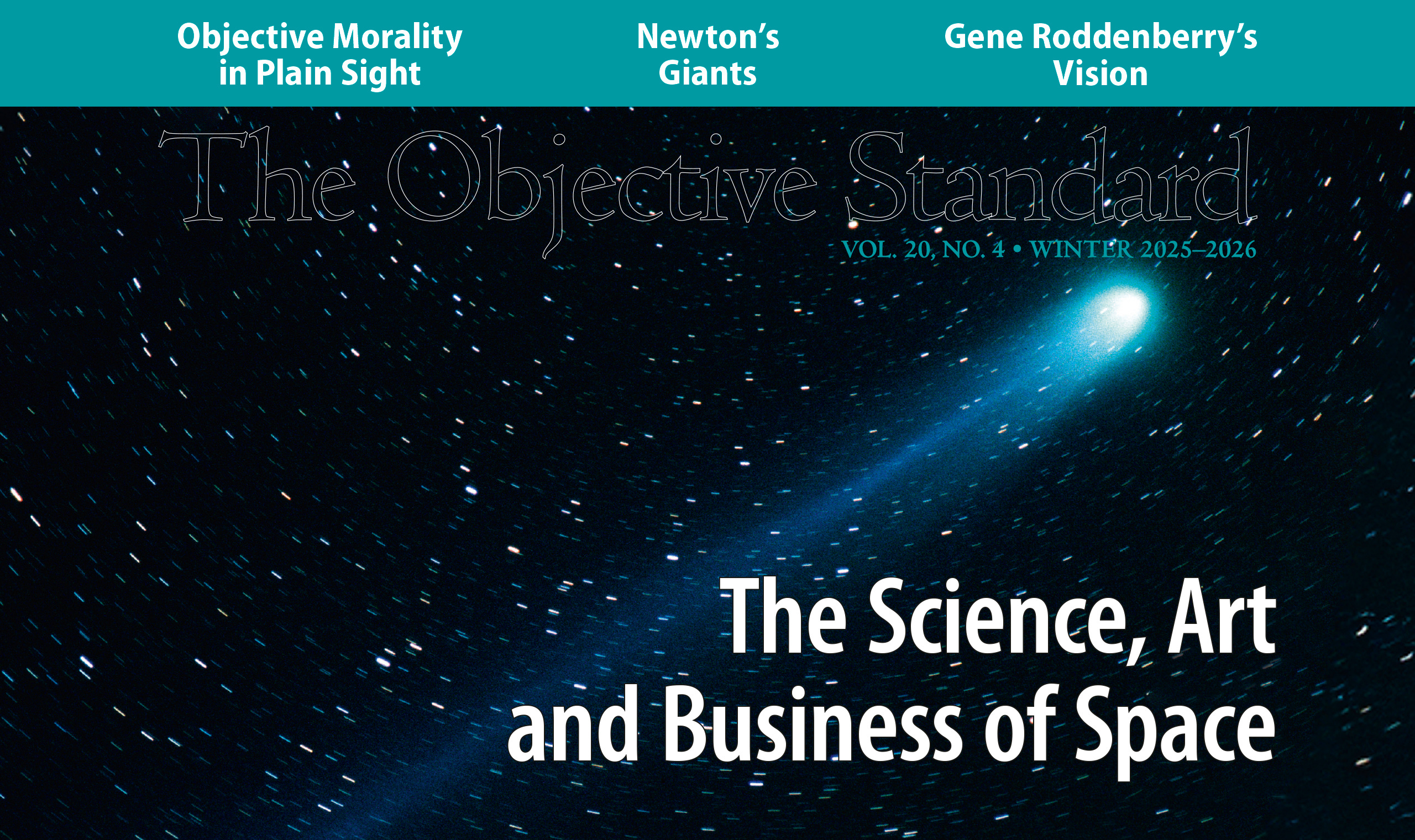
Welcome to the Winter 2025 issue of The Objective Standard, which rounds out two decades of crystal clear commentary from an Objectivist perspective.
This wellspring is made possible by people like you, who understand the importance of philosophy for freedom and flourishing. If you’d like to help expand our reach, consider upgrading your subscription or becoming a Standard Bearer. As Ayn Rand noted, “When you write an article in which you evaluate cultural phenomena rationally, you do more for Objectivism than you could in any other form”—and, by extension, when you support a periodical that produces a constant stream of such articles, you do more to advance the philosophy than you could by any other means.
Now to the contents of this eightieth issue of the journal for people of reason.
First up in our Heroes section is “‘I Believe in Humanity’: The Defiant Optimism of Gene Roddenberry,” in which Thomas Walker-Werth explores the life and values of the man behind Star Trek. Despite growing up in a church-attending Southern family, Roddenberry rejected religion in favor of reason, with which he dove headlong into the world of science fiction and created one of the most forward-thinking, optimistic, beloved series ever. Whether or not you’re a Trekkie, I think you’ll find great value in the story of this man of the mind.
Next, also by Thomas, is a profile of two underappreciated heroes in the history of science: Tycho Brahe and Johannes Kepler. In an age when it was still common to believe that the heavens were formations of fixed spheres rotating around the Earth, Brahe took astonishingly precise measurements of the movements of planets, comets, and other celestial bodies, which, in turn, enabled his student Kepler to discover laws governing the movements of planets, thereby paving the way for Isaac Newton to identify the fundamental laws of motion. As Newton acknowledged, “If I have seen further it is by standing on the shoulders of Giants.” Brahe and Kepler are two of his giants.
Last in Thomas’s space-themed trilogy is a tribute to Elon Musk and SpaceX for their extraordinary contributions to human spaceflight and for launching a new space age. The recent successful test flights of their new Starship spacecraft have demonstrated that private innovation can deliver commercially viable human spaceflight, whereas government space agencies have failed.
Next up, Timothy Sandefur examines two new biographies of antislavery activist Charles Sumner, highlighting ways in which these and previous attempts to profile this heroic man fall short. In his usual style, Sandefur draws on numerous sources to paint a vivid picture of Sumner’s life and values, leaving us wishing that he’d write the just biography this great man deserves.
In our Philosophy section, I show that “The Objective Standard of Morality is Hiding in Plain Sight.” This is followed by two short pieces by me regarding the murder of Charlie Kirk: “Thinking vs. Tribing: The Difference of the Day,” which identifies the fundamental and opposite ways in which people reacted to the atrocity; and “Reason and Rights: Pillars of Civilized Society,” which shows why the recognition and acceptance of reason as man’s only means of knowledge is essential to the recognition and protection of individual rights.
Opening our Politics section, Kiyah Willis analyzes the alleged viability of a “two-state solution” to the conflict between Israel and jihadist groups and regimes seeking to destroy it, showing why such a solution is made impossible by the ideology of Israel’s sworn enemies.
Next, Nicholas Provenzo shows why “Government Threats against ABC Are Unconstitutional and Violate Rights”—zeroing in on the facts that constitute the threat and the underlying principle that governs all such situations.
In today’s political chaos, the Black Lives Matter riots of 2020 may seem like a distant memory, but the ideas that gave rise to them linger on. In his review of Summer of Our Discontent: The Age of Certainty and the Demise of Discourse by Thomas Chatterton Williams, Timothy Sandefur highlights how Williams identifies factors that fueled those riots and what we must do to avoid such causes in the future—while also highlighting relevant fundamental principles that Chatterton and so many others fail to identify.
Timothy follows that with a review of The Great Contradiction: The Tragic Side of the American Founding by Joseph Ellis, who properly repudiates the “1619 Project” and its false claims about the American founding but sadly fails to identify, much less defend, the principles on which the republic was based.
The Politics section concludes with Aditya Patil’s review of The White Pill: A Tale of Good and Evil by Michael Malice, which gives deserved credit to Malice for his cogent and detailed reminder of the evils of the Soviet Union, along with thoughtful criticism of Malice’s relatively unphilosophical approach to the nightmare of communism.
Our Arts section kicks off with Tim White’s review of Guillermo del Toro’s widely acclaimed Frankenstein movie. Tim argues that the film succeeds in telling this classic story in a way that is both refreshingly new and faithful to the source material. Related, in “Achievement and Moral Cowardice: Who Is the ‘Real Monster’ in Frankenstein?,” John Devlin turns to Mary Shelley’s original novel, arguing against the popular notion that Victor Frankenstein himself is the “real monster” and upholding the truth that the conscious, intentional being who actually commits the horrendous murders is indeed the real monster.
Thomas Walker-Werth wraps up the issue with three short articles: “The Fantastic Four: First Steps Almost Addresses the Big Moral Problem with Superhero Movies” identifies the altruistic premise that so often dominates superhero stories and that this new blockbuster came tantalizingly close to questioning; “The Value of Individuality: Lessons from the Borg of Star Trek” highlights an episode of Star Trek: The Next Generation that artfully captures the vital nature of freedom to determine one’s own values and character; and “How GoldenEye Brought James Bond into the Modern World” marks the thirtieth anniversary of this landmark instalment in the 007 franchise, examining how it handles the real-world fall of Bond’s traditional enemy, the Soviet Union.
That’s it for this issue. I hope you enjoy the articles and reviews. If so, be sure to recommend and share them with friends on social media, in conversation, and especially on Substack.
Also, if you have a Substack publication of your own, please recommend The Objective Standard on your homepage (see “recommendations” on your dashboard). And if you’ve not yet subscribed to the journal for people of reason, head over to TheObjectiveStandard.com and become a subscriber—or, better yet, a Standard Bearer.
Happy holidays!
Craig Biddle
Editor in Chief
The Objective Standard