

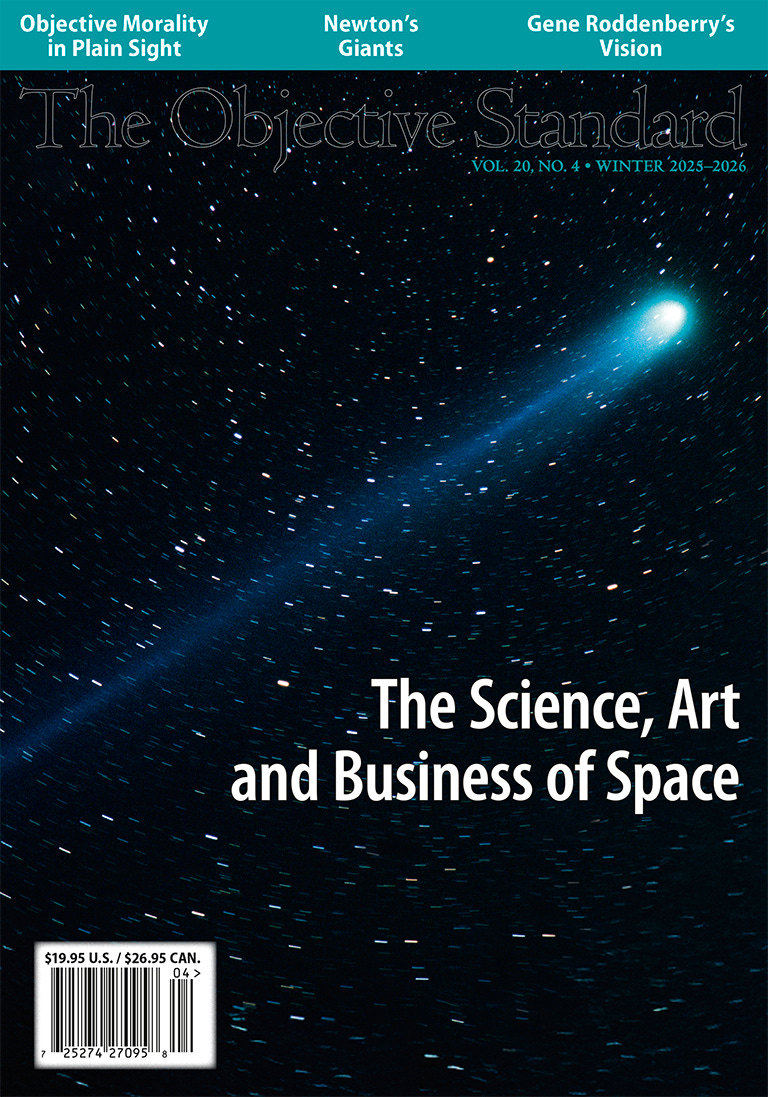
If you are a paid subscriber, you can access PDF and EPUB versions of this issue here.
In this issue:
The Winter 2025 Issue of TOS Is Published!

Welcome to the Winter 2025 issue of The Objective Standard, which rounds out two decades of crystal clear commentary from an Objectivist perspective.
Cover Article
“I Believe in Humanity”: The Defiant Optimism of Gene Roddenberry

Gene Roddenberry's story is inspirational—an example of how one man who knows what he stands for can change the direction of a culture.
Heroes
The Giants Who Paved the Way for Newton

When the Danish astronomer Tycho Brahe died on October 24, 1601, seven years before the invention of the telescope, it was not the end of his contribution to astronomy. Rather, his death opened the door for his student Johannes Kepler to leverage his work to make some of the most crucial discoveries in the history of science.
Congratulations to SpaceX for Opening a New Space Age

The dream of humanity colonizing the solar system just got a whole lot closer to reality.
Charles Sumner: The Antislavery Hero America Needs to Remember

Massachusetts Senator Charles Sumner was that rarest of political creatures: a deeply principled man who nevertheless rose to the highest levels of government power. Best remembered today as one of slavery’s most vocal enemies, he was also a leading scholar of international law whose achievements included overseeing the annexation of Alaska.
Philosophy
The Objective Standard of Morality Is Hiding in Plain Sight

For thousands of years, people have debated the objective standard of morality. Is there such a thing? If so, what is it? And how can we know it?
Thinking vs. Tribing: The Difference of the Day

While civilized people mourn the assassination of Charlie Kirk—and the uncivilized celebrate it—we would do well to name the relevant divide at a deeper level.
Reason and Rights: Pillars of Civilized Society

Charlie Kirk was murdered because someone felt his “hateful” speech should be silenced.
Politics
The Two-State Delusion

On October 7, 2023, Israel experienced one of the darkest days in its history. In the early morning hours, Hamas launched a brutal surprise attack, murdering more than a thousand Israelis and taking more than two hundred hostages. Since that day—indeed, since its inception—Israel has been fighting a war for its survival.
Government Threats against ABC Are Unconstitutional and Violate Rights

The right to speak does not depend on agreement or approval. It protects the peaceful expression of ideas—whether brilliant or foolish, noble or vile—from coercion. To attack that right is to attack reason itself.
Summer of Our Discontent: The Age of Certainty and the Demise of Discourse by Thomas Chatterton Williams (Review)

Williams is surely right that “genuine liberals, as well as their moderate and center-right partners, have no choice but to reclaim the abandoned moral high ground." But it can only be reclaimed if we are clear about a morality rooted in reason, individualism, and the politics of liberty.
The Great Contradiction: The Tragic Side of the American Founding by Joseph Ellis (Review)

America’s founders made unprecedented progress toward the liberation of the human race from the tyranny and ignorance in which it had languished for so long. This is an objectively good thing, and the founders accomplished it because they did, however imperfectly, “glimpse the eternal truths.”
The White Pill: A Tale of Good and Evil by Michael Malice (Review)

The twentieth century’s most destructive ideology is now the least understood. Across Europe, America, and parts of the Global South, support for socialism and communism is making a comeback.
The Arts
Frankenstein, Directed by Guillermo del Toro (Review)

Few (if any) novels have been adapted and retold more than Mary Shelley’s Frankenstein. By 2025, almost no take on the story is both new and broadly faithful to the original, which left writer and director Guillermo del Toro with essentially one option: Tell the same story again but better. At this, he succeeds wonderfully; his adaptation is one of the best to date.
Achievement and Moral Cowardice: Who Is the "Real Monster" in Frankenstein?

With Guillermo del Toro’s Frankenstein adaptation recently hitting movie theaters and streaming services, it’s worth revisiting Mary Shelley’s classic gothic novel and a persistent misunderstanding of the story’s meaning.
The Fantastic Four: First Steps Almost Addresses the Big Moral Problem with Superhero Movies

It’s frustrating that few, if any, of the many recent superhero movies dealt meaningfully with one of the genre’s biggest problems: the typically unchallenged premise that superheroes, by virtue of having superpowers, are somehow morally obliged to sacrifice themselves for others.
The Value of Individuality: Lessons from the Borg of Star Trek

Star Trek’s Borg storyline is an outstanding example of science fiction’s ability to use fantastical stories as allegories for real-world subjects. Not only do these arcs serve to highlight the life-destroying nature of collectivism and the evil of suppressing individual thought, they also highlight why we as individuals must think deeply and carefully about our unique identities, values, and purposes in life.
How GoldenEye Brought James Bond into the Modern World

GoldenEye is, in many respects, Bond at its best.