


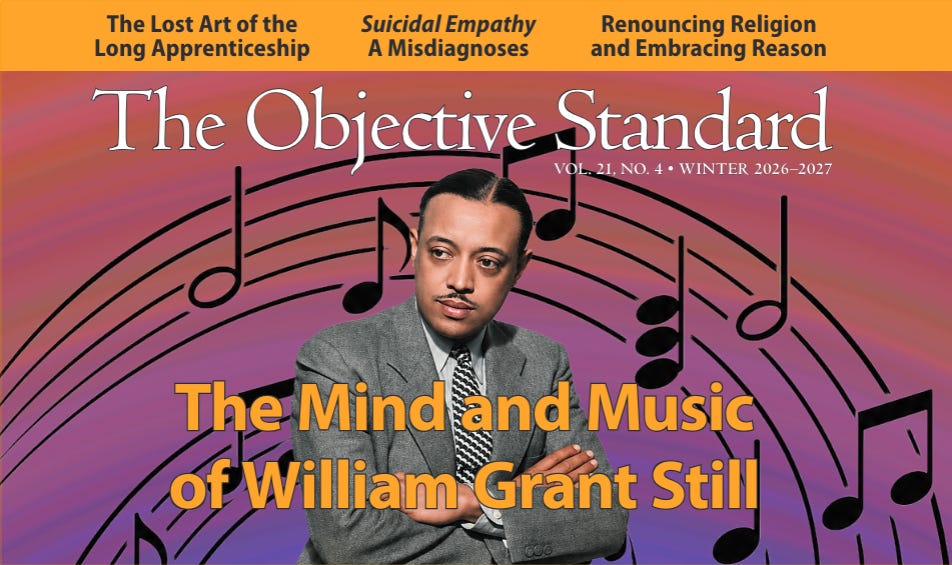
Welcome to the Winter 2026 issue of The Objective Standard, the rational alternative to conservatism and regressivism.
Let me begin with a hearty thank you to managing editor Thomas Walker, who departs TOS with this issue to pursue some exciting new ventures.
Thomas has been writing and editing for TOS since 2020. He’s written scores of excellent articles and reviews, edited hundreds more, and overseen the production of our weekly and quarterly publications. I’m deeply grateful for his thoughtful work, his dedication to clarity, precision, and truth, and the many ways he has helped make TOS the journal it is today.
Thomas is launching Rational Endeavour, an organization dedicated to promoting curiosity, optimism, and reason. Its projects include The Endeavourist, a magazine covering science, philosophy, history, and more; and EndeavourCon, a conference debuting in Bedford, England, on May 23, 2027. For details, visit RationalEndeavour.com.
Please join me in thanking Thomas for his superb work at TOS and wishing him great success with his new endeavors. Thank you, Thomas—and fly high!
Now, to the contents of this, the eighty-second issue of The Objective Standard, which wraps up our twenty-first year of publication.
In the cover article, “America’s Composer: The Individualistic Mind and Music of William Grant Still,” Rebecca Day paints a fascinating portrait of a pioneering American composer who created extraordinary music while rejecting the race-based collectivism of many of his musical contemporaries and striving for a “universal idiom” that gave his music a distinctly American voice.
In “How I Renounced Religion and Embraced a Life of Reason,” adapted from his LevelUp 2026 talk, Maddox Locher recounts how he went from pretending to have engaged with “God” to please his Sunday school teacher to rejecting religion and faith in favor of reason, evidence, and the requirements of human life.
In a related piece, “Sam Harris’s Waking Up: A Self-Defeating, ‘Secular’ Spirituality,” Maddox examines the prominent atheist’s attempt to offer a secular approach to spirituality—and exposes fundamental flaws that undermine it.
Also on the theme of the human spirit, Thomas Walker interviews life coach and psychology graduate Daria Ermolenko about how emotions arise and how we can change them for the better, and about what self-esteem is and how it affects friendships and romantic relationships.
In “The Lost Art of the Long Apprenticeship,” Samuel Peters examines a once-common approach to education and skill development that helped produce such extraordinary masters as Leonardo da Vinci. Samuel explains how long-term apprenticeships enabled aspiring creators to develop exceptional abilities—and why the decline of this approach is a significant loss. This is Samuel’s first contribution to TOS, and I’m delighted to welcome him to our pages.
Next up is “Understanding the Declaration of Independence (Part 3),” Timothy Sandefur’s examination of the colonists’ grievances against the king and Parliament, Jefferson’s deleted condemnation of the slave trade, and the closing language by which the colonies declared themselves independent. This is the final installment drawn from Timothy’s outstanding book Proclaiming Liberty: John Adams, Thomas Jefferson, and the Declaration of Independence. You’ll find the first two in our Summer and Fall 2026 issues.
In “Why Airlines Suck: Ryanair CEO Points the Finger at Government,” Thomas Walker highlights Ryanair CEO Michael O’Leary’s refreshingly forthright criticism of government interference in the airline industry. O’Leary identifies the real culprits behind many of the industry’s problems: the politicians and bureaucrats who restrict the freedom and innovation of those who provide air travel.
Also regarding aviation, in “The Heroes of Flight 1073,” Thomas tells the story of the courageous men who prevented what otherwise would have been one of the worst Islamic terrorist attacks in decades. This is an instance of the principle aptly stated by C. S. Lewis: “Courage is not simply one of the virtues but the form of every virtue at the testing point.” Thank goodness for these men—or more precisely, thank these men for their goodness.
The continuing threat of such attacks is related to a broader problem in Western culture: the willingness to tolerate ideas and practices that are fundamentally hostile to human life. In his review of Gad Saad’s Suicidal Empathy, Michael Dahlen explains (a) why Saad is right that such tolerance is a serious cultural problem but wrong about its underlying causes—and (b) why identifying those causes correctly matters.
Next up, in “Praxis: The Rude Awakening Colleges Need,” Thomas Walker interviews Joshua Sternberg about an innovative alternative to traditional college that helps young people develop practical skills, pursue productive careers, and take greater responsibility for their futures.
Rounding out the issue are three reviews of recent films and television productions.
In “The Vibrancy and Vividness of Sense and Sensibility (2026),” Angelica Werth examines a new adaptation of Jane Austen’s beloved novel, focusing on its artistic merits and its treatment of the characters and values that make Austen’s work so enduring.
In “Bear in Obsession: Villain or Victim of Circumstance?” Ava Scott-Nadal examines the disturbing film’s central character and explores the morally important question of whether he is responsible for his actions or merely a product of his circumstances.
And finally, in “Netflix’s East of Eden Turns Steinbeck’s Villainess into a Confused Mess,” Angelica Werth shows how this new adaptation undermines a crucial character in John Steinbeck’s original story—and in doing so, distorts the meaning and diminishes the impact of the work.
That’s the lineup. I hope these articles, interviews, and reviews sharpen your mind, fuel your soul, and enrich your life.
Enjoy the issue, and be sure to share your favorite articles with friends.
A mind is a beautiful thing to use!
—Craig Biddle