


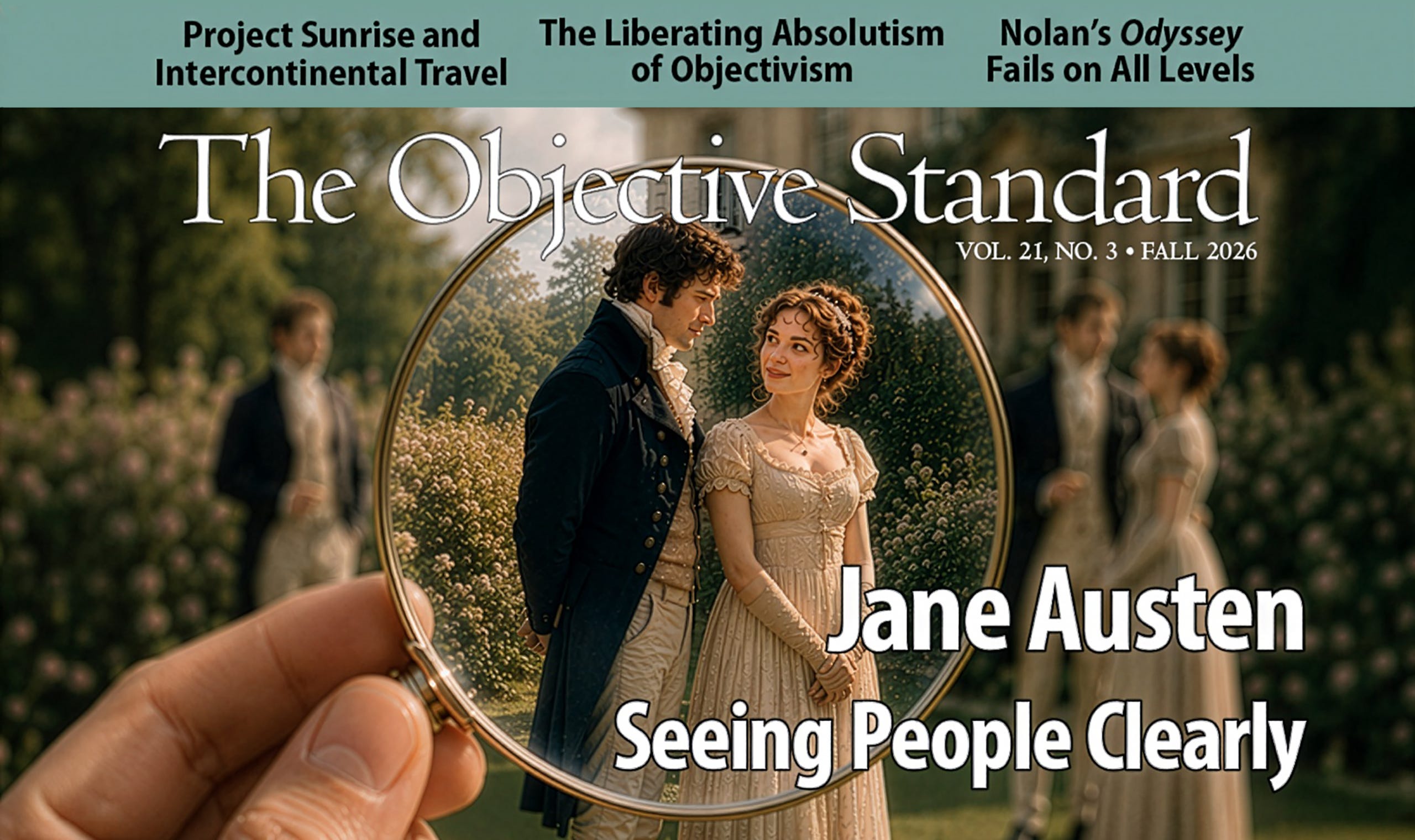
Welcome to the Fall 2026 issue of The Objective Standard, the rational alternative to conservatism and regressivism.
When we navigate relationships, even with the moral clarity of an integrated, rational philosophy, determining the best course of action can be difficult. We need to fully understand both others and ourselves. One thing that can help enormously is actively engaging with well-crafted stories that show and contrast characters grasping and failing to grasp their emotions and motives—and the consequences for their lives. In “Seeing People Clearly: Lessons from Jane Austen,” Angelica Werth describes and demonstrates how one of literature’s greatest authors depicts these processes and how we can apply her insights to our own lives.
Art movements are often also philosophic movements. A powerful example of this is the little-known pre-Soviet Russian poetry school known as Acmeism. In “The Morning of Acmeism: The Forgotten School of Reality-Affirming Poetry,” Objective Standard Institute junior fellow Georgy Sinitsky details this movement and the brief expression of rationality it represented in the bleak history of Russian thought.
Rational philosophy is, by its nature, absolute—it is grounded in and expressive of the facts of reality. But whereas many think of absolute principles as restrictive, Craig Biddle argues in “The Liberating Absolutism of Objectivism” that this absolutism actually frees us from the tyrannical whims of subjectivism to understand and uphold principles that empower us to live our best lives.
Next, in part two of “Understanding the Declaration of Independence,” Timothy Sandefur continues his exploration of the ideas that underpinned the American founding, observing the timeless principles that apply as much in any era as they did in 1776.
To the extent that entrepreneurs are free from coercion, they will be able to innovate. I demonstrate this fact in “Project Sunrise: The Future of Intercontinental Travel,” detailing the impressive achievement of Airbus and Qantas in developing the longest-range passenger jet ever built. I also note how much further advanced aviation might be if it were not for past and present government meddling in the industry.
Then, in “The Volunteers Who Turned Failed Transport Links into Thriving Tourist Attractions,” I celebrate the passionate individuals who, in the stifling environment of widespread nationalization and industrial decline of 1950s Britain, set out to acquire and restore railway lines that today serve as an immersive educational experience of what life and industry were like in decades past, as well as offering opportunities for film, training, research, and more.
Kicking off our reviews for this issue, in “Angel Down Makes a Mockery of Pulitzer Prize’s Celebration of Excellence,” Angelica Werth examines this deeply flawed book, which rejects the conceptual nature of literature in favor of giving an emotional impression—as though the two must necessarily be opposed.
While books that reject meaning and clarity are awarded Pulitzers, movies either lacking in moral themes or possessing frighteningly dangerous ones are widely praised by critics and adored by the public. In “Nolan’s Odyssey (2026) Fails on All Levels: As an Adaptation, as a Film, and as a Story,” Tim White shows why Nolan’s adaptation of Homer’s classic is more an insult than a tribute to the ancient epic. Meanwhile, in “Odysseus and the Limits of Ancient Heroism,” John Devlin recognizes the importance of the original work as the pioneer of heroism in literature while highlighting how the mysticism of ancient Greek culture undermined its otherwise heroic theme.
Then White highlights another example of morally bankrupt movies attracting widespread praise in “Citizen Vigilante Is Exactly What It Looks Like—and That’s Not a Good Thing.” His examination of the film explores many aspects of its story and the ethical premises it exhibits, while Robert Bidinotto’s “I Write Vigilante Thrillers—But Citizen Vigilante Disgusts Me” focuses on the nature of vigilante protagonists and offers a contrast to show how they can be heroic when written properly.
Rounding off this issue, in “Mickey 17: The Importance of Valuing Life—Especially Your Own,” Ava Scott-Nadal thoughtfully evaluates the film, which uses a creative science-fiction setting to explore how easily respect for individual lives can be lost and why we should always value human life and uphold our right to our own.
That’s it for this issue—I hope you enjoy the articles and reviews. If so, be sure to recommend and share them with friends on social media, in conversation, and especially on Substack. If you have a Substack publication of your own, please recommend The Objective Standard on your home page (see “recommendations” on your dashboard). And if you’ve not yet subscribed to the journal for people of reason, head over to TheObjectiveStandard.com and become a subscriber or upgrade your subscription today.
Thank you for your business and support,
Thomas F. Walker
Managing Editor
The Objective Standard