


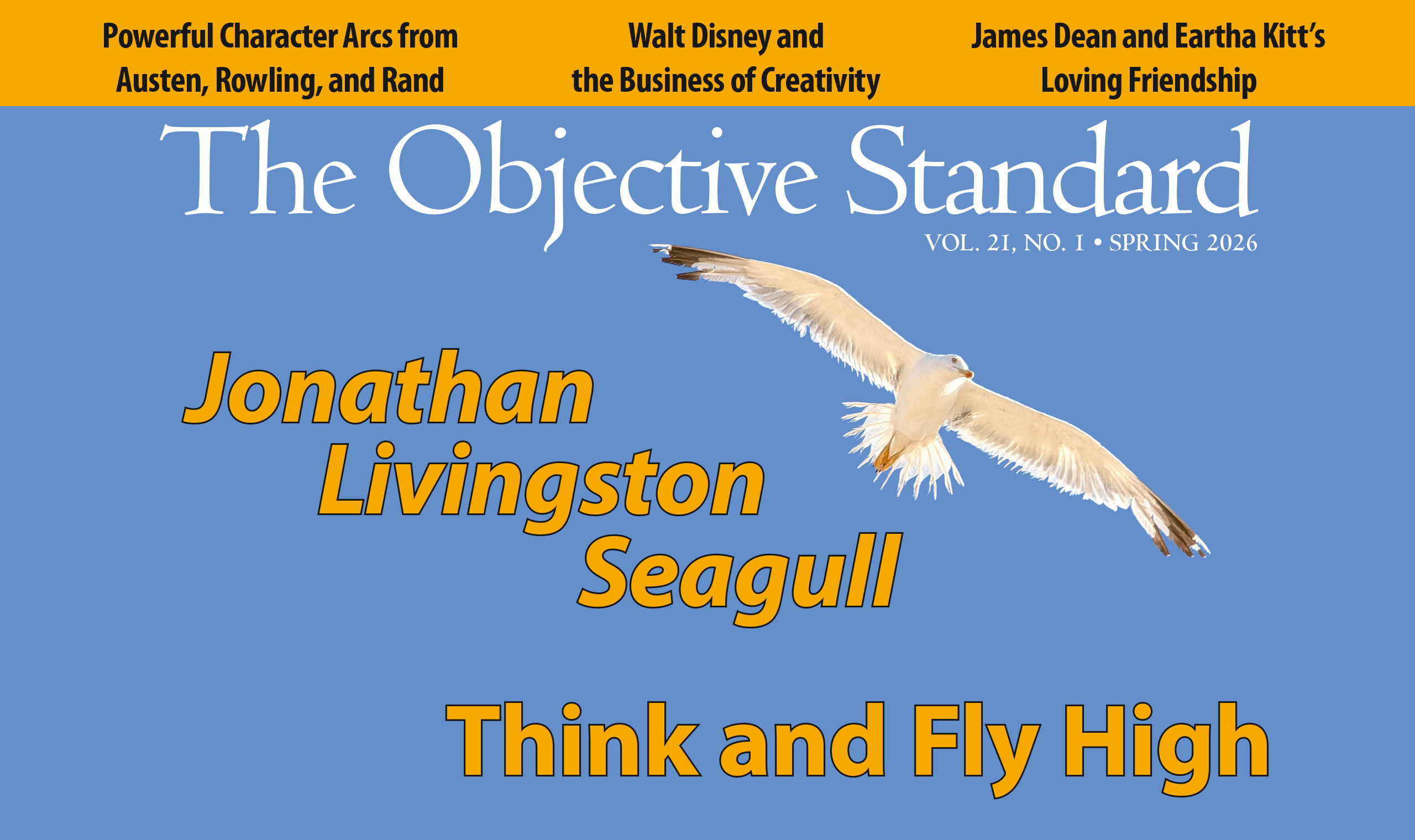
Welcome to the Spring 2026 issue of The Objective Standard, the rational alternative to conservatism and regressivism.
This issue begins our twenty-first year of publication. 2025 was a challenging year for TOS as we relaunched the journal on our new home at Substack, but now that the final kinks are ironed out, we’re delighted with what we’ve built in this new space. And we love that Substack enables you to share, comment on, and post about our articles so easily. We hope you’re enjoying these features, too.
Now, to the contents of this eighty-first issue of The Objective Standard.
First up, in “Think and Fly High: Inspiration from Jonathan Livingston Seagull,” Daria Topchii, a junior fellow at Objective Standard Institute (OSI), highlights the beauty and virtues of Richard Bach’s novella. Although the story flies into mystical territory at times, it is essentially about the importance of independent thinking, purposeful living, and loving one’s life. It also has some remarkable similarities to passages and ideas in Ayn Rand’s The Fountainhead and Atlas Shrugged. I think you’ll be delighted.
Continuing with the theme of beautiful stories and storytellers, Tim Chermak chronicles the life, works, virtues, and vision of the father of animated cinema in “Walt Disney and the Business of Creativity.” In this article adapted from his talk at LevelUp 2025, Tim makes a compelling case that Disney was, in fact, the greatest capitalist in American history and leaves us wishing that the great man had lived to see his most ambitious project realized.
Next up, we have the first TOS article from musician and art historian Rebecca Day. In “‘Our Souls Were Mates’: The Loving, Values-Based Friendship of James Dean and Eartha Kitt,” Rebecca dives into this short-lived yet rich relationship, showing how non-romantic love can be profoundly life-enhancing.
After that, Tim White shines a light on an alternative to what currently passes for American education in his review of The Subversive Art of a Classical Education: Reclaiming the Mind in an Age of Speed, Screens, and Skill-Drills by Michael S. Rose. The book sets out a blueprint for a better approach to schooling based on objective communication and encouraging independent thought.
In “Character Arcs and the Arc of Your Life,” Angelica Werth explores the growth arcs of three great fictional characters: Jane Austen’s Elizabeth Bennet, Ayn Rand’s Hank Rearden, and J. K. Rowling’s Neville Longbottom. In this article adapted from her talk at LevelUp Europe 2025, Angelica draws out the value from these stories and shows how the lessons these characters learn can help us turn our own lives into stories of virtue, growth, and success.
Next up, I explore the value and meaning of one of progressive rock’s seminal albums in “The Inspiring Individualism of 2112.” Not only are the album’s lyrics and the stories they tell powerful concretizations of individualism and reason—so, too, is Rush’s defiant refusal to compromise when their record label pressured them to abandon the style of music they loved. That steadfast commitment to their values earned them a place among rock royalty.
Moving from music to architecture, in “Can Robots Bring Back Beautiful Buildings?” I interview Arka Serezh, founder of Gondor Industries, a company dedicated to harnessing the power of robotics to bring beautiful stonework back into architecture in new and innovative ways.
I then review Mercy, directed by Timor Bekmambetov, an extreme example of the current tendency for some films to have high audience approval ratings but poor critical receptions. In this case, I believe many reviewers have mistaken the film’s core point, focusing on its depiction of AI rather than on its ideas about justice.
Then we have “Eleven Soaring Poems about Flight,” including works from Edmond Rostand, Henry Wadsworth Longfellow, Percy Bysshe Shelley, and even such unexpected names as Wilbur Wright and our own Craig Biddle.
Next, in “Two Perspectives on Stopping Trump and Other Tyrants,” Nicholas Provenzo reviews two books, Robert Tracinski’s Dictator from Day One: How Donald Trump Is Overthrowing the Constitution and How to Fight Back and Ira Chaleff’s To Stop a Tyrant: The Power of Political Followers to Make or Break a Toxic Leader. Whether you’re concerned by Trump’s disregard for the Constitution, rights, and reason, or you’re battling rights-abusing leaders elsewhere in the world, Nicholas highlights the valuable insights these books contain for understanding and opposing the tyrants of today.
Lastly, OSI junior fellow Margherita Bovo makes her TOS debut with two philosophically rich reviews of important works: The Death of Nature: Women, Ecology, and the Scientific Revolution by Carolyn Merchant and The Enlightenment: The Pursuit of Happiness, 1680–1790 by Ritchie Robertson. The first book pioneered the virulent movement known today as “ecofeminism” whereas the second is a welcome exposition on why the Enlightenment should be studied and lauded.
That’s it for this issue—I hope you enjoy the articles and reviews. If so, be sure to recommend and share them with friends on social media, in conversation, and especially on Substack. If you have a Substack publication of your own, please recommend The Objective Standard on your home page (see “recommendations” on your dashboard). And if you’ve not yet subscribed to the journal for people of reason, head over to TheObjectiveStandard.com and become a subscriber or upgrade your subscription today.
Thank you for your business and support,
Thomas Walker-Werth
Managing Editor
The Objective Standard