


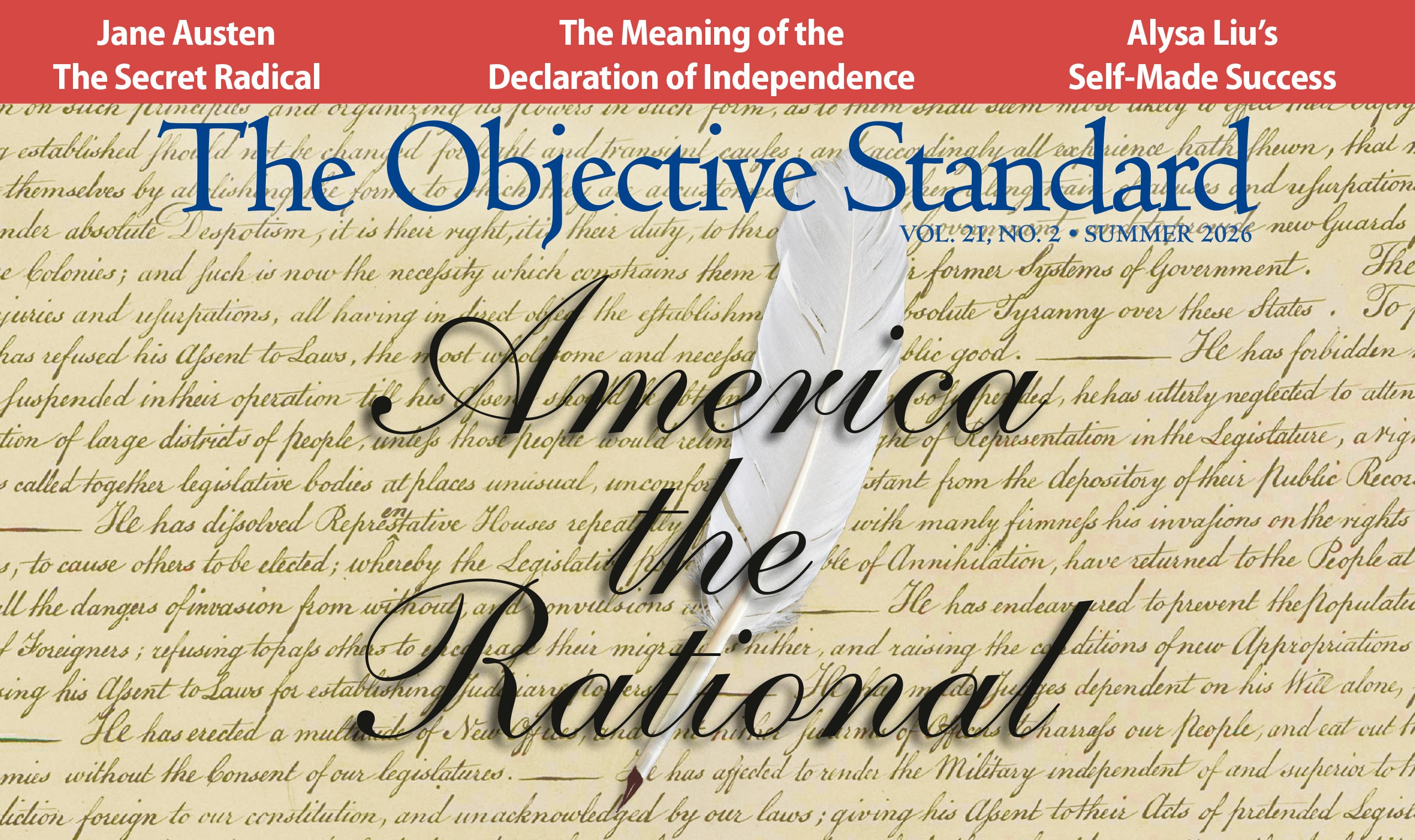
Welcome to the Summer 2026 issue of The Objective Standard, the rational alternative to conservatism and regressivism.
July 4, 2026 will mark 250 years since the signing of the Declaration of Independence. In that quarter millennium, America has—to the extent that it has upheld its founding principles—become a country that enables people to use their minds, to invent technologies, and to create everything from airplanes and skyscrapers to satellites and smartphones to Disney Land and Hollywood.
In “America the Rational,” Craig Biddle zeroes in on the fundamental value that enabled all these wonders, namely, political freedom—and, more fundamentally, on the value that makes freedom defensible and sustainable: reason. If we are to preserve, defend, and improve America, Biddle argues, we must enlist reason as our basic tool for the job.
America would have been possible if not for the founders who enshrined the values of freedom, self-determination, and limited government in the Declaration of Independence. In his review of Timothy Sandefur’s Proclaiming Liberty: John Adams, Thomas Jefferson, and the Declaration of Independence, Tom Malone shows how Sandefur sets the record straight about what the Declaration truly means and why it is as invaluable today as it was in 1776.
This is followed by an excerpt from Sandefur’s chapter “Understanding the Declaration of Independence.” (Sandefur will speak on this topic at LevelUp 2026, taking place among the gleaming skyscrapers of Chicago, July 8–11.)
America’s productive output goes beyond technology—the Land of the Free is also a powerhouse of artistic creativity. So, what better way to celebrate Freedom 250 than with “Ten Poems on America the Beautiful”?
This year, an American spacecraft carried four astronauts around the Moon for the first time since 1972. Although this is a feat that only American space programs have achieved, many others are well on their way to replicating it. In “Artemis II Takes the Small Step, But Who Will Make the Giant Leap?,” I show that for America to retain its lead in the space industry, those in charge must learn the lessons of the Space Shuttle program’s failure and recognize that private industry, not NASA, should design and build the spacecraft that will take America back to the Moon and beyond.
Missions to the Moon still impress us, but we take for granted many aspects of modern life at which people of a couple centuries ago would have marveled. One of these is the virtually instantaneous global communication we now enjoy. This is thanks in part to a nineteenth-century American hero, Samuel Morse. In his profile of Morse’s life and achievements, Aditya Patil gives the inventor, best known for the code that bears his name, due recognition for his perseverance and genius in pioneering long-distance electronic communication.
Ronald Reagan once called freedom “a fragile thing . . . never more than one generation from extinction,” and recent American (and global) history has demonstrated how right he was. Many writers and filmmakers have told valuable stories about the importance of defending and preserving freedom, but such stories can also be told through music. One example is The Protomen’s musically and narratively impressive three-part story of resistance, which I highlight in “‘Hold Back the Night’: The Protomen’s Musical Warning to Stand Up for Freedom.”
Arguably one of the richest periods of American musical output was the 1960s and 1970s, when innovative artists combined influences from the blues to country to classical to create a plethora of new musical styles. One leading innovator in that period was Lowell George, whose sadly short life and prolific musical catalog Rebecca Day explores in “No ‘Little Feat’—Lowell George’s Musical Innovation.”
Another American musician who made his start in this period was Michael Jackson—the “King of Pop.” Jackson has been the subject of a hail of accusations that Tim White robustly refuted in his 2020 TOS article “Justice for Michael Jackson.” Now, White reviews the new biopic Michael, commending its portrayal of Jackson’s life and defending it from another barrage of criticism pertaining to the allegations that, White argues, have no basis in reality.
Revolutionary ideas influenced writers across the pond as well, including Jane Austen, who was born in December 1775. Diving into this influence, Angelica Werth reviews Jane Austen, the Secret Radical by Helena Kelly, noting how Kelly recognizes many of the valuable themes expressed in Austen’s novels but often overlooked by many of her fans and biographers.
Next up, in “Mother Courage: “Epic Theater” vs the Human Soul,” Anna Shnaidman challenges the praise heaped on Bertolt Brecht’s unconventional play. She describes how it presents a character essentially lacking moral agency, thereby depriving it of a key ingredient of any good story: moral choice.
Then, in “Dracula: A Love Tale: A Sincere but Fatally Flawed Love Story,” Tim White reviews the latest film adaptation of Bram Stoker’s classic tale, commending many of its artistic elements while critically examining its portrayal of love.
From a flawed portrayal of romantic love to a well-executed portrayal of the love of friends, I look back on a classic of 1970s spy fiction in “Purpose and Friendship in The Persuaders!”
Next, Daria Topchii celebrates a recent exemplar of joyful independence and achievement in “A Self-Authored Victory: How Stepping Away Made Alysa Liu an Olympic Champion.”
Lastly, Margherita Bovo reviews “I Am Dynamite! A Life of Friedrich Nietzsche by Sue Prideaux,” showing how Prideaux corrects many common misunderstandings about Nietzsche’s life and ideas, enabling readers to navigate the philosopher’s work without falling prey to those who miscommunicated his philosophy during and after his lifetime.
That’s it for this issue—I hope you enjoy the articles and reviews. If so, be sure to recommend and share them with friends on social media, in conversation, and especially on Substack. If you have a Substack publication of your own, please recommend The Objective Standard on your home page (see “recommendations” on your dashboard). And if you’ve not yet subscribed to the journal for people of reason, head over to TheObjectiveStandard.com and become a subscriber or upgrade your subscription today.
Thank you for your business and support,
Thomas F. Walker
Managing Editor
The Objective Standard